All topicsSTATE OF AI REPORT.

Robots begin to plan before they act

Robotics borrowed an important idea from reasoning models: make an intermediate plan before acting. In the 2025 report, this helped explain progress in manipulation systems while keeping impressive demonstrations separate from dependable commercial deployment.

Questions in this section

What is Chain-of-Action planning?Had humanoids reached widespread deployment?Why use video to train robots?How mature was driverless transport?

An inspectable step between the command and the motors

Molmo-Act translated a high-level command into intermediate visual or geometric representations, such as a trajectory sketch, before producing motor commands. Gemini Robotics 1.5 paired a high-level planner with a system that executed its plan. These intermediate steps gave researchers something to inspect when a robot failed and a way to organize longer tasks.
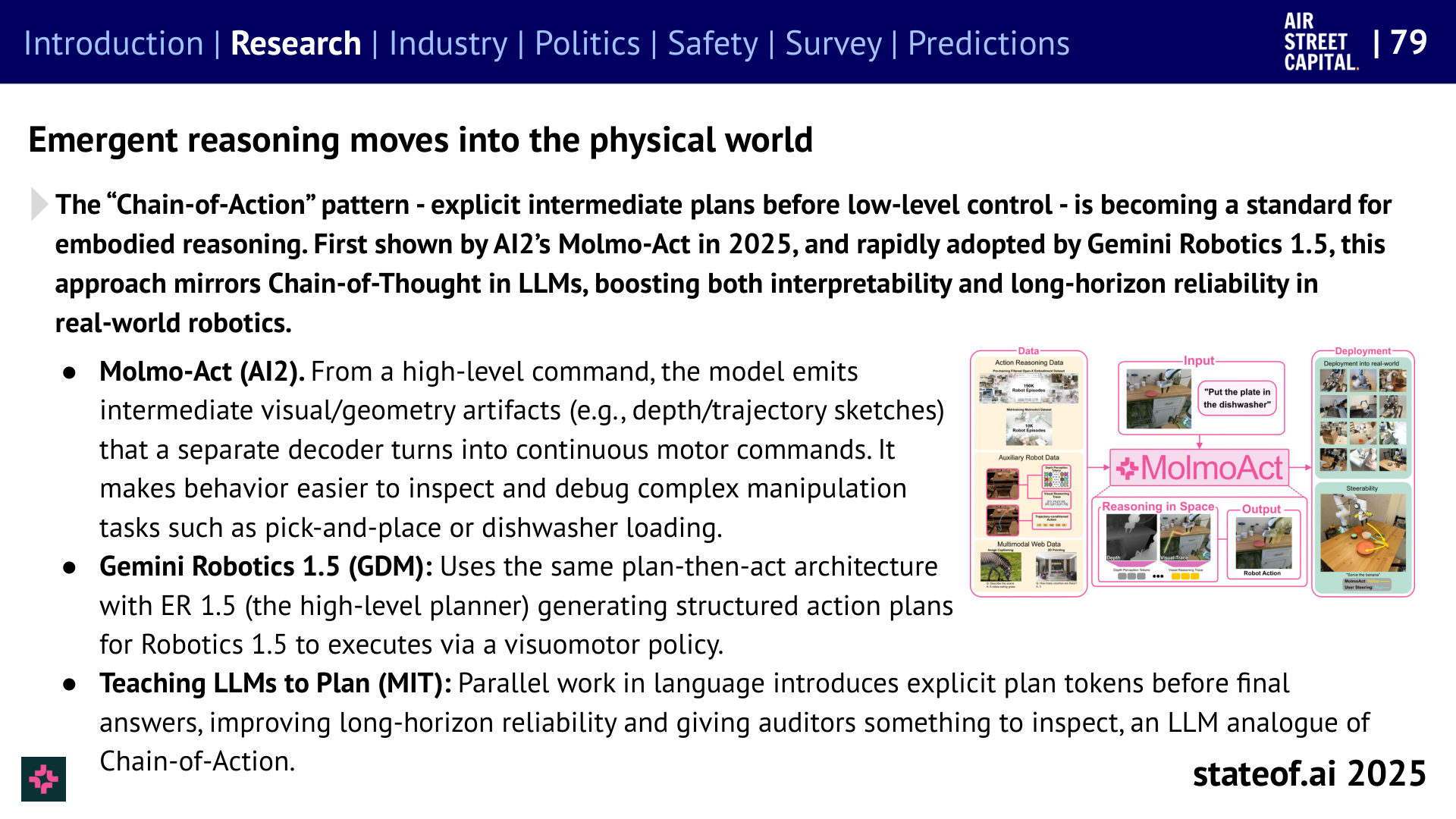
An inspectable step between the command and the motors - 2025 report, slide 79
An inspectable step between the command and the motors. 2025 report, slide 79 (PDF page 80)

More data, with a difficult adaptation tradeoff

Researchers increasingly learned from unstructured video and combined vision, language, and action. But adapting a large pretrained model to much smaller robot datasets risked losing general knowledge. The report contrasted approaches that preserved the base model with approaches that trained the system end to end. Data scale and task requirements influenced which approach made sense.
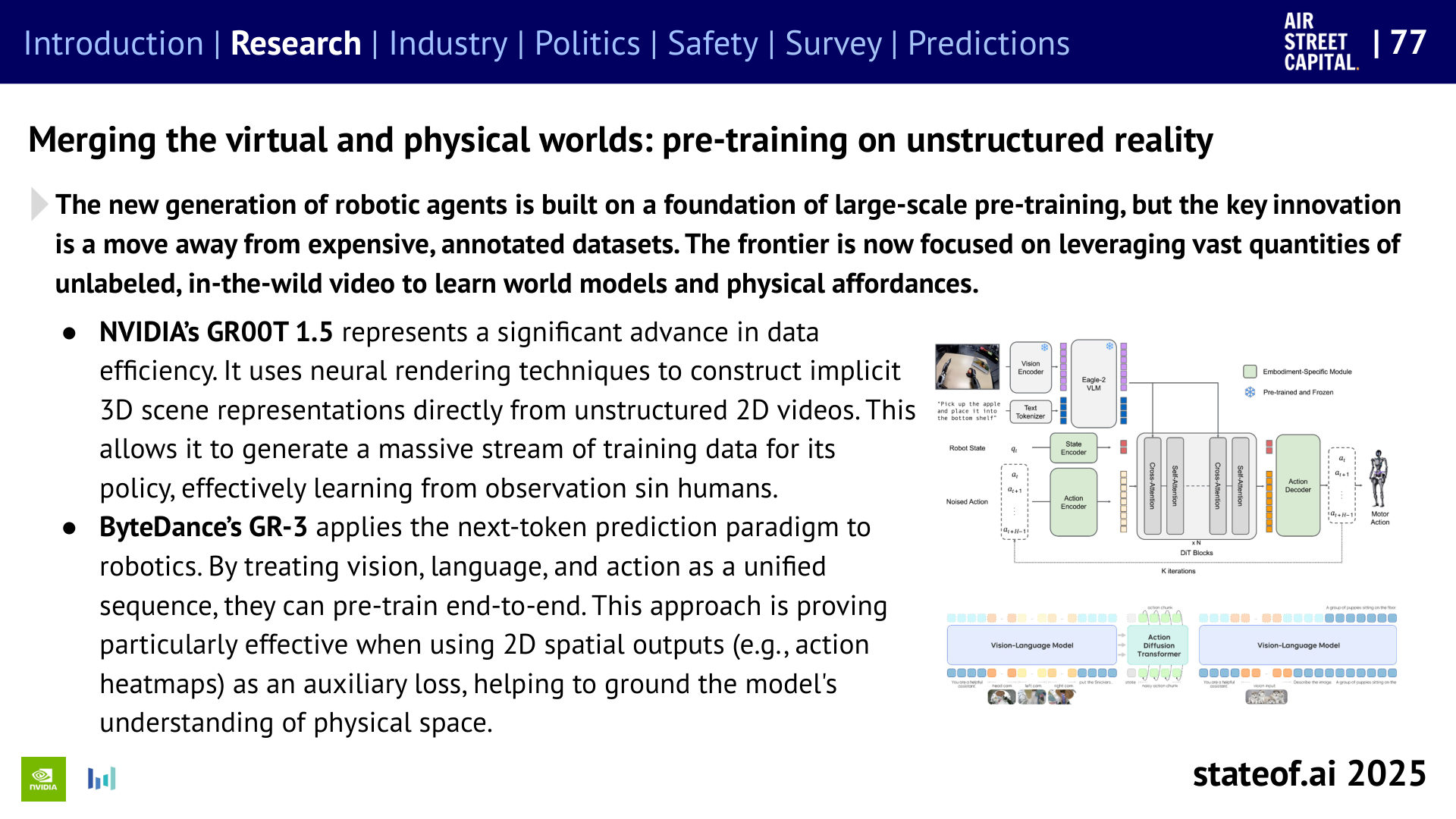
More data, with a difficult adaptation tradeoff - 2025 report, slide 77
More data, with a difficult adaptation tradeoff. 2025 report, slide 77 (PDF page 78)

Deployment evidence varies by market

Driverless transport had accumulated meaningful operating mileage: the report recorded 71 million Waymo rider-only miles through March 2025. Humanoids were at a different stage. The report described a landscape dominated by research purchases, pilot programs, and demonstrations, alongside early paid deployments such as Agility’s work with GXO. Those markets should not be combined into one claim that general-purpose robotics was solved.
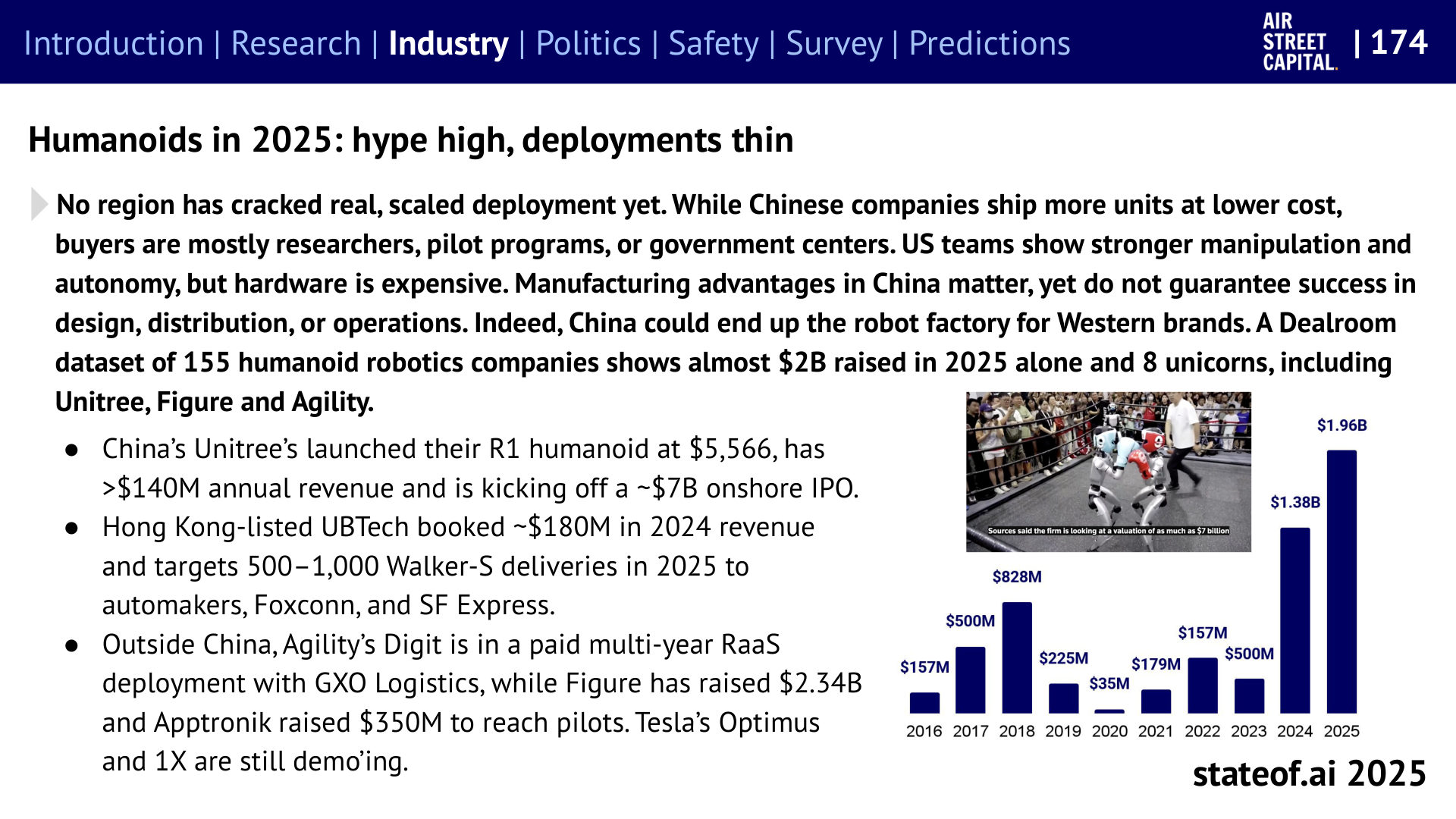
Deployment evidence varies by market - 2025 report, slide 174
Deployment evidence varies by market. 2025 report, slide 174 (PDF page 175)

Evidence you can use

Different kinds of robotics evidence

2025 report snapshot

Different kinds of robotics evidence
MeasureReported valueDefinition and source
Molmo-ActPlan before controlIntermediate visual and geometric artifacts2025 report, slide 79 (PDF page 80)
Waymo71 million rider-only milesCumulative through March 20252025 report, slide 173 (PDF page 174)
HumanoidsMostly pilots and research purchasesReport assessment of deployment maturity2025 report, slide 174 (PDF page 175)

This table compares types of evidence, not a common performance benchmark. Driverless mileage does not establish general manipulation ability, and an inspectable action plan does not establish reliable full-task completion.

Frequently asked questions

Sources and dates

Historical snapshot published October 9, 2025. This web edition was prepared on October 10, 2026 from the online deck and original launch posts. Findings and forecasts retain their original time frame.

  1. 2025 report, slide 77 (PDF page 78)Original 2025 report. Slide numbers printed in the deck are one lower than PDF page numbers because the cover is unnumbered.
  2. 2025 report, slide 78 (PDF page 79)Original 2025 report. Slide numbers printed in the deck are one lower than PDF page numbers because the cover is unnumbered.
  3. 2025 report, slide 79 (PDF page 80)Original 2025 report. Slide numbers printed in the deck are one lower than PDF page numbers because the cover is unnumbered.
  4. 2025 report, slide 172 (PDF page 173)Original 2025 report. Slide numbers printed in the deck are one lower than PDF page numbers because the cover is unnumbered.
  5. 2025 report, slide 173 (PDF page 174)Original 2025 report. Slide numbers printed in the deck are one lower than PDF page numbers because the cover is unnumbered.
  6. 2025 report, slide 174 (PDF page 175)Original 2025 report. Slide numbers printed in the deck are one lower than PDF page numbers because the cover is unnumbered.
  7. State of AI Report 2025: online slides
  8. Nathan Benaich: The State of AI Report 2025Air Street Press, October 9, 2025.
  9. Welcome to State of AI Report 2025Original website launch post, October 9, 2025.

Cite this page

Benaich, Nathan. “Robots begin to plan before they act.” State of AI Report 2025. Historical report snapshot; web edition prepared 2026-10-10.