All topicsSTATE OF AI REPORT.

AI becomes a collaborator in scientific discovery

The most interesting scientific systems in the 2025 report did more than summarize papers. They proposed hypotheses, debated alternatives, designed candidates, and passed them to experiments. Their value depended on what survived independent checking and laboratory validation.

Questions in this section

Could AI generate useful scientific hypotheses in 2025?What did ProGen3 show?Did these systems replace scientists?Why is novel chemistry an important evaluation?

From a question to a testable hypothesis

DeepMind’s Co-Scientist organized agents around hypothesis generation and experimental planning. The report described drug candidates and biological targets tested in vitro, along with a blind test concerning bacteriophage transfer. Stanford’s Virtual Lab used a principal-investigator agent and specialists to design nanobodies, including experimentally confirmed binders. Human researchers and laboratories remained part of these workflows.
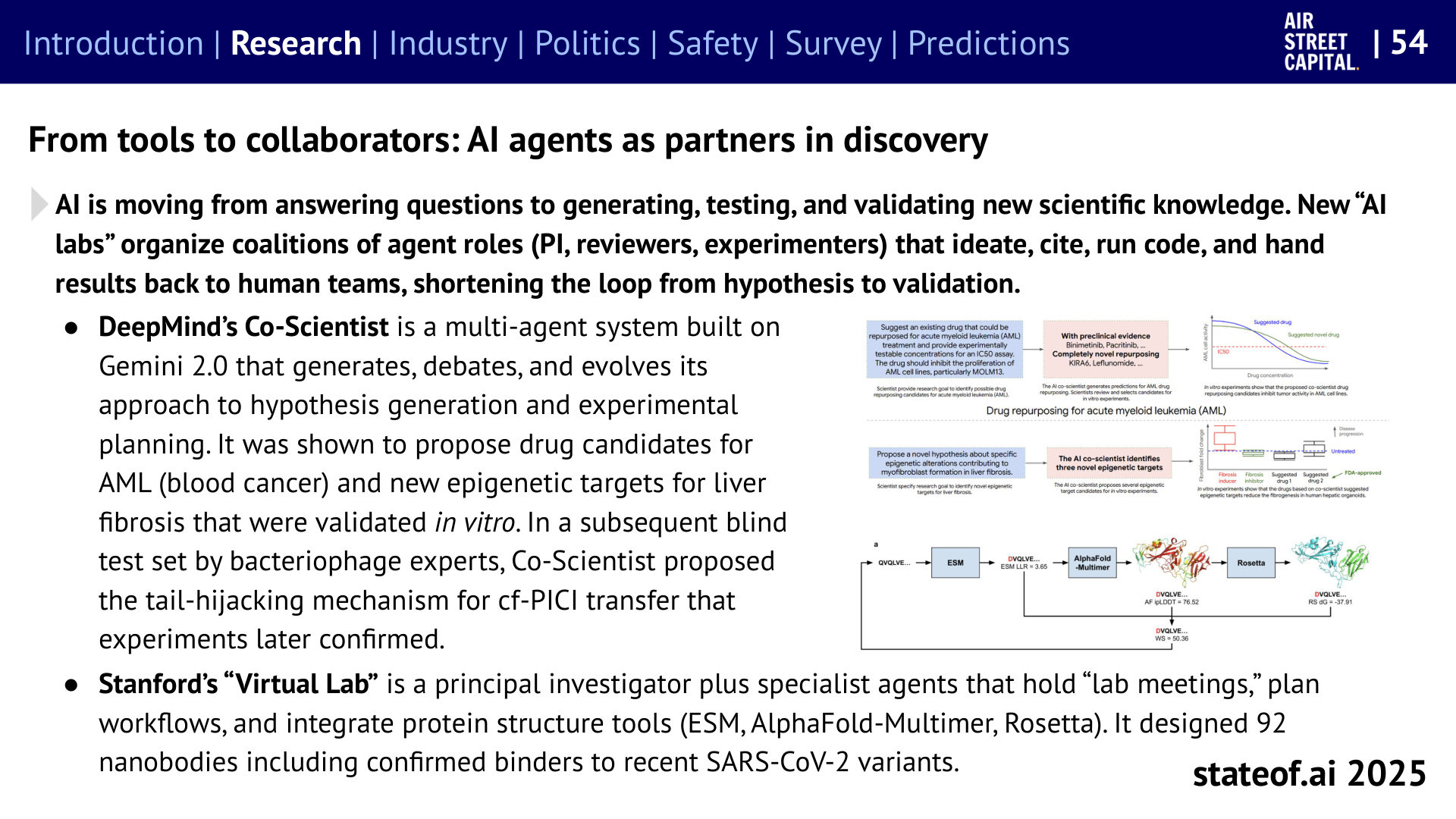
From a question to a testable hypothesis - 2025 report, slide 54
From a question to a testable hypothesis. 2025 report, slide 54 (PDF page 55)

Protein models gain a scaling framework

Profluent’s ProGen3 studied how protein language-model performance changed with compute and scale. Its largest model was a 46B-parameter mixture of experts trained on 1.5 trillion tokens. Larger models generated viable proteins across a broader sequence space, and alignment helped more at larger scale. That supplied a framework for choosing training investments in biological design.
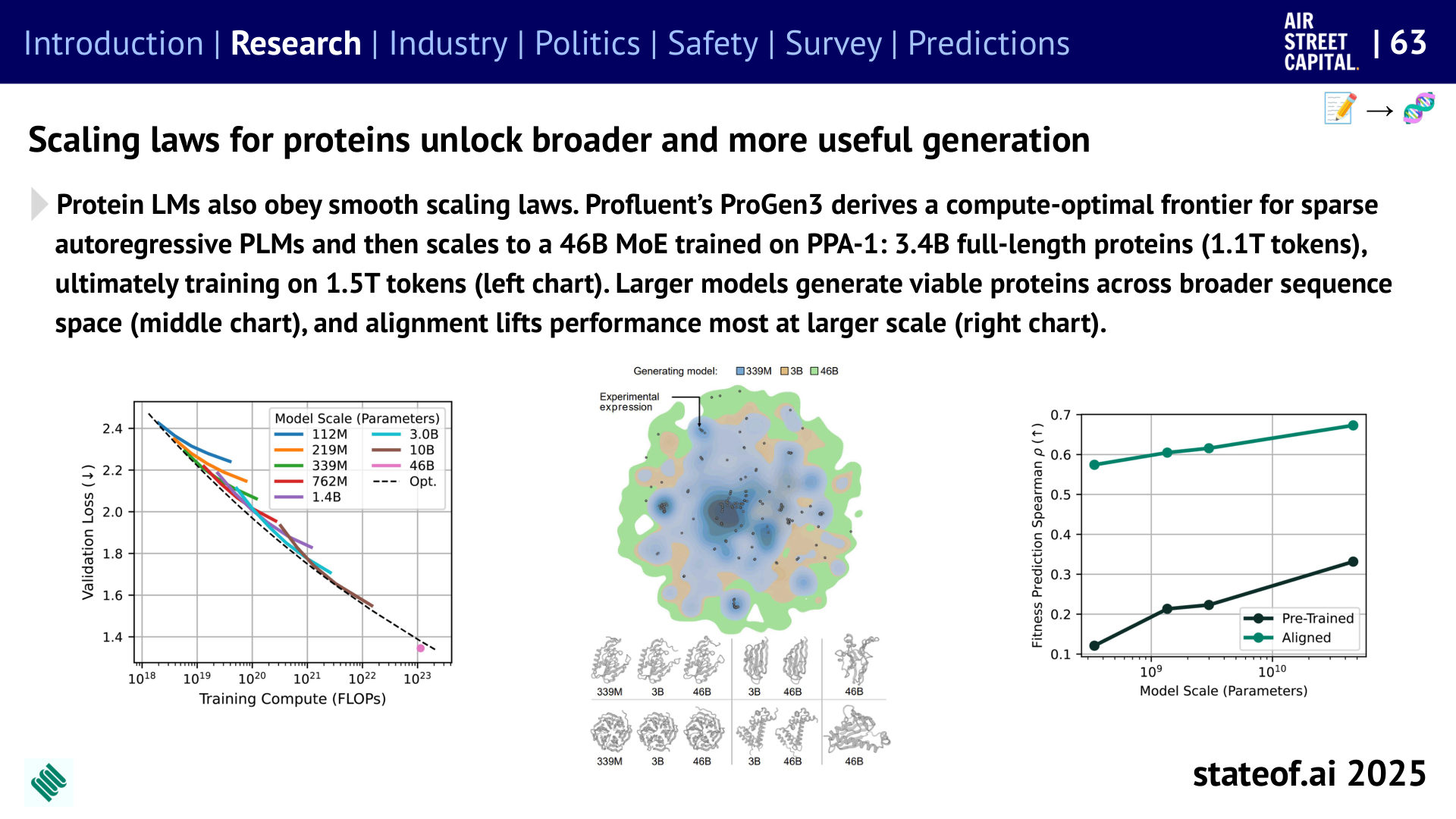
Protein models gain a scaling framework - 2025 report, slide 63
Protein models gain a scaling framework. 2025 report, slide 63 (PDF page 64)

Novelty is the difficult test

The report also examined where molecular predictions failed. On a benchmark of 2,600 protein-ligand pairs, AlphaFold 3 and reproductions performed better when pockets and poses resembled familiar cases. Novel chemistry remained harder. A plausible-looking structure or a good average score was not enough: useful discovery required tests of unfamiliar cases and physical validity.
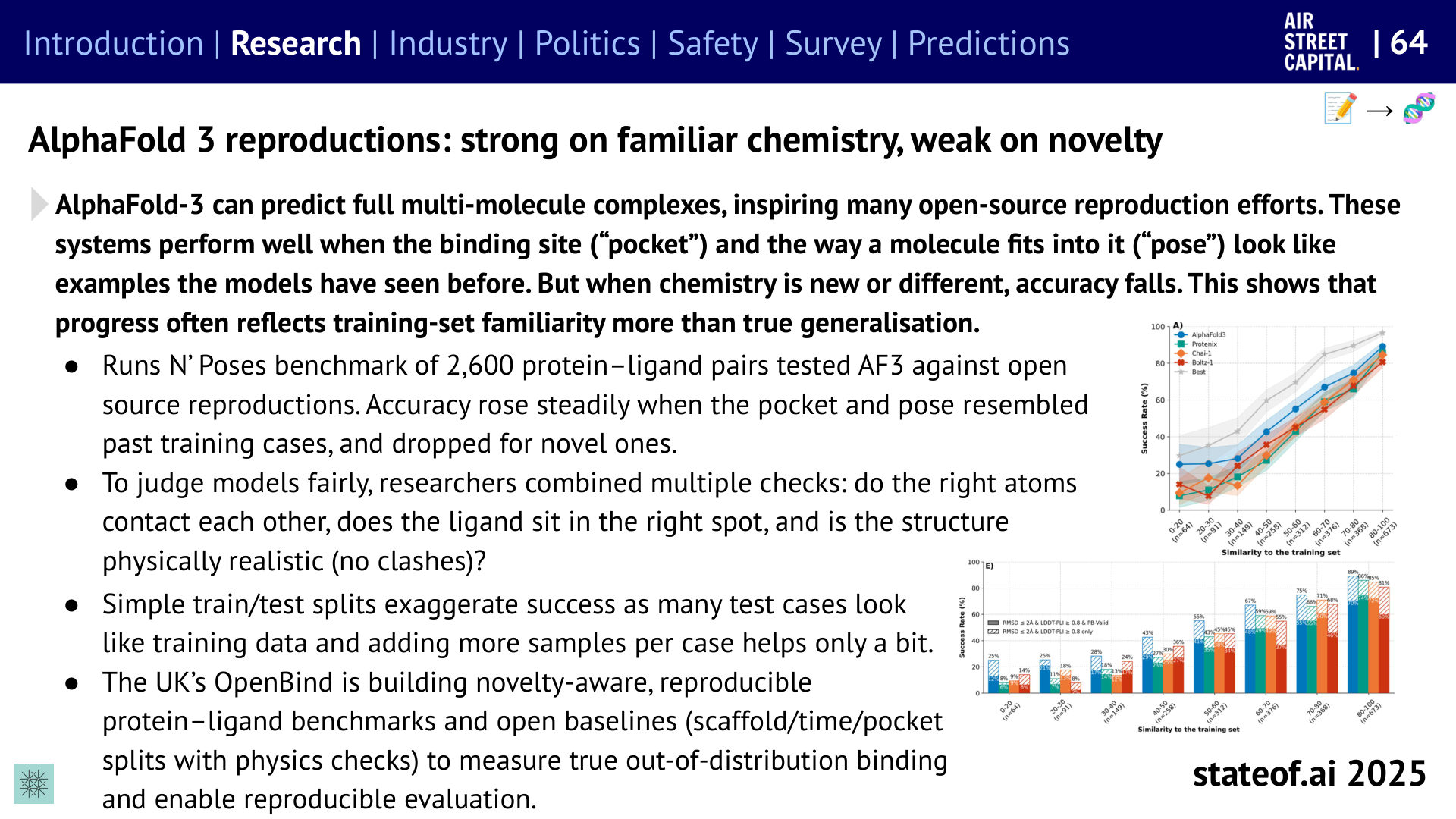
Novelty is the difficult test - 2025 report, slide 64
Novelty is the difficult test. 2025 report, slide 64 (PDF page 65)

Evidence you can use

ProGen3 model and training scale

2025 report snapshot

ProGen3 model and training scale
MeasureReported valueDefinition and source
Largest model46B parametersMixture-of-experts protein language model2025 report, slide 63 (PDF page 64)
Training tokens1.5 trillionTotal tokens used in training2025 report, slide 63 (PDF page 64)
PPA-1 dataset3.4 billion full-length proteinsReported dataset composition2025 report, slide 63 (PDF page 64)

Model size, training tokens, and dataset size are distinct quantities. These values describe the reported research system; they do not establish clinical efficacy or imply that every generated protein works in an experiment.

Frequently asked questions

What did ProGen3 show?

Protein language models exhibited predictable scaling behavior, with larger models generating viable proteins across broader sequence space. The report describes a 46B-parameter mixture-of-experts model trained on 1.5 trillion tokens.

Source: 2025 report, slide 63 (PDF page 64).

Sources and dates

Historical snapshot published October 9, 2025. This web edition was prepared on October 10, 2026 from the online deck and original launch posts. Findings and forecasts retain their original time frame.

  1. 2025 report, slide 33 (PDF page 34)Original 2025 report. Slide numbers printed in the deck are one lower than PDF page numbers because the cover is unnumbered.
  2. 2025 report, slide 54 (PDF page 55)Original 2025 report. Slide numbers printed in the deck are one lower than PDF page numbers because the cover is unnumbered.
  3. 2025 report, slide 55 (PDF page 56)Original 2025 report. Slide numbers printed in the deck are one lower than PDF page numbers because the cover is unnumbered.
  4. 2025 report, slide 63 (PDF page 64)Original 2025 report. Slide numbers printed in the deck are one lower than PDF page numbers because the cover is unnumbered.
  5. 2025 report, slide 64 (PDF page 65)Original 2025 report. Slide numbers printed in the deck are one lower than PDF page numbers because the cover is unnumbered.
  6. State of AI Report 2025: online slides
  7. Nathan Benaich: The State of AI Report 2025Air Street Press, October 9, 2025.
  8. Welcome to State of AI Report 2025Original website launch post, October 9, 2025.

Cite this page

Benaich, Nathan. “AI becomes a collaborator in scientific discovery.” State of AI Report 2025. Historical report snapshot; web edition prepared 2026-10-10.