All topicsSTATE OF AI REPORT. 2019

The 2019 forecasts, in their original form

The second edition looked ahead to language-model startups, privacy-preserving methods, education, and governance. These are historical forecasts made at publication, not new predictions or retrospective claims of success.

Questions in this section

What did the 2019 report predict?Are these predictions graded on this page?What funding threshold did the NLP startup forecast set?How did the report make its self-driving forecast measurable?Which organizations were targeted by the privacy-preserving ML forecast?What did the education forecast anticipate?What two events were linked in the quantum-computing forecast?What change did the governance forecast require?

The original conditions define the call

The report published 6 predictions for the next twelve months. Several combined a technical or commercial development with a threshold, deadline, or named group of organizations. Those details matter: an event that meets only part of a prediction should not silently count as the whole outcome.
The original conditions define the call - 2019 report, PDF page 131
The original conditions define the call. 2019 report, PDF page 131

Keep forecasts separate from later grading

The complete list below preserves the wording of the original report, with PDF line breaks removed. The predictions scorecard provides subsequent assessment separately. This archive keeps the original publication-time claim visible so readers can compare it with later evidence.

Some forecasts specified an outcome; others specified a response

The six predictions mixed measurable thresholds, such as capital raised and driving miles, with institutional changes in education and governance. Those are different kinds of claims. Reviewing them fairly requires preserving both the numbers and the organizations or behaviors the original wording identified.

The six forecasts, as published

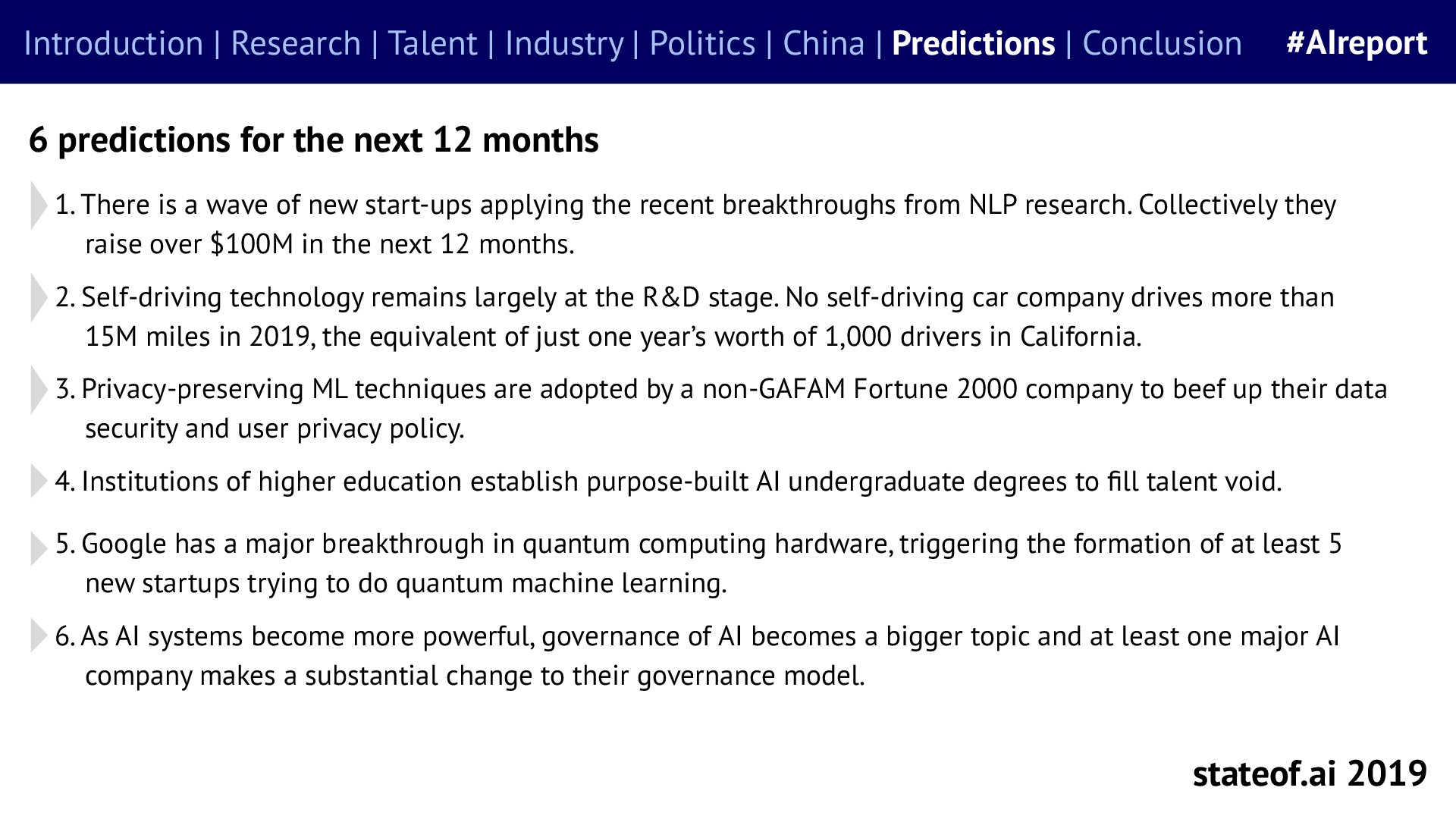
  1. There is a wave of new start-ups applying the recent breakthroughs from NLP research. Collectively they raise over $100M in the next 12 months.
  2. Self-driving technology remains largely at the R&D stage. No self-driving car company drives more than 15M miles in 2019, the equivalent of just one year’s worth of 1,000 drivers in California.
  3. Privacy-preserving ML techniques are adopted by a non-GAFAM Fortune 2000 company to beef up their data security and user privacy policy.
  4. Institutions of higher education establish purpose-built AI undergraduate degrees to fill talent void.
  5. Google has a major breakthrough in quantum computing hardware, triggering the formation of at least 5 new startups trying to do quantum machine learning.
  6. As AI systems become more powerful, governance of AI becomes a bigger topic and at least one major AI company makes a substantial change to their governance model.

2019 report, PDF page 131. See the predictions scorecard for subsequent grading.

Evidence you can use

Predictions in the 2019 report

Historical snapshot: June 2019. Dates and populations are specified per row.

Predictions in the 2019 report
MeasureReported valueDefinition and source
Number of original forecasts6Count of the numbered predictions on the source slide.2019 report, PDF page 131
Forecast horizonNext 12 monthsHorizon stated on the original prediction slide.2019 report, PDF page 131

Forecasts are prospective statements, not observed results. Preserve every threshold, named condition, and time window when grading. Original spelling is retained; PDF line wrapping and typographic ligatures are normalized.

Frequently asked questions

What did the 2019 report predict?

The second edition looked ahead to language-model startups, privacy-preserving methods, education, and governance. It published 6 forecasts for the next twelve months; the complete original list appears on the predictions topic page.

Source: 2019 report, PDF page 131.

Sources and dates

Historical snapshot published June 28, 2019. This web edition was prepared on 2026-10-11 from the online deck and original launch posts. Findings and forecasts retain their original time frame.

  1. 2019 report, PDF page 131Original 2019 report. This edition has no printed slide numbers. References use one-based PDF pages.
  2. State of AI Report 2019: online slides
  3. Stories from Air Street launch essayJune 30, 2019.

Cite this page

Benaich, Nathan, and Ian Hogarth. “The 2019 forecasts, in their original form.” State of AI Report 2019. Historical report snapshot; web edition prepared 2026-10-11.