STATE OF AI REPORT 2019.
The most widely read and trusted analysis of key developments in AI.

Explore the full report
Language models meet a growing AI industry
The second report captured an important shift: language models pretrained on large text collections could be adapted to many tasks. Reinforcement learning advanced in games, AI investment grew, and governments confronted questions of oversight, surveillance, and strategic dependence. A dedicated China section examined research, hardware, and deployment.
Published on June 28, 2019, this edition captures what we knew then. The findings and predictions below retain that historical perspective.
Read the original Stories from Air Street launch essay, or explore the 2019 report by topic.
Let’s dive into the key stories.
Pretraining changes language AI
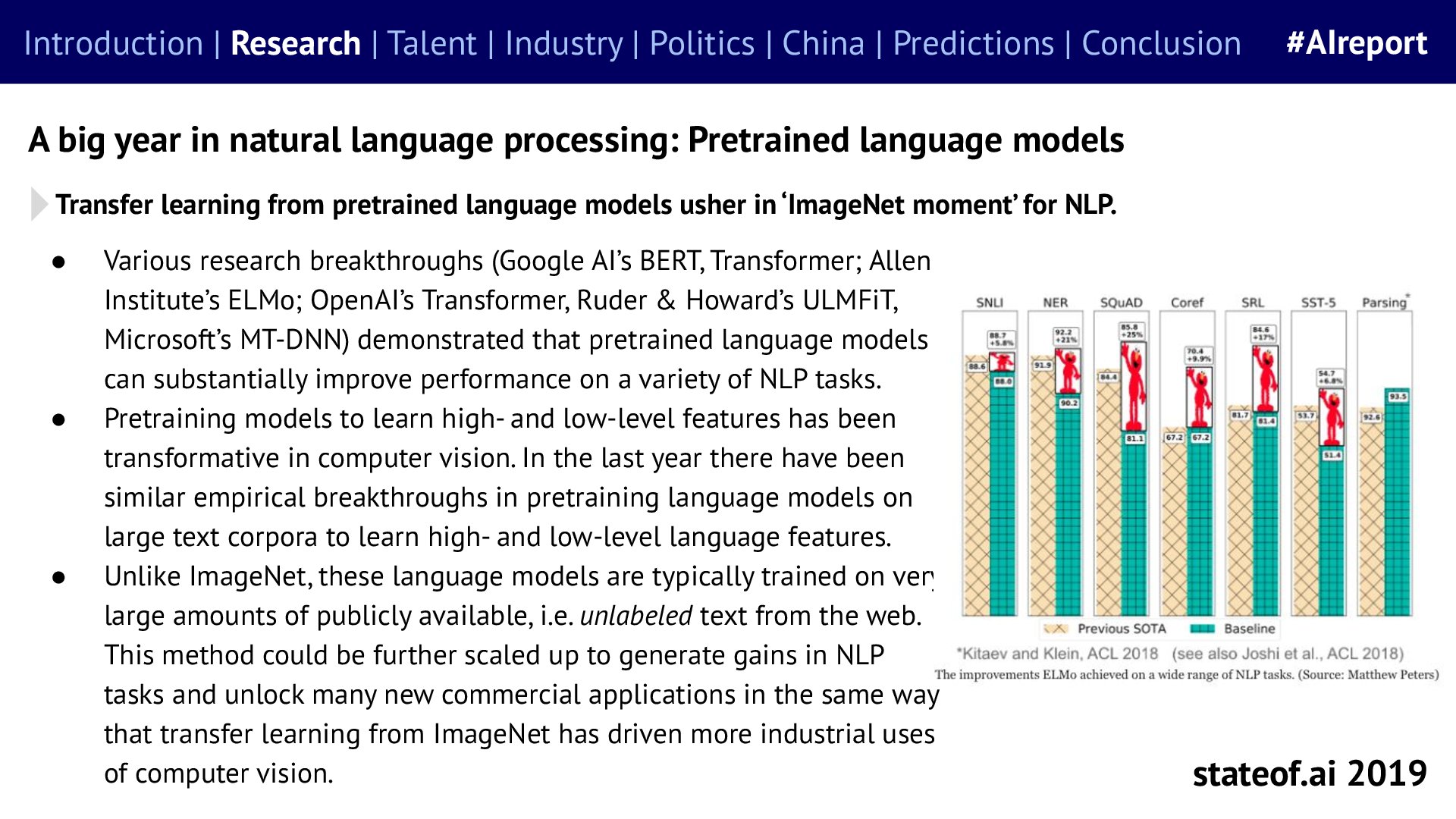
The 2019 report described an ImageNet-like moment for language: models learned from large collections of unlabeled text and transferred that knowledge to other tasks. Progress in games and biology showed the reach of learning systems, while the limits of each demonstration still mattered.
OpenAI Five won two games against the world champion Dota 2 team in April 2019. In the subsequent Arena event, the report recorded a 99.4% win rate across 7,257 competitive games involving 15,019 players. The system trained through self-play, combining games against its current policy with games against older versions. The result extended the evidence beyond a single exhibition match.
Training grows while representation remains uneven
AI education was expanding quickly, but the 2019 report showed that participation remained concentrated. Universities were investing in computing across disciplines, while studies of conference authorship exposed substantial gender imbalance.
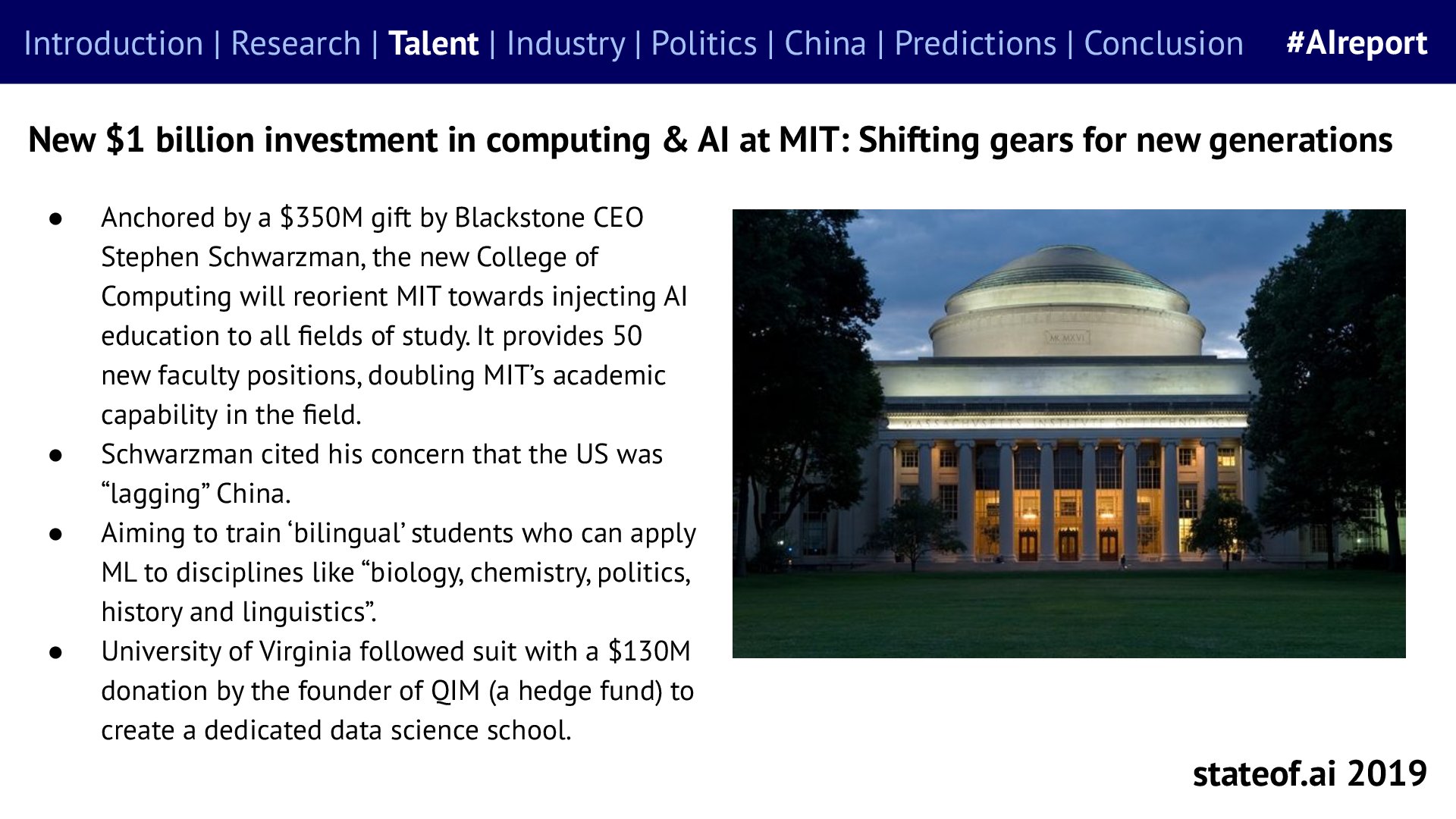
MIT’s initiative joined computing capacity with work across other disciplines and proposed 50 faculty positions. The report presented a response to demand for people who could combine computational methods with subject knowledge, rather than treating every future AI practitioner as a specialist in the same narrow field.
Capital and acquisitions follow technical progress
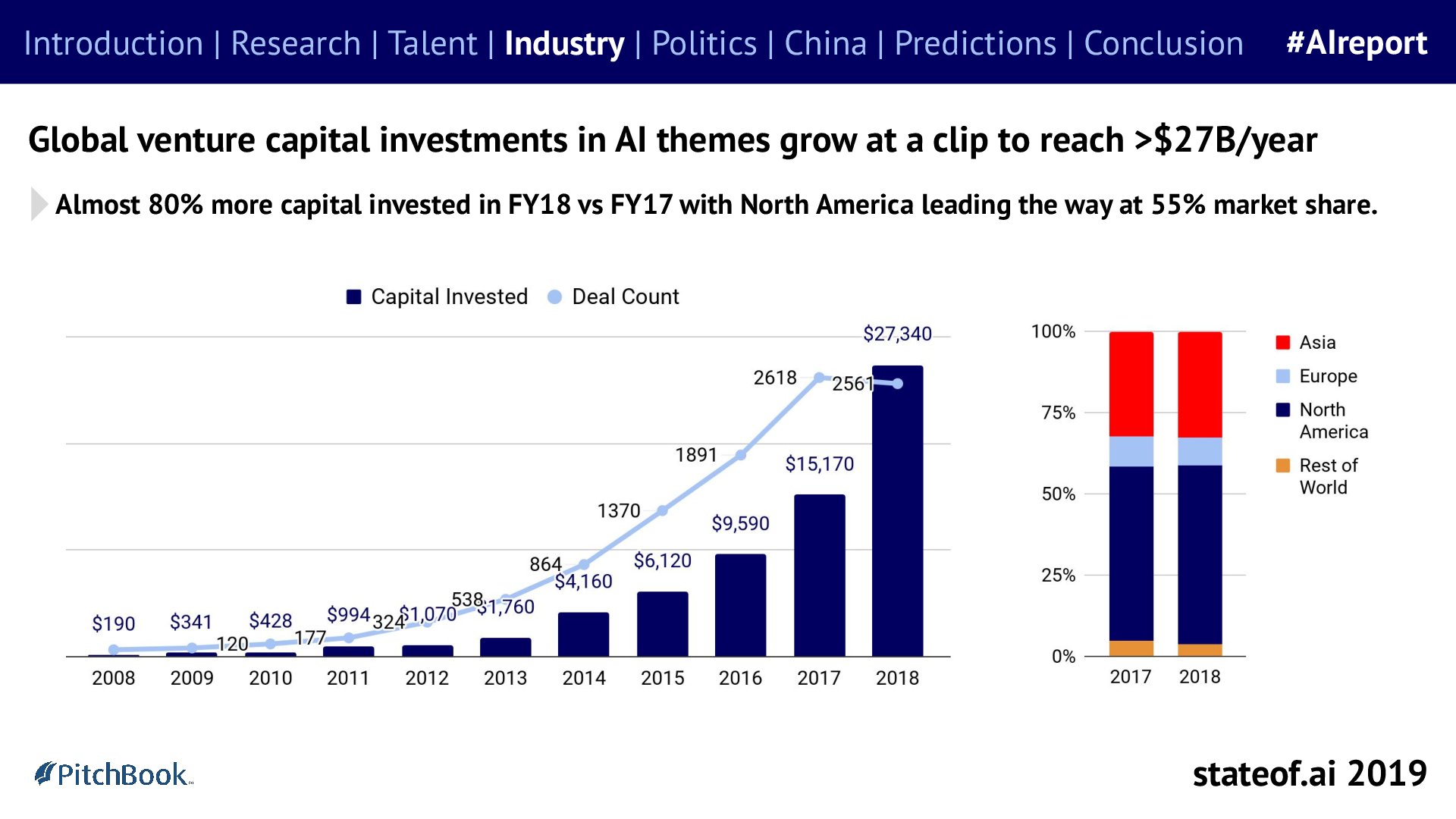
The 2019 report documented a growing market around AI research. Venture investment and acquisitions showed commercial interest, while new language capabilities were starting to enter products. Those financial measures described activity around AI, rather than proof that every application had found durable demand.
Berkshire Grey combined automated picking, mobile robots, packaging, and sorting for e-commerce fulfillment. The report presented this as an application of robotics across a supply-chain workflow. It helped make the industry story concrete: investment and acquisitions were accompanied by companies trying to increase throughput in physical operations.
AI oversight moves from principles to institutions
The 2019 report examined how governments could shape AI through education, investment, and oversight. At the same time, increasingly capable surveillance systems made the consequences of deployment more concrete. Technical progress was becoming a question of institutional responsibility.
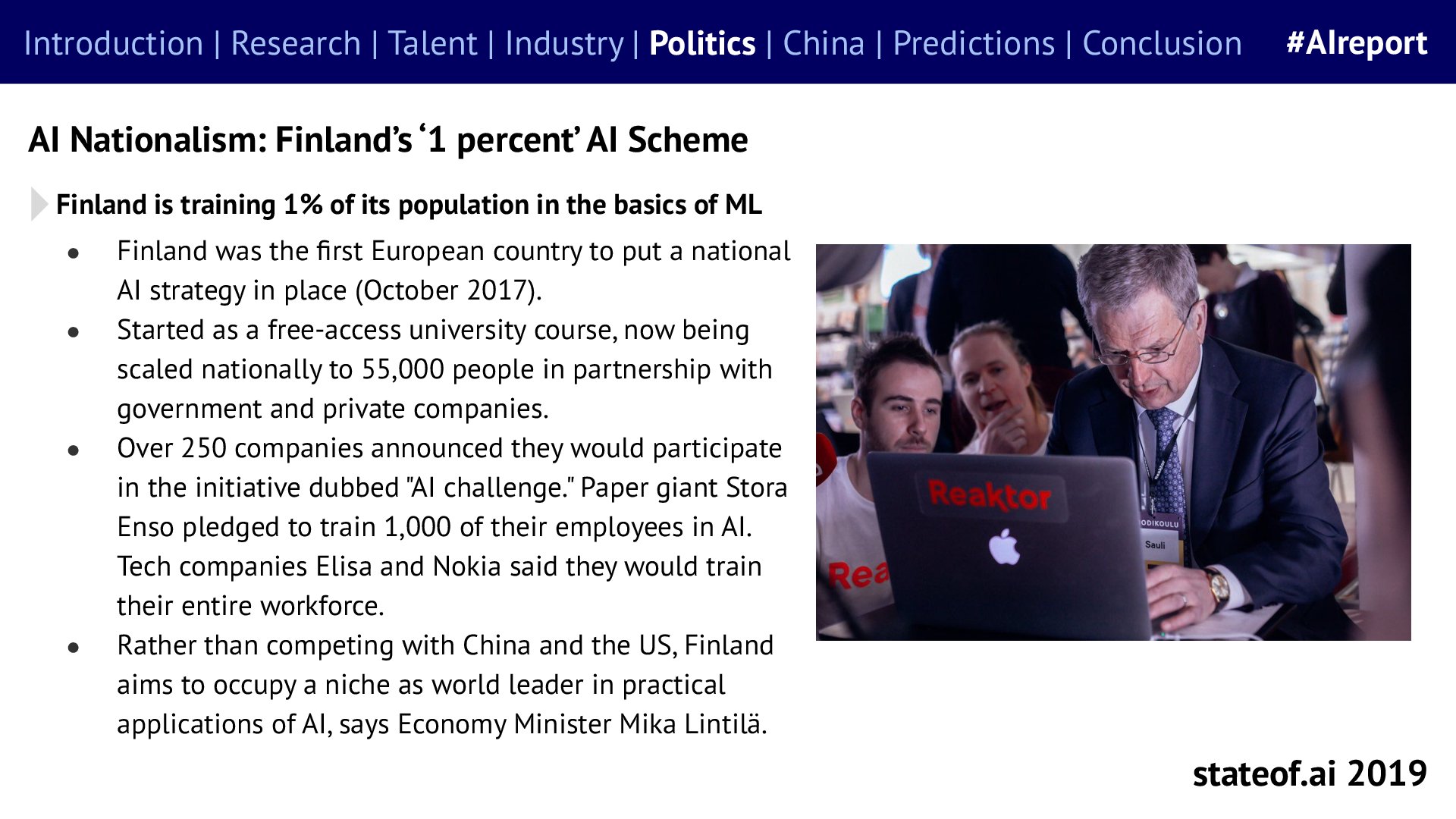
Finland’s initiative aimed to introduce basic AI concepts to 1% of the population and involved participating companies. That broadened the policy question beyond building elite research capacity: people also needed enough familiarity to recognize applications, limitations, and implications in their own work.
China expands research and industrial deployment
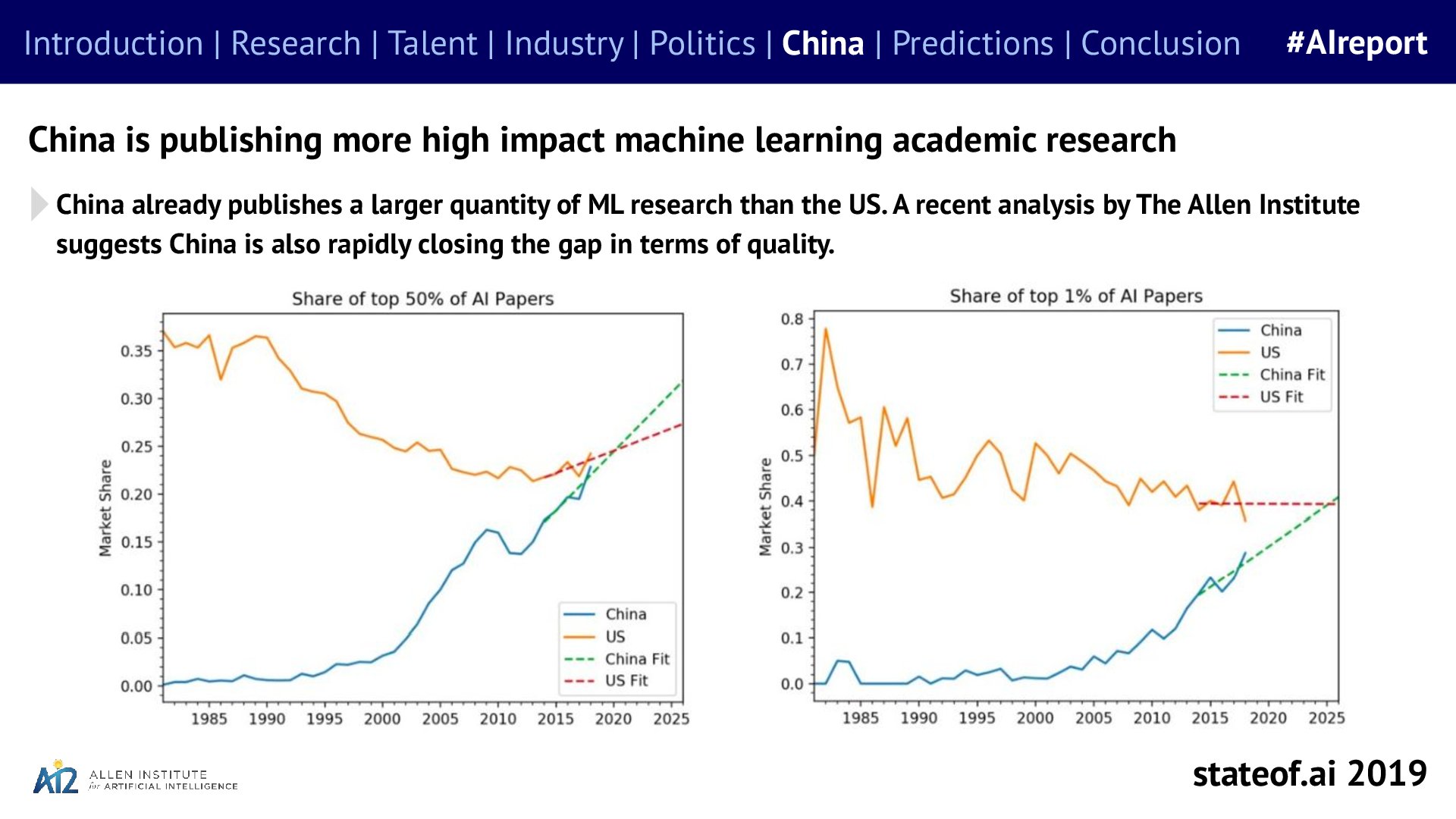
The 2019 report devoted a separate section to China. It examined both visible deployment and the harder question of strategic independence. Growth in research output and industrial automation coexisted with a continuing semiconductor trade deficit.
The report examined whether patent holders continued to pay to maintain their rights. It found that 91% of five-year-old Chinese design patents and 61% of five-year-old utility model patents had been abandoned. These were different patent categories, so their counts and renewal patterns needed to be read separately. High filing volume alone did not establish durable commercial value.
The 2019 forecasts, in their original form
The second edition looked ahead to language-model startups, privacy-preserving methods, education, and governance. These are historical forecasts made at publication, not new predictions or retrospective claims of success.
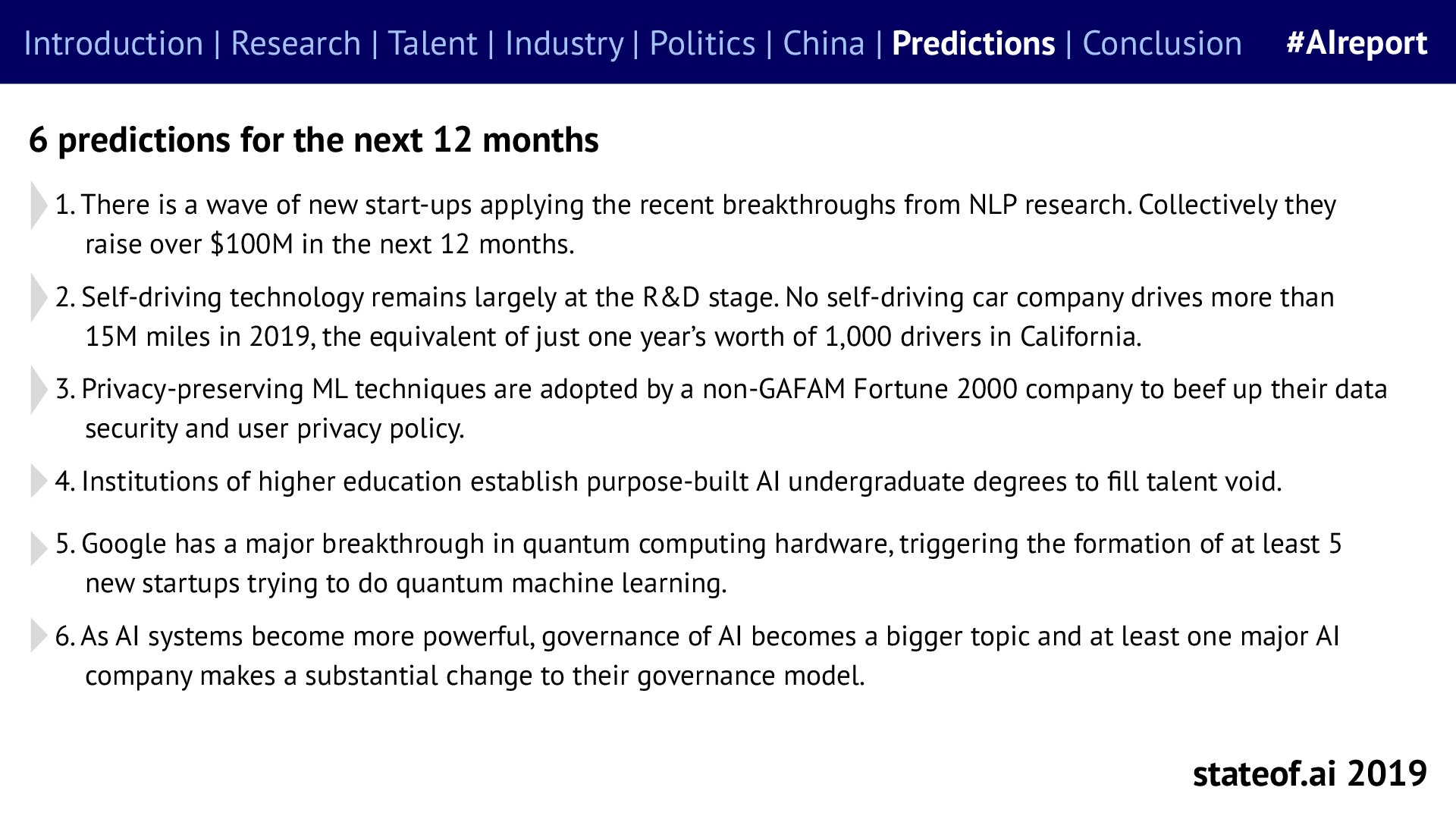
The six predictions mixed measurable thresholds, such as capital raised and driving miles, with institutional changes in education and governance. Those are different kinds of claims. Reviewing them fairly requires preserving both the numbers and the organizations or behaviors the original wording identified.
Three of the forecasts published in 2019:
- There is a wave of new start-ups applying the recent breakthroughs from NLP research. Collectively they raise over $100M in the next 12 months.
- Self-driving technology remains largely at the R&D stage. No self-driving car company drives more than 15M miles in 2019, the equivalent of just one year’s worth of 1,000 drivers in California.
- Privacy-preserving ML techniques are adopted by a non-GAFAM Fortune 2000 company to beef up their data security and user privacy policy.
The report is authored by Nathan Benaich and Ian Hogarth
For our writing throughout the year, subscribe to Air Street Press.
Cite the report
Benaich, N. and Hogarth, I. (2019). State of AI Report 2019. https://www.stateof.ai/2019