How to read this finding
Forecasts are prospective statements, not observed results. Preserve every threshold, named condition, and time window when grading. Original spelling is retained; PDF line wrapping and typographic ligatures are normalized.
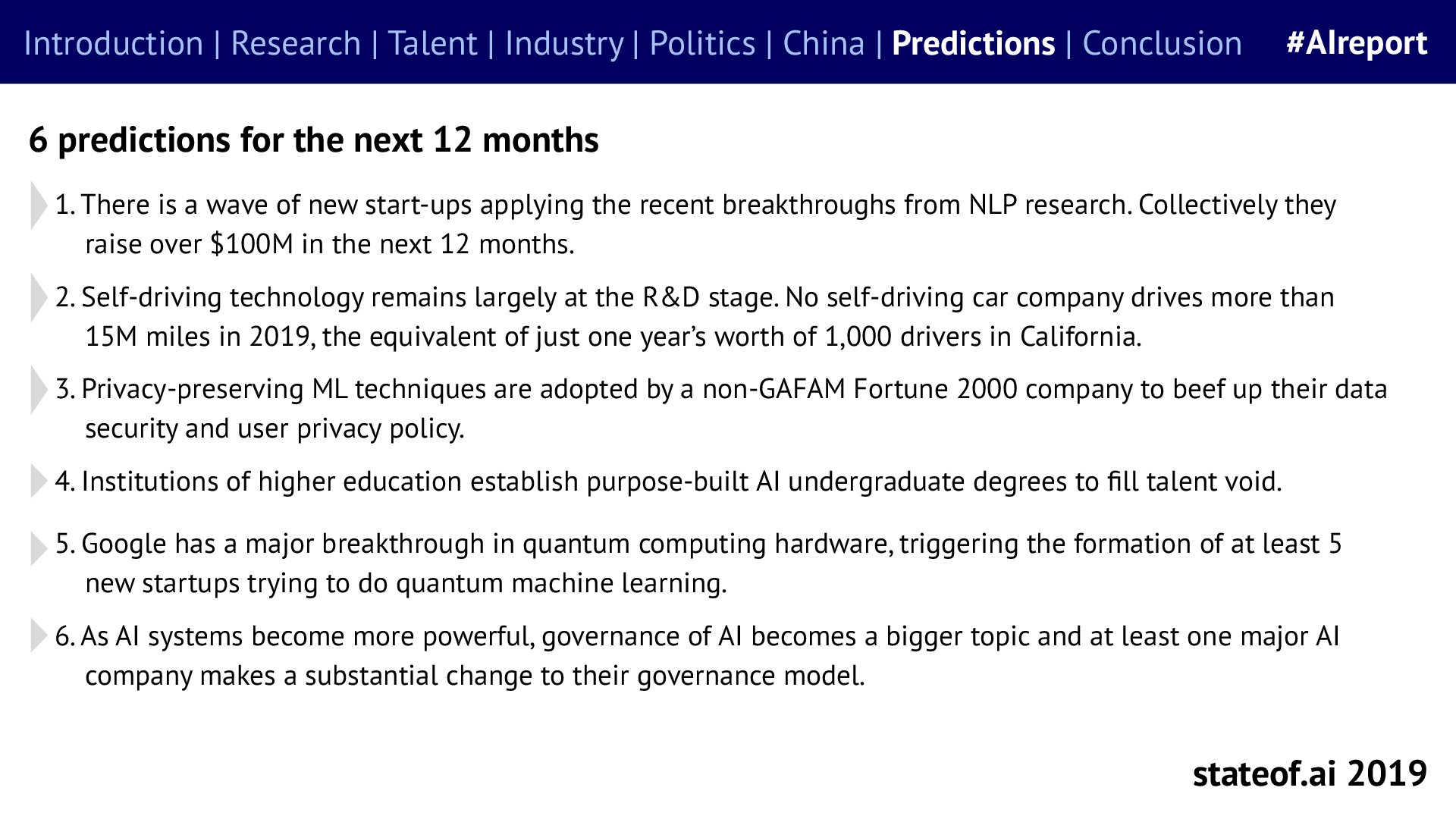
The second edition looked ahead to language-model startups, privacy-preserving methods, education, and governance. It published 6 forecasts for the next twelve months; the complete original list appears on the predictions topic page.
Forecasts are prospective statements, not observed results. Preserve every threshold, named condition, and time window when grading. Original spelling is retained; PDF line wrapping and typographic ligatures are normalized.
Evidence you can use
Historical snapshot: June 2019. Dates and populations are specified per row.
| Measure | Reported value | Definition and source |
|---|---|---|
| Number of original forecasts | 6 | Count of the numbered predictions on the source slide.2019 report, PDF page 131 |
| Forecast horizon | Next 12 months | Horizon stated on the original prediction slide.2019 report, PDF page 131 |
Forecasts are prospective statements, not observed results. Preserve every threshold, named condition, and time window when grading. Original spelling is retained; PDF line wrapping and typographic ligatures are normalized.
Historical snapshot published June 28, 2019. This web edition was prepared on 2026-10-11 from the online deck and original launch posts. Findings and forecasts retain their original time frame.
Benaich, Nathan, and Ian Hogarth. “What did the 2019 report predict?” State of AI Report 2019. Historical report snapshot; web edition prepared 2026-10-11.