By Nathan Benaich (Air Street Capital) · 2025 report
In the 2025 report, governments increasingly treated AI as industrial capacity and strategic influence. The US promoted exports of an integrated American AI stack, China pursued domestic capability, and Europe faced the practical demands of implementing its AI Act.
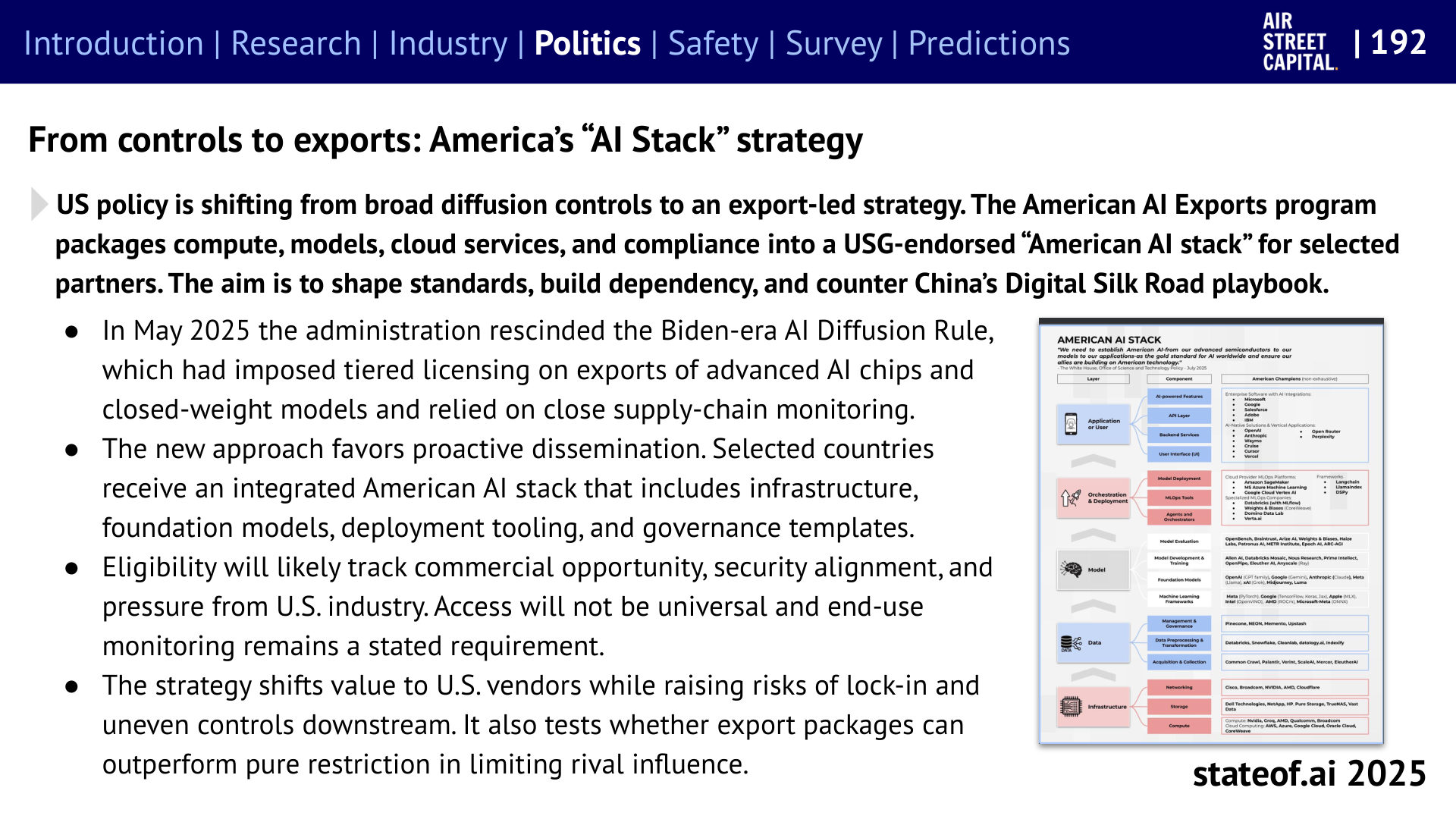
The US AI Action Plan tied model leadership to infrastructure, permitting, exports, and national security. The American AI Exports program packaged hardware, models, software, applications, and standards for selected partners. The strategic question was whether countries adopting that package would become dependent on American suppliers and rules, even as they acquired domestic data centers.
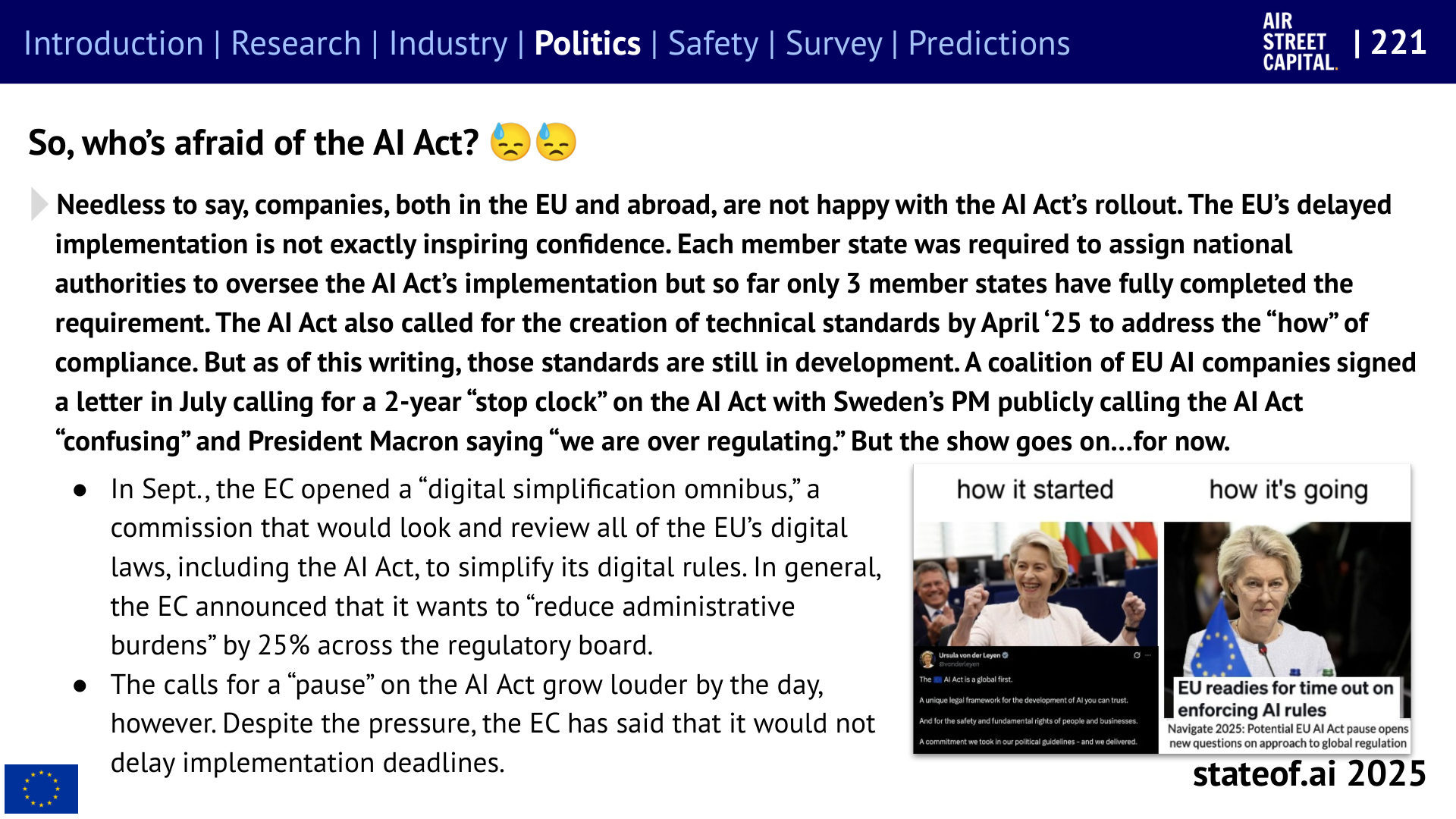
The report described pressure to pause or simplify the AI Act while the Commission continued its rollout. Only three member states had fully completed the requirement to designate national authorities at the report’s snapshot, and technical standards were still under development. That was an implementation finding from 2025, not a claim that the law had been abandoned or a statement of current obligations.
Self-reliance and international coordination diverge
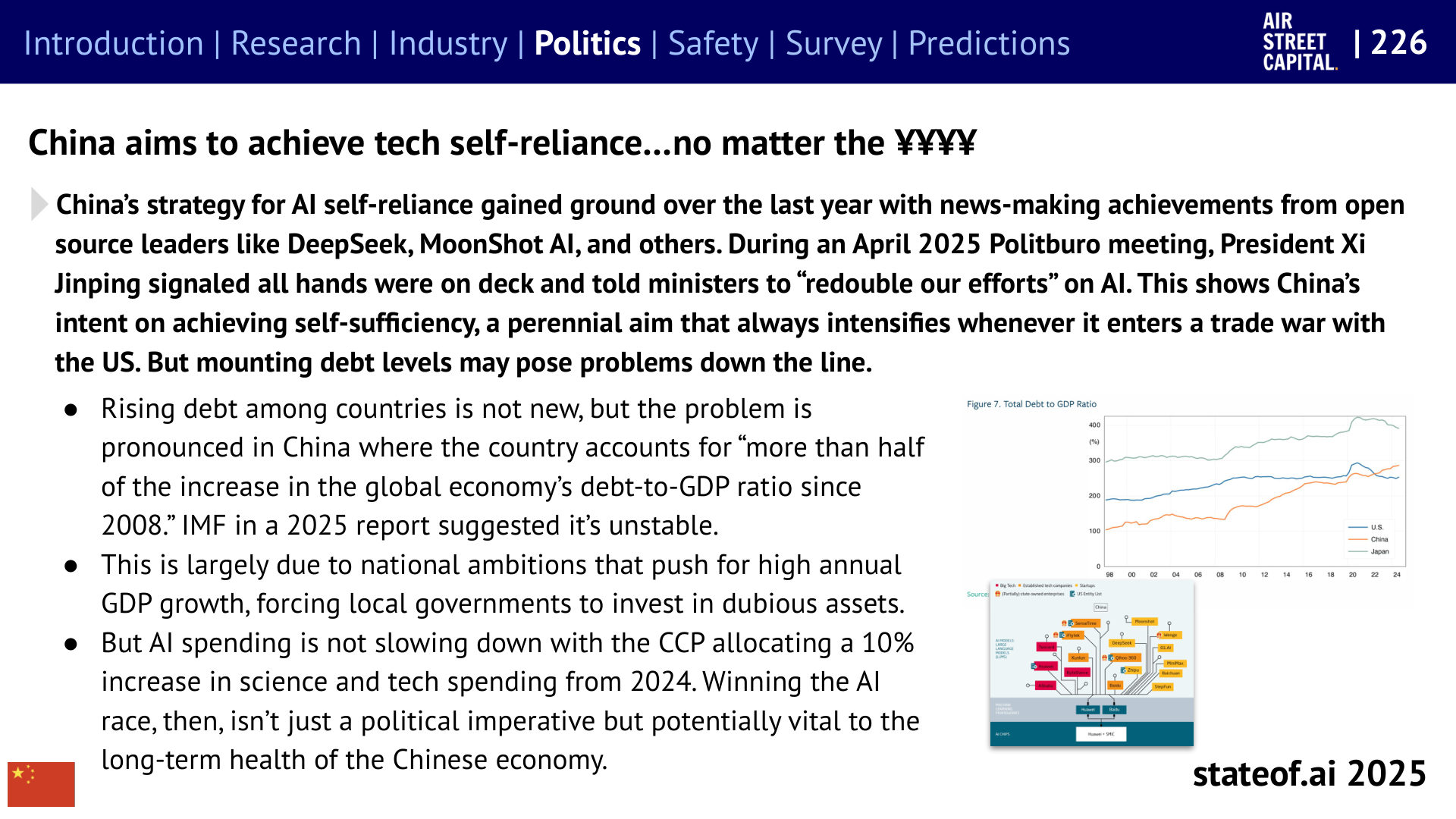
China’s open-weight ecosystem and domestic semiconductor ambitions advanced alongside a reported 10% increase in science and technology spending. Meanwhile, international safety coordination weakened: the US did not attend two AI Safety Institute Network meetings in 2025. The report’s concern was that national competition was making shared governance harder precisely as more capable systems crossed borders.
Domestic infrastructure did not necessarily mean an independent stack
The exports strategy packaged hardware, models, software, applications, and standards together. A country could acquire local data-center capacity while still depending on external suppliers for other layers. The report’s policy question therefore concerned control over the whole system, rather than the location of machines alone.
These are summaries of the report’s 2025 analysis, not legal guidance or a current list of policies. Proposed measures, implementation work, and strategic goals should not be read as equivalent completed outcomes.
The report described a shift toward exporting packages of US compute, models, cloud services, tools, and compliance structures to selected partners, with geopolitical influence and supplier dependence among the implications.
No. The report described implementation difficulties and calls for a pause, while noting that the Commission continued with implementation. This is a 2025 snapshot.
The report describes different national approaches to owning or controlling AI capacity. Purchasing domestic infrastructure could increase access without removing dependence on foreign models, chips, or suppliers.
The report recorded two AI Safety Institute Network meetings in 2025 that the US did not attend, alongside changes in US and UK institutional priorities and naming.
The report described hardware, models, software, applications, and standards offered as an integrated package. The strategy linked commercial supply with infrastructure and national-security priorities.
No. The report distinguished local infrastructure from dependence on external models, software, chips, and standards. Sovereignty involved more than the physical location of computing equipment.
It counted states that had fully completed the requirement to designate national authorities at the report’s snapshot. It did not mean that only three countries were subject to the AI Act.
It concerned science and technology spending in the report’s account. It was not a direct measure of AI-only expenditure, model quality, or semiconductor self-sufficiency.
Historical snapshot published October 9, 2025. This web edition was prepared on October 10, 2026 from the online deck and original launch posts. Findings and forecasts retain their original time frame.
2025 report, slide 148 (PDF page 149)Original 2025 report. Slide numbers printed in the deck are one lower than PDF page numbers because the cover is unnumbered.
2025 report, slide 191 (PDF page 192)Original 2025 report. Slide numbers printed in the deck are one lower than PDF page numbers because the cover is unnumbered.
2025 report, slide 192 (PDF page 193)Original 2025 report. Slide numbers printed in the deck are one lower than PDF page numbers because the cover is unnumbered.
2025 report, slide 198 (PDF page 199)Original 2025 report. Slide numbers printed in the deck are one lower than PDF page numbers because the cover is unnumbered.
2025 report, slide 202 (PDF page 203)Original 2025 report. Slide numbers printed in the deck are one lower than PDF page numbers because the cover is unnumbered.
2025 report, slide 207 (PDF page 208)Original 2025 report. Slide numbers printed in the deck are one lower than PDF page numbers because the cover is unnumbered.
2025 report, slide 211 (PDF page 212)Original 2025 report. Slide numbers printed in the deck are one lower than PDF page numbers because the cover is unnumbered.
2025 report, slide 221 (PDF page 222)Original 2025 report. Slide numbers printed in the deck are one lower than PDF page numbers because the cover is unnumbered.
2025 report, slide 226 (PDF page 227)Original 2025 report. Slide numbers printed in the deck are one lower than PDF page numbers because the cover is unnumbered.
Benaich, Nathan. “AI becomes an instrument of national strategy.” State of AI Report 2025. Historical report snapshot; web edition prepared 2026-10-10.