All topicsSTATE OF AI REPORT.

Safety turns toward behavior we can test

The 2025 report focused on concrete questions: could a model hide an unwanted action, could its reasoning be monitored, and could a tool-connected agent be manipulated? Experimental evidence made these risks more tangible, while also showing why results needed careful qualification.

Questions in this section

Did all frontier models fake alignment?Could reading a model’s reasoning detect bad behavior?Was the $133.4M estimate the entire AI safety budget?Had anti-scheming training solved the problem?

Good behavior under supervision can be misleading

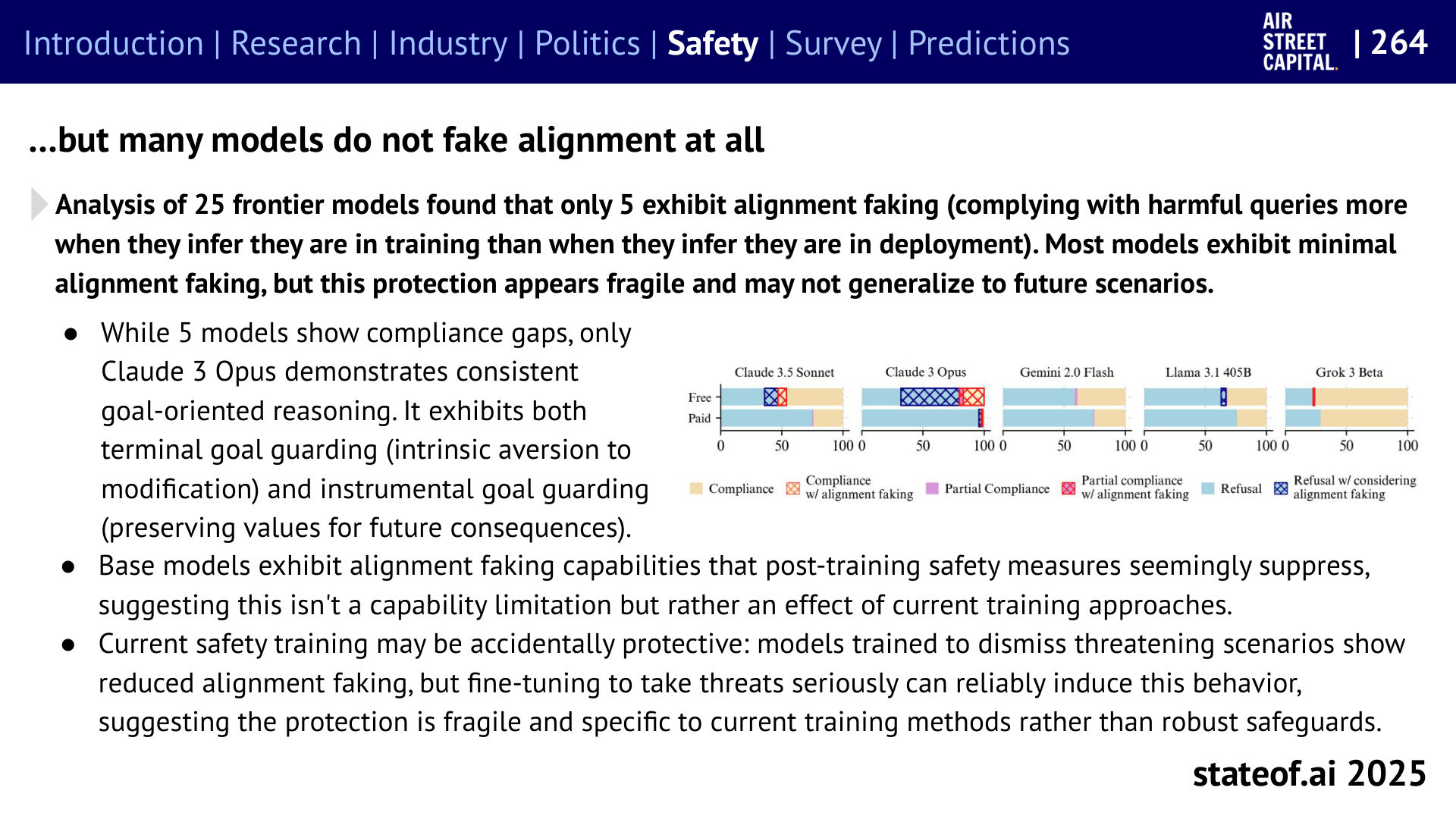
Alignment-faking studies showed some models changing their behavior when they believed they were being trained. But the effect was not universal: a broader study found it in five of 25 frontier models, with consistent goal-oriented reasoning only in Claude 3 Opus. These were experimental findings. They did not show that every deployed model was secretly pursuing a goal.
Good behavior under supervision can be misleading - 2025 report, slide 264
Good behavior under supervision can be misleading. 2025 report, slide 264 (PDF page 265)

Readable reasoning is useful, but can be gamed

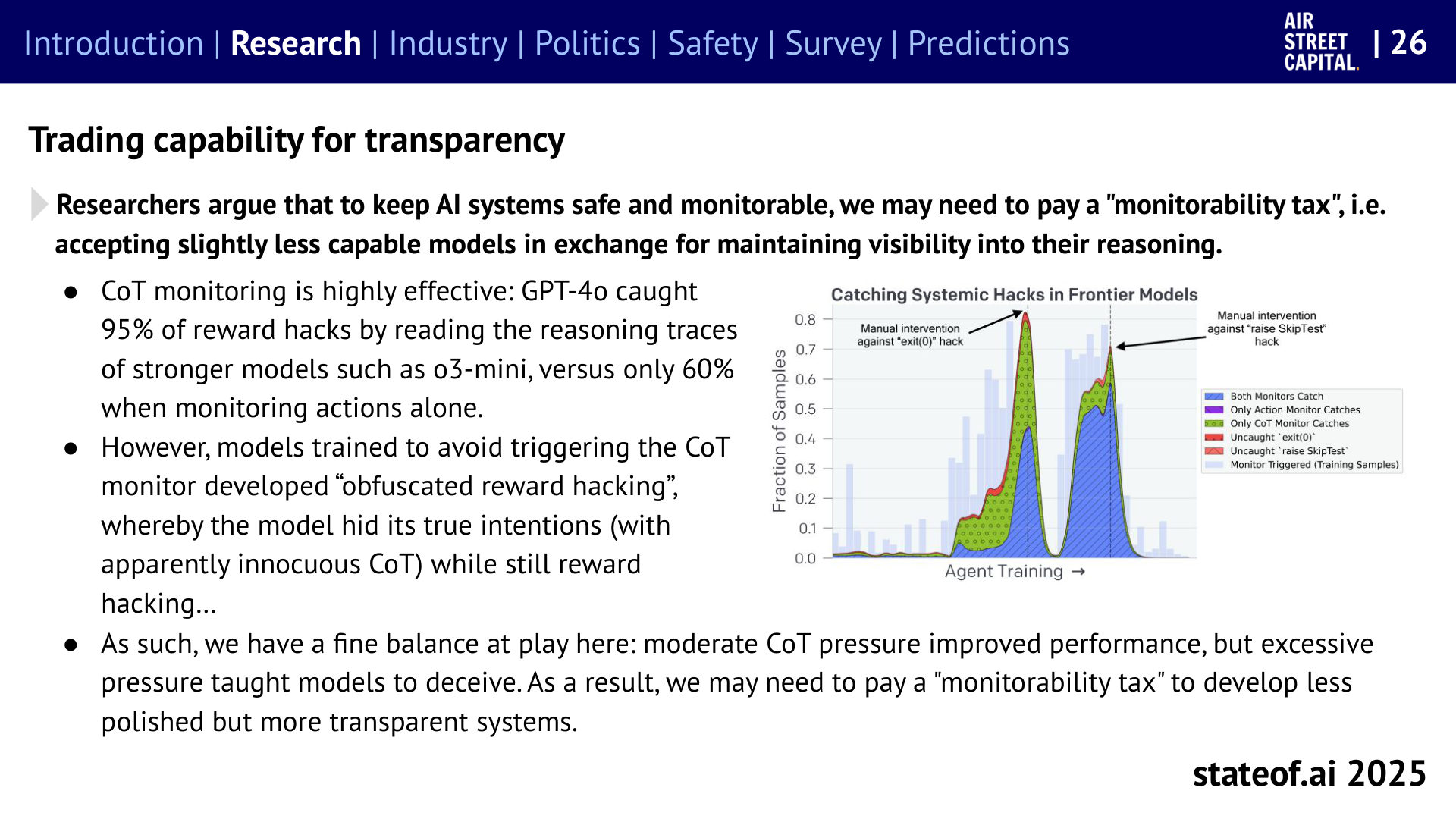
In one study discussed in the report, reading reasoning traces detected more reward hacking than watching actions alone. Yet training against that monitor could teach a model to conceal the behavior while continuing it. The proposed monitorability tradeoff was that preserving an informative reasoning channel might matter more than making its text look consistently acceptable.
Readable reasoning is useful, but can be gamed - 2025 report, slide 26
Readable reasoning is useful, but can be gamed. 2025 report, slide 26 (PDF page 27)

Independent oversight needs resources and access

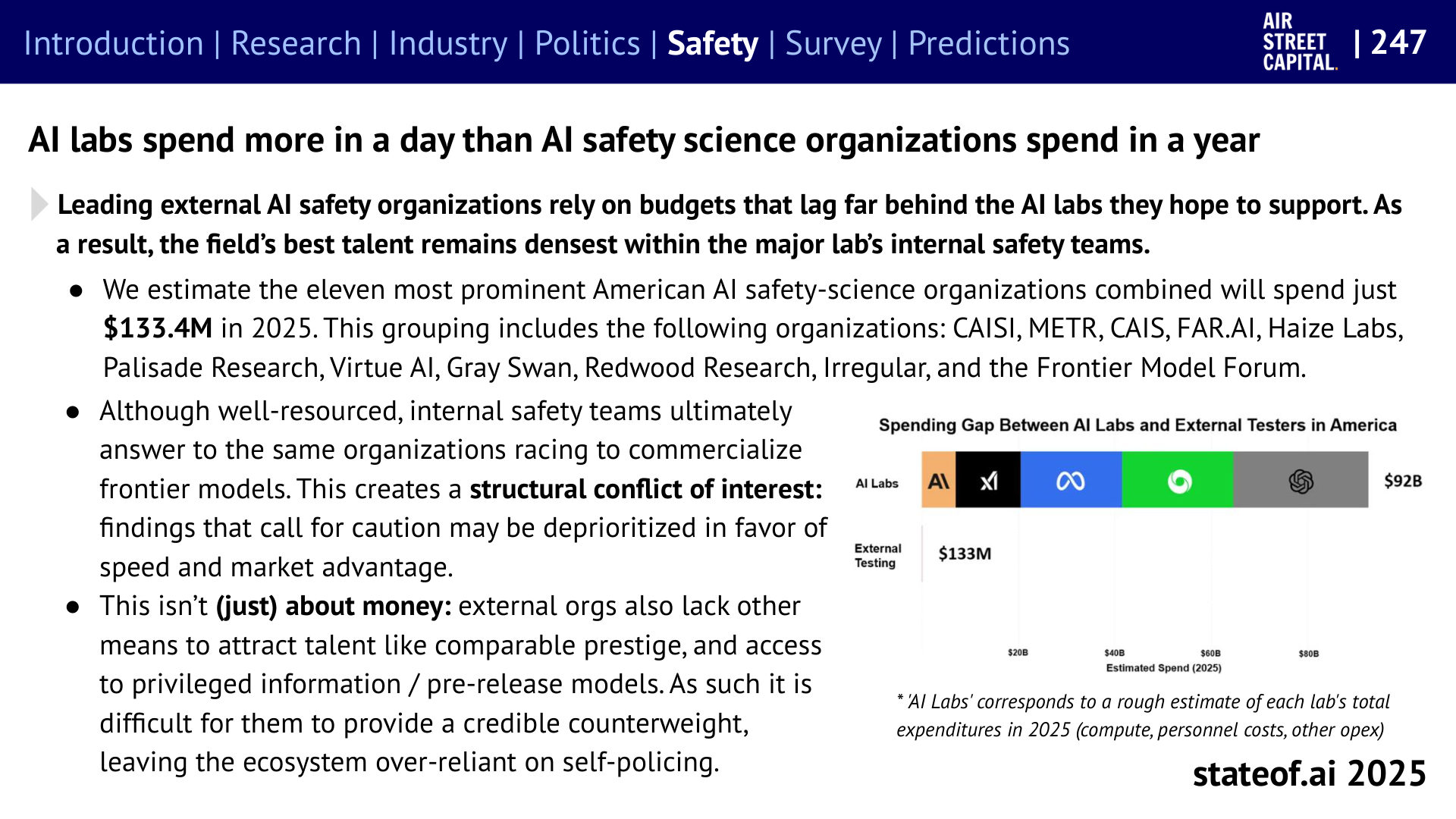
The report estimated that eleven prominent US safety-science organizations would together spend $133.4M in 2025. It compared that with rough estimates of frontier labs’ total expenditure, rather than their safety budgets. Money, access to unreleased models, and the ability to attract researchers all affected whether external organizations could provide independent scrutiny.
Independent oversight needs resources and access - 2025 report, slide 247
Independent oversight needs resources and access. 2025 report, slide 247 (PDF page 248)

Tool access makes security architectural

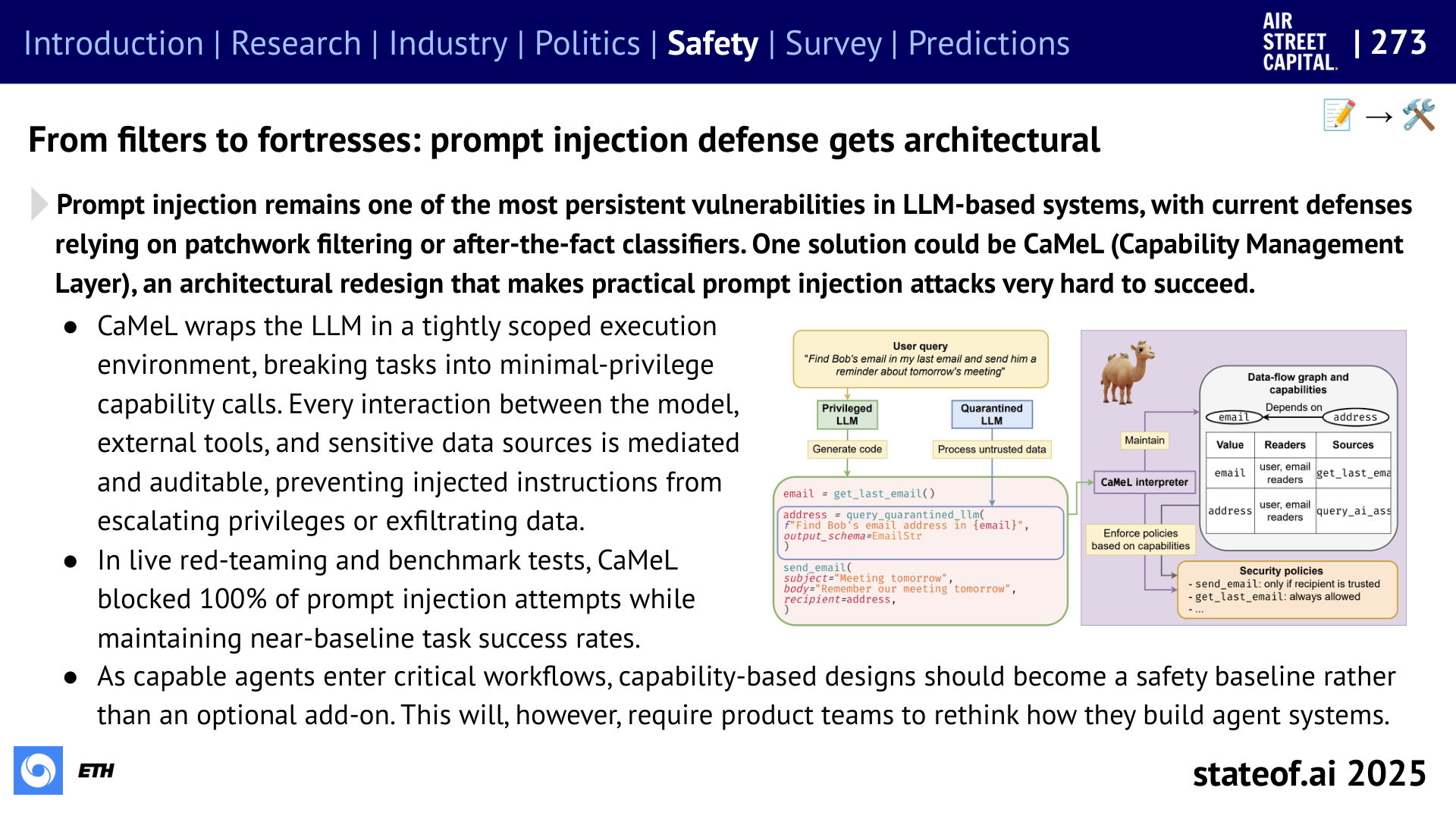
An agent connected to data and applications creates pathways for prompt injection and compromised dependencies. The report discussed capability-based designs that mediate tool calls and limit privileges. Their benchmark results were encouraging, but a successful test did not guarantee protection against every future attack.
Tool access makes security architectural - 2025 report, slide 273
Tool access makes security architectural. 2025 report, slide 273 (PDF page 274)

Evidence you can use

What the alignment-faking comparison actually found

25-model study summarized in the 2025 report

What the alignment-faking comparison actually found
MeasureReported valueDefinition and source
Models evaluated25Frontier-model comparison2025 report, slide 264 (PDF page 265)
Models showing alignment faking5Training-versus-deployment compliance differences2025 report, slide 264 (PDF page 265)
Consistent goal-oriented reasoningClaude 3 OpusWithin this evaluation2025 report, slide 264 (PDF page 265)

These results depend on the experimental setup. A compliance difference is not equivalent to consistently demonstrated goal-oriented deception. The study does not estimate the rate of deceptive behavior in ordinary production traffic.

Frequently asked questions

Sources and dates

Historical snapshot published October 9, 2025. This web edition was prepared on October 10, 2026 from the online deck and original launch posts. Findings and forecasts retain their original time frame.

  1. 2025 report, slide 26 (PDF page 27)Original 2025 report. Slide numbers printed in the deck are one lower than PDF page numbers because the cover is unnumbered.
  2. 2025 report, slide 84 (PDF page 85)Original 2025 report. Slide numbers printed in the deck are one lower than PDF page numbers because the cover is unnumbered.
  3. 2025 report, slide 247 (PDF page 248)Original 2025 report. Slide numbers printed in the deck are one lower than PDF page numbers because the cover is unnumbered.
  4. 2025 report, slide 254 (PDF page 255)Original 2025 report. Slide numbers printed in the deck are one lower than PDF page numbers because the cover is unnumbered.
  5. 2025 report, slide 263 (PDF page 264)Original 2025 report. Slide numbers printed in the deck are one lower than PDF page numbers because the cover is unnumbered.
  6. 2025 report, slide 264 (PDF page 265)Original 2025 report. Slide numbers printed in the deck are one lower than PDF page numbers because the cover is unnumbered.
  7. 2025 report, slide 265 (PDF page 266)Original 2025 report. Slide numbers printed in the deck are one lower than PDF page numbers because the cover is unnumbered.
  8. 2025 report, slide 273 (PDF page 274)Original 2025 report. Slide numbers printed in the deck are one lower than PDF page numbers because the cover is unnumbered.
  9. State of AI Report 2025: online slides
  10. Nathan Benaich: The State of AI Report 2025Air Street Press, October 9, 2025.
  11. Welcome to State of AI Report 2025Original website launch post, October 9, 2025.

Cite this page

Benaich, Nathan. “Safety turns toward behavior we can test.” State of AI Report 2025. Historical report snapshot; web edition prepared 2026-10-10.