All topicsSTATE OF AI REPORT.

AI moves from predicting biology to designing it

AI’s scientific role continued to expand in 2024. AlphaFold 3 modeled interactions beyond proteins alone, while Profluent generated new genome editors that worked in human cells in vitro. The consequential change was the growing connection between a model’s output and something that could be tested experimentally.

Questions in this section

What did AI-designed genome editors achieve in 2024?What was new in AlphaFold 3?Did these findings establish an AI-designed treatment?

AlphaFold 3 models more of the molecular system

AlphaFold 3 extended structure modeling to interactions involving proteins, small molecules, DNA, RNA, and antibodies. Its design used diffusion to generate three-dimensional coordinates. The report also raised limits: comparisons did not include some stronger baselines, and code was not available at the time of publication.
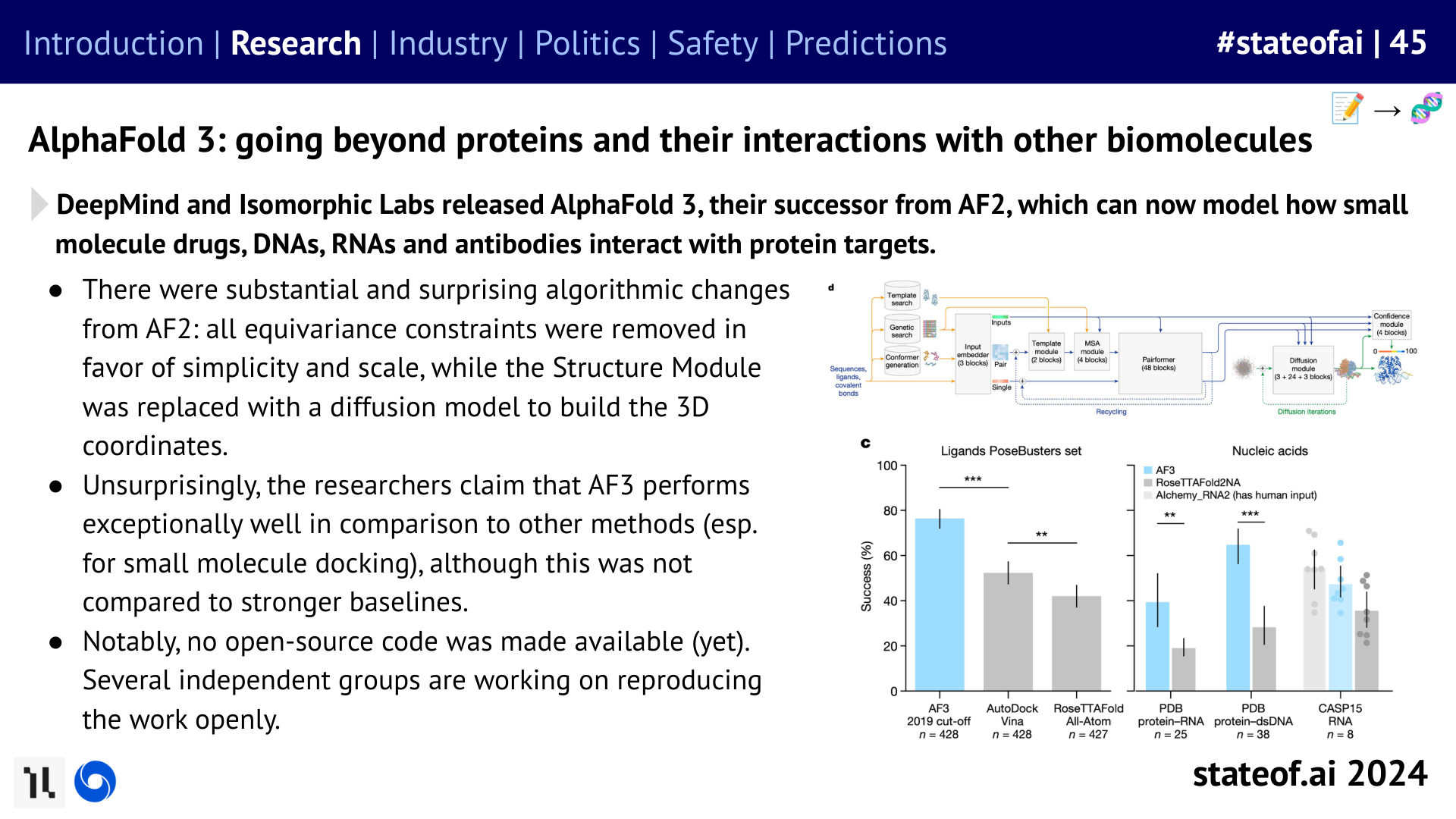
AlphaFold 3 models more of the molecular system - 2024 report, slide 45
AlphaFold 3 models more of the molecular system. 2024 report, slide 45 (PDF page 46)

Language models generate functional genome editors

Profluent fine-tuned a protein language model on its CRISPR-Cas Atlas and generated novel editors that altered DNA in human cells in vitro. The work went beyond plausible sequences to experimental function. One editor, OpenCRISPR-1, was made openly available; the result was a research validation, not a clinical treatment.
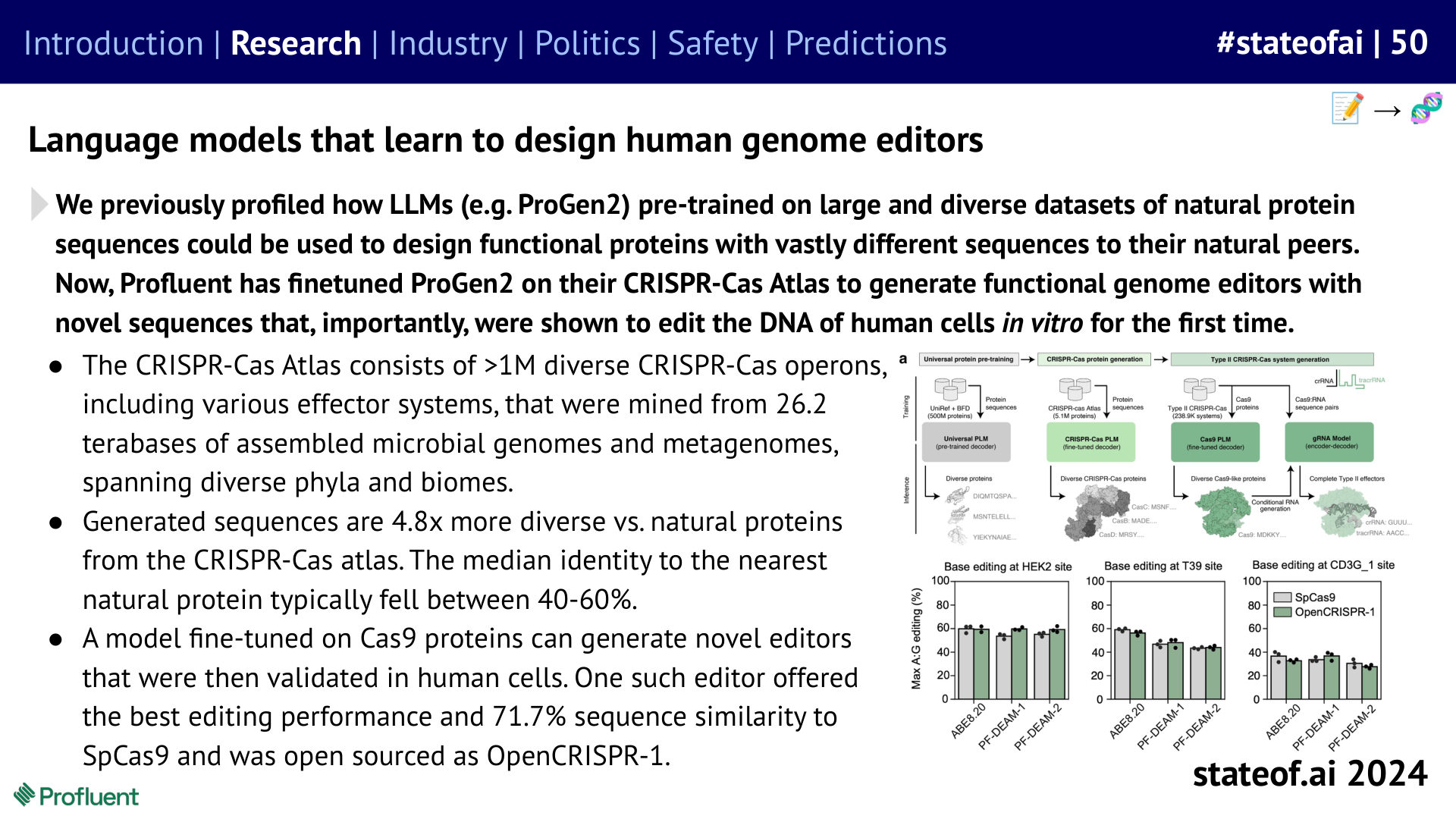
Language models generate functional genome editors - 2024 report, slide 50
Language models generate functional genome editors. 2024 report, slide 50 (PDF page 51)

The data and the experiment both matter

The CRISPR-Cas Atlas contained more than one million operons mined from large collections of microbial genomes and metagenomes. Generated sequences were substantially different from known natural examples. Those differences became scientifically meaningful because selected editors were then tested in cells, rather than judged only by model scores.

Evidence you can use

AI for science in the 2024 report

Historical snapshot: October 2024. Dates and populations are specified per row.

AI for science in the 2024 report
MeasureReported valueDefinition and source
CRISPR-Cas AtlasMore than 1M operonsDiverse CRISPR-Cas systems mined for the dataset described in the report.2024 report, slide 50 (PDF page 51)
Source genomic data26.2 terabasesAssembled microbial genome and metagenome data used to mine the atlas.2024 report, slide 50 (PDF page 51)
OpenCRISPR-1 sequence similarity71.7% to SpCas9Similarity reported for the selected functional editor, not an editing success rate.2024 report, slide 50 (PDF page 51)

Sequence similarity is not biological efficacy. Cell-based experiments establish function under the tested conditions; they do not establish clinical safety or therapeutic effectiveness. AlphaFold 3 claims retain the access and baseline limitations noted in the original report.

Frequently asked questions

Sources and dates

Historical snapshot published October 10, 2024. This web edition was prepared on October 10, 2026 from the online deck and original launch posts. Findings and forecasts retain their original time frame.

  1. 2024 report, slide 45 (PDF page 46)Original 2024 report. Printed slide numbers are one lower than PDF page numbers because the cover is unnumbered.
  2. 2024 report, slide 50 (PDF page 51)Original 2024 report. Printed slide numbers are one lower than PDF page numbers because the cover is unnumbered.
  3. State of AI Report 2024: online slides
  4. Nathan Benaich: The State of AI Report 2024Air Street Press, October 10, 2024.
  5. Welcome to State of AI Report 2024Original website launch post, October 10, 2024.

Cite this page

Benaich, Nathan. “AI moves from predicting biology to designing it.” State of AI Report 2024. Historical report snapshot; web edition prepared 2026-10-10.