By Nathan Benaich (Air Street Capital) · 2024 report
By October 2024, the policy debate was moving from proposals to implementation. The EU had passed its AI Act, the US was using executive authority to set frontier-model requirements, and governments were building institutions to evaluate increasingly capable systems.
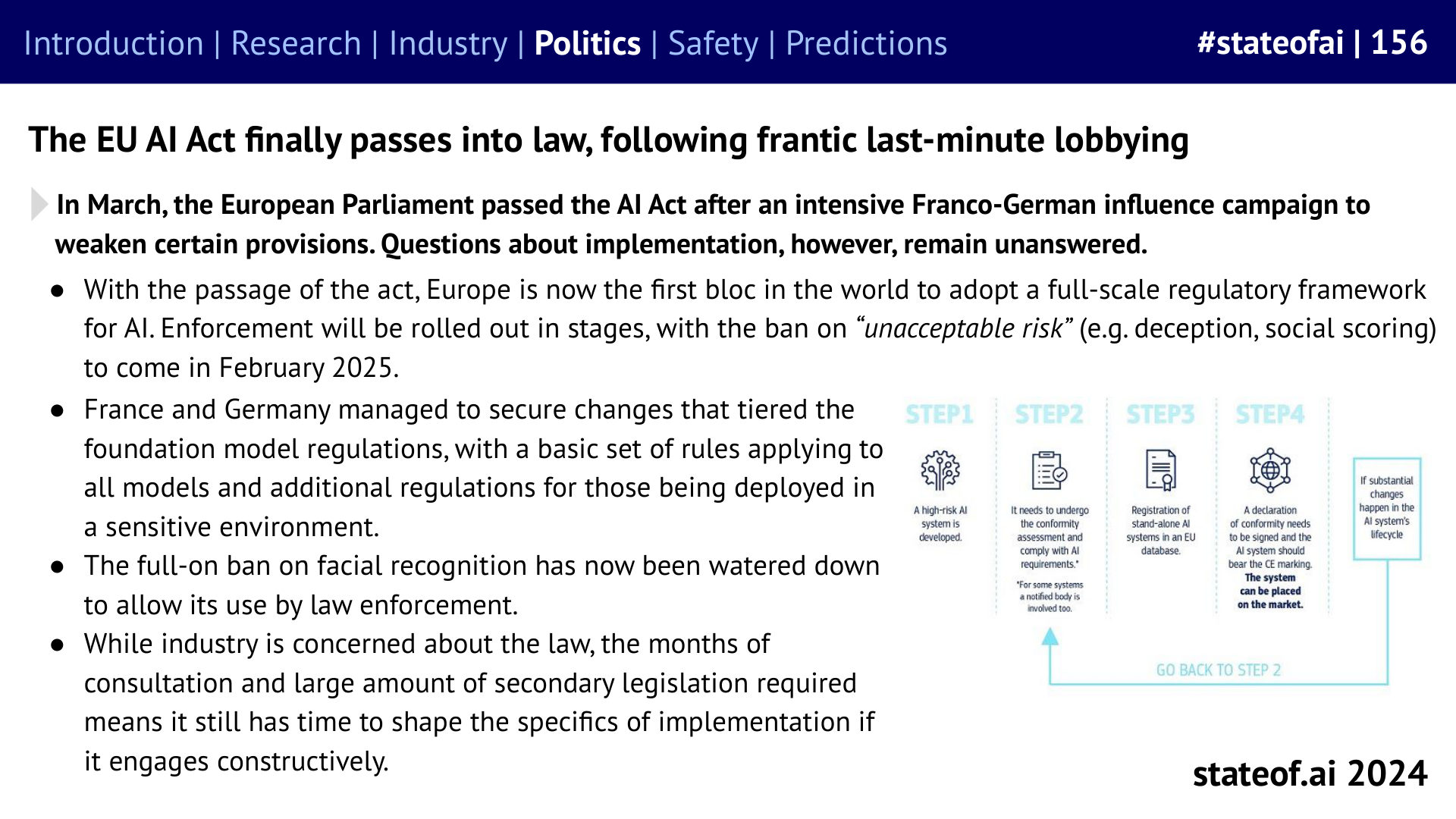
The EU AI Act became law, with obligations scheduled to take effect in stages. The report emphasized that passage did not settle every implementation question: consultations and secondary legislation still left room to shape how the rules would work. This account describes the position in October 2024.
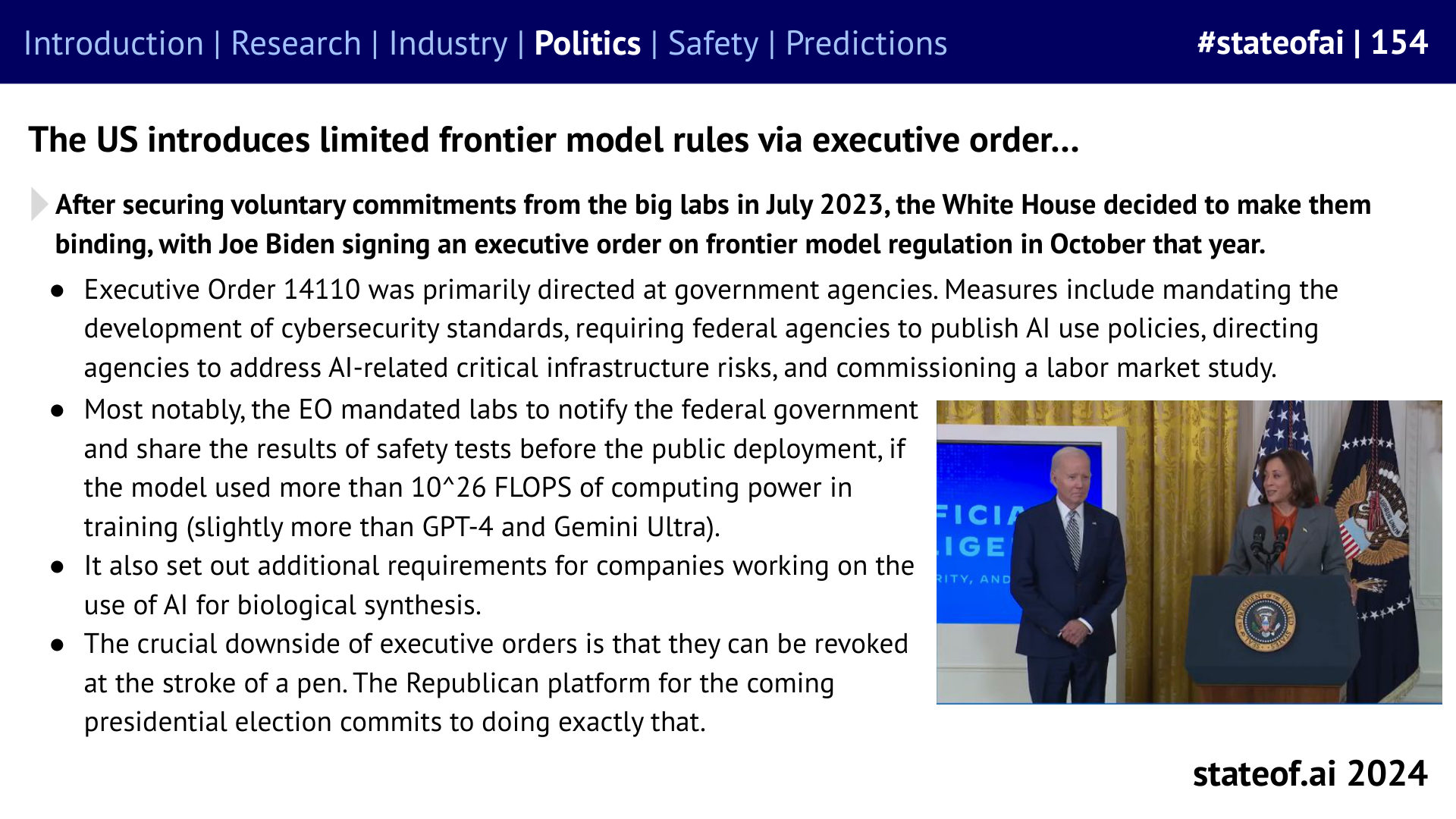
The report described Executive Order 14110 as primarily directing federal agencies, while also introducing reporting requirements for very large model training runs. It stressed the fragility of this route: a later administration could revoke an executive order. The report’s discussion is a historical account, not a description of current US law.
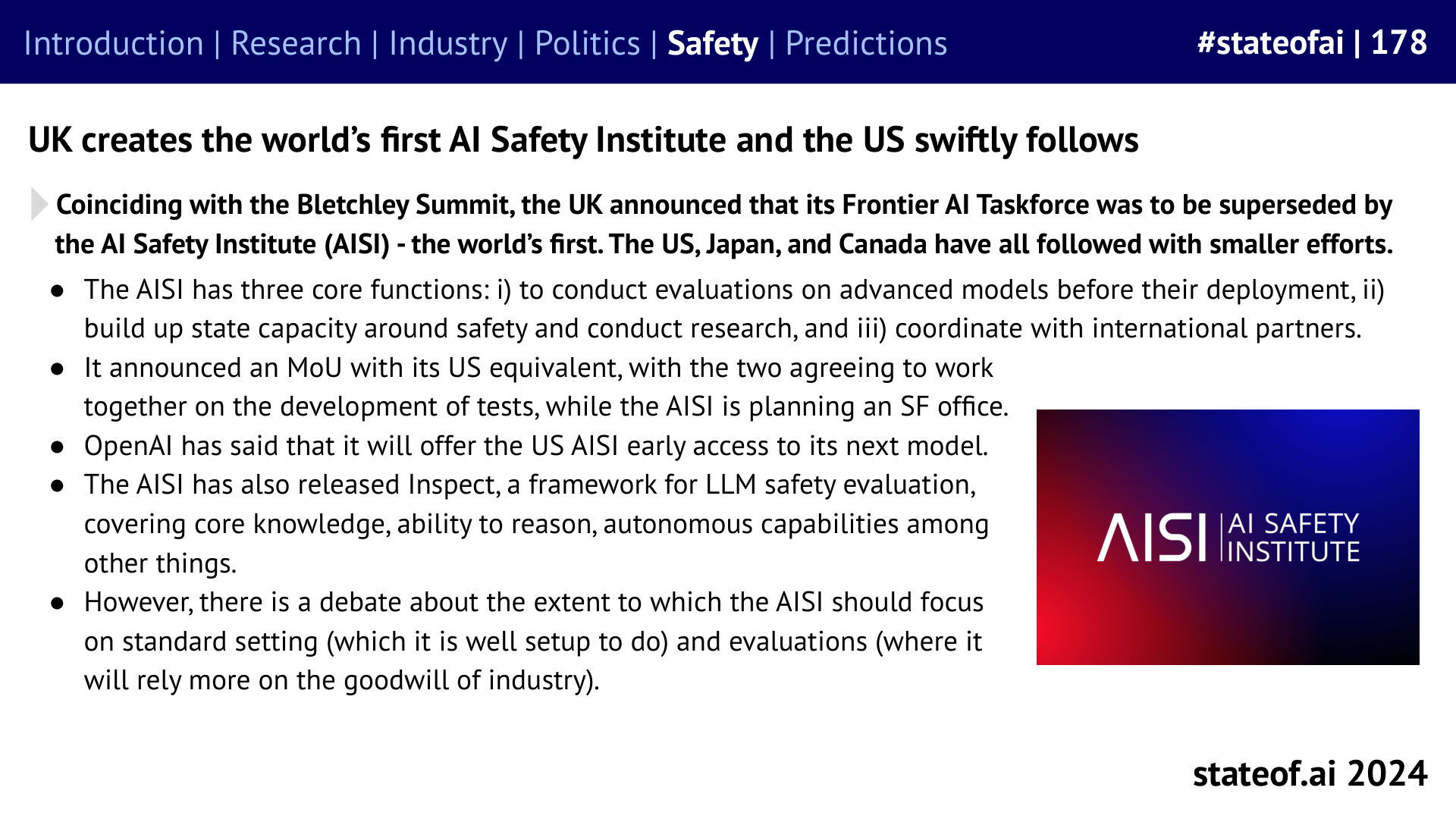
The UK’s AI Safety Institute succeeded the Frontier AI Taskforce, with counterparts emerging in other countries. Its work included evaluations, research, international coordination, and the Inspect evaluation framework. The report distinguished developing government expertise from having guaranteed access to every model that needed evaluation.
Evaluation capacity and access were separate requirements
An institute could develop researchers, tools, and international relationships without guaranteed access to every model of interest. The report made that distinction important to the institutional story. Building the ability to evaluate frontier systems was one step; obtaining timely access to apply that ability was another.
Evidence you can use
AI policy in the 2024 report
Historical snapshot: October 2024. Dates and populations are specified per row.
This is the legal and institutional picture recorded in October 2024. Scheduled dates and rules are preserved as historical evidence and should not be used as current compliance guidance.
The Act had passed into law, with implementation staged over time and further details still to be resolved. The report highlighted the gap between adopting a framework and putting it into practice.
The report described executive-order requirements for federal agencies and reporting on very large training runs, while noting that executive orders could be revoked by a later administration.
No. The report described staged obligations, consultations, and secondary legislation. Adoption established a framework while leaving important practical questions to later implementation.
No. It was a scheduled date for prohibitions on unacceptable-risk uses in the October 2024 account. The report could describe that schedule without establishing what subsequently occurred.
It concerned reporting for very large model-training runs under the US executive-order framework described by the report. It was not a universal limit on all AI computation.
An executive order could be revoked by a later administration. The report therefore distinguished this route from a durable statutory settlement, within its 2024 historical account.
The report described evaluation, research capacity, and international coordination. These functions did not automatically amount to regulatory power or guaranteed access to every frontier model.
Historical snapshot published October 10, 2024. This web edition was prepared on October 10, 2026 from the online deck and original launch posts. Findings and forecasts retain their original time frame.
2024 report, slide 154 (PDF page 155)Original 2024 report. Printed slide numbers are one lower than PDF page numbers because the cover is unnumbered.
2024 report, slide 156 (PDF page 157)Original 2024 report. Printed slide numbers are one lower than PDF page numbers because the cover is unnumbered.
2024 report, slide 178 (PDF page 179)Original 2024 report. Printed slide numbers are one lower than PDF page numbers because the cover is unnumbered.