All topicsSTATE OF AI REPORT.

Robotics gains shared tools and better ways to learn

Robotics became a larger part of the 2024 report as researchers worked around its persistent data bottleneck. Open tools made it easier to start, human demonstrations supplied training examples, and autonomous driving provided evidence of deployment at increasing scale.

Questions in this section

What changed in commercial autonomous driving in 2024?What was LeRobot?How did HumanPlus learn humanoid skills?

Shared tools lower the barrier to robotics

Hugging Face’s LeRobot brought pretrained models, demonstration datasets, and development tools into a shared ecosystem. Robotics had fewer open resources than language or vision research. Making them easier to find and reuse reduced the amount each team needed to build before it could begin experimenting.
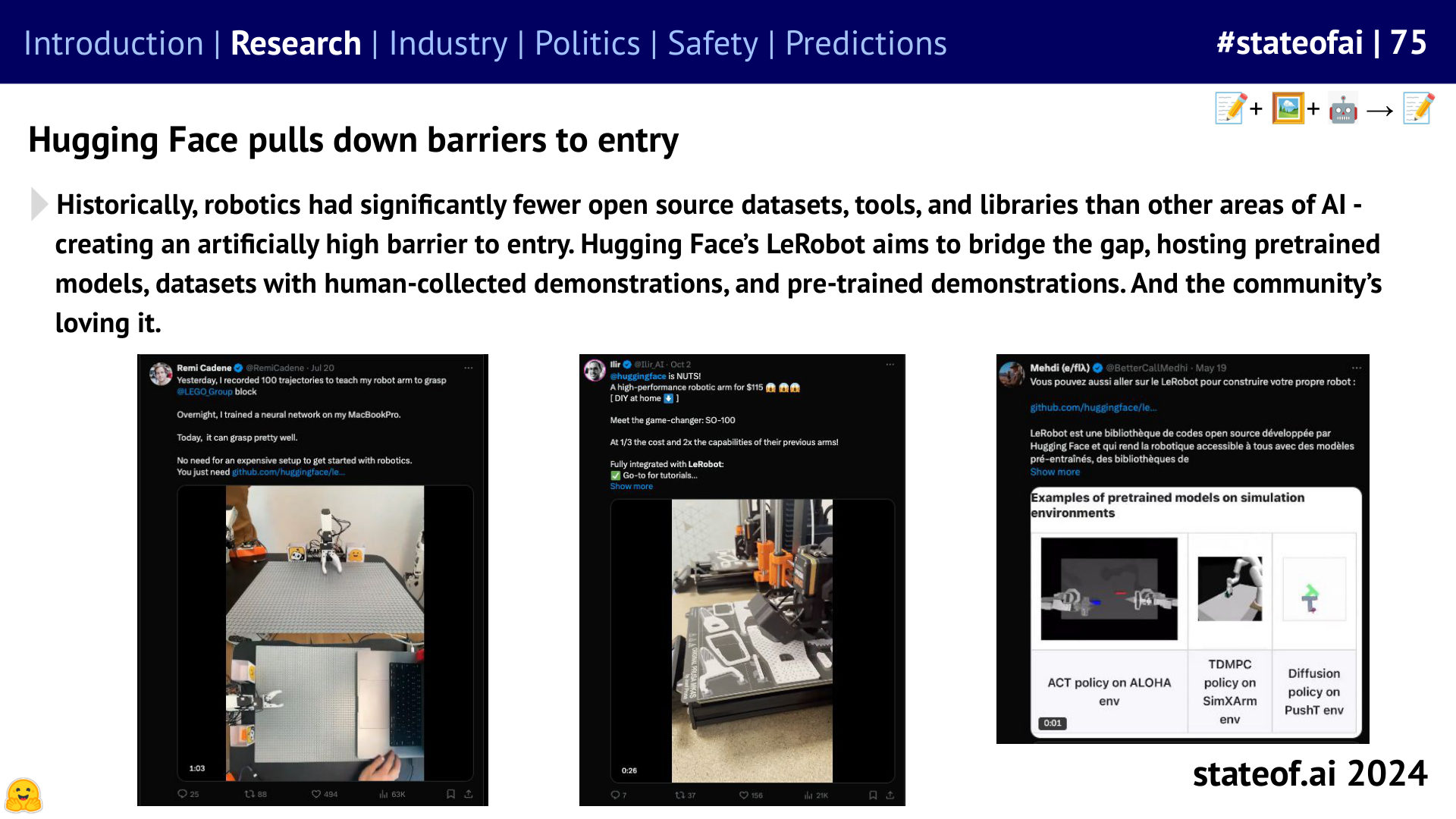
Shared tools lower the barrier to robotics - 2024 report, slide 75
Shared tools lower the barrier to robotics. 2024 report, slide 75 (PDF page 76)

Humanoids learn from human demonstrations

HumanPlus combined a shadowing system with imitation learning. A camera let a person control a humanoid’s whole body, and demonstrations then trained autonomous skills. The report described tasks learned with up to 40 demonstrations, while the underlying control policy also relied on motion data and simulation. The small demonstration count was not the system’s entire training budget.
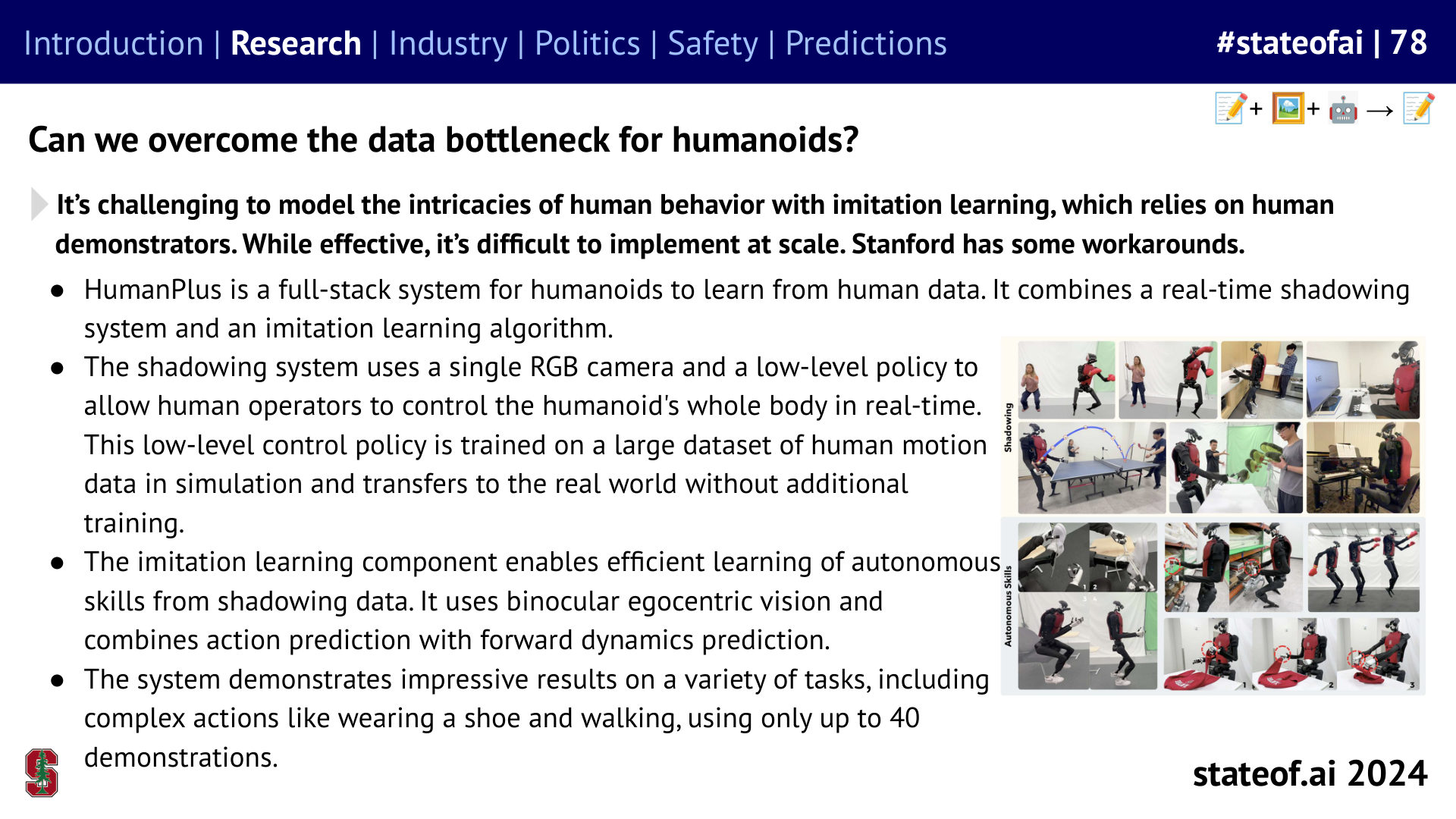
Humanoids learn from human demonstrations - 2024 report, slide 78
Humanoids learn from human demonstrations. 2024 report, slide 78 (PDF page 79)

Autonomous driving reaches more customers

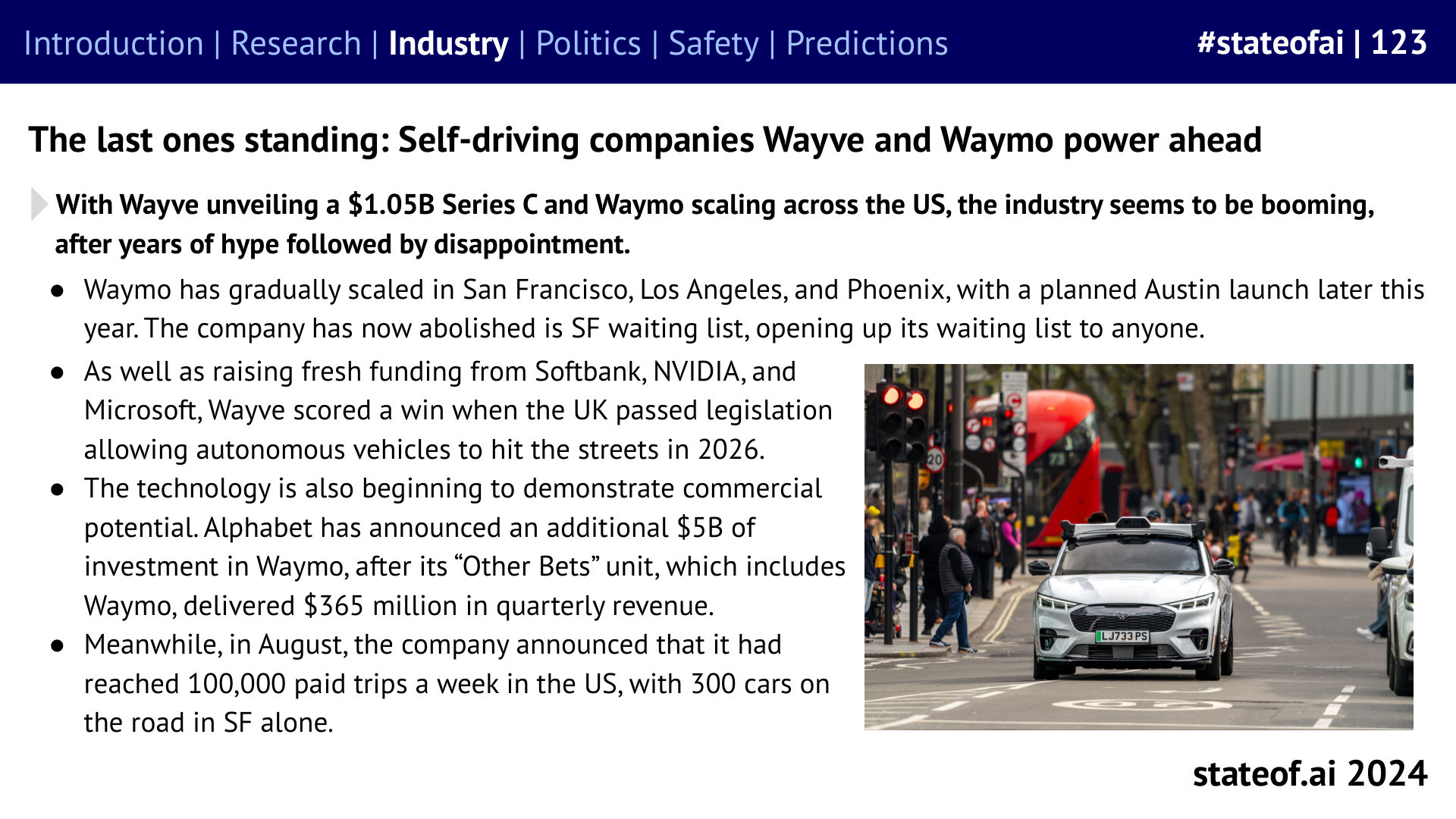
Waymo reported 100,000 paid trips per week in the US in August 2024, and Wayve raised a $1.05 billion Series C. These were meaningful signs of deployment and financing after years of disappointment. They represented different business models and milestones, rather than a single measure of autonomous-driving readiness.
Autonomous driving reaches more customers - 2024 report, slide 123
Autonomous driving reaches more customers. 2024 report, slide 123 (PDF page 124)

Evidence you can use

Robotics in the 2024 report

Historical snapshot: October 2024. Dates and populations are specified per row.

Robotics in the 2024 report
MeasureReported valueDefinition and source
HumanPlus task demonstrationsUp to 40Demonstrations for the tasks highlighted by the report, in addition to prior motion data and simulation training.2024 report, slide 78 (PDF page 79)
Waymo paid trips100,000 per weekUS paid-trip milestone announced in August 2024.2024 report, slide 123 (PDF page 124)
Wayve Series C$1.05BFunding round reported in the 2024 edition; a financing figure, not revenue.2024 report, slide 123 (PDF page 124)

Demonstration counts, paid trips, and funding measure different things. The HumanPlus examples are research tasks, while Waymo’s trip volume is an operational milestone. Neither establishes unrestricted general-purpose autonomy.

Frequently asked questions

Sources and dates

Historical snapshot published October 10, 2024. This web edition was prepared on October 10, 2026 from the online deck and original launch posts. Findings and forecasts retain their original time frame.

  1. 2024 report, slide 75 (PDF page 76)Original 2024 report. Printed slide numbers are one lower than PDF page numbers because the cover is unnumbered.
  2. 2024 report, slide 78 (PDF page 79)Original 2024 report. Printed slide numbers are one lower than PDF page numbers because the cover is unnumbered.
  3. 2024 report, slide 123 (PDF page 124)Original 2024 report. Printed slide numbers are one lower than PDF page numbers because the cover is unnumbered.
  4. State of AI Report 2024: online slides
  5. Nathan Benaich: The State of AI Report 2024Air Street Press, October 10, 2024.
  6. Welcome to State of AI Report 2024Original website launch post, October 10, 2024.

Cite this page

Benaich, Nathan. “Robotics gains shared tools and better ways to learn.” State of AI Report 2024. Historical report snapshot; web edition prepared 2026-10-10.