By Nathan Benaich (Air Street Capital) · 2024 report
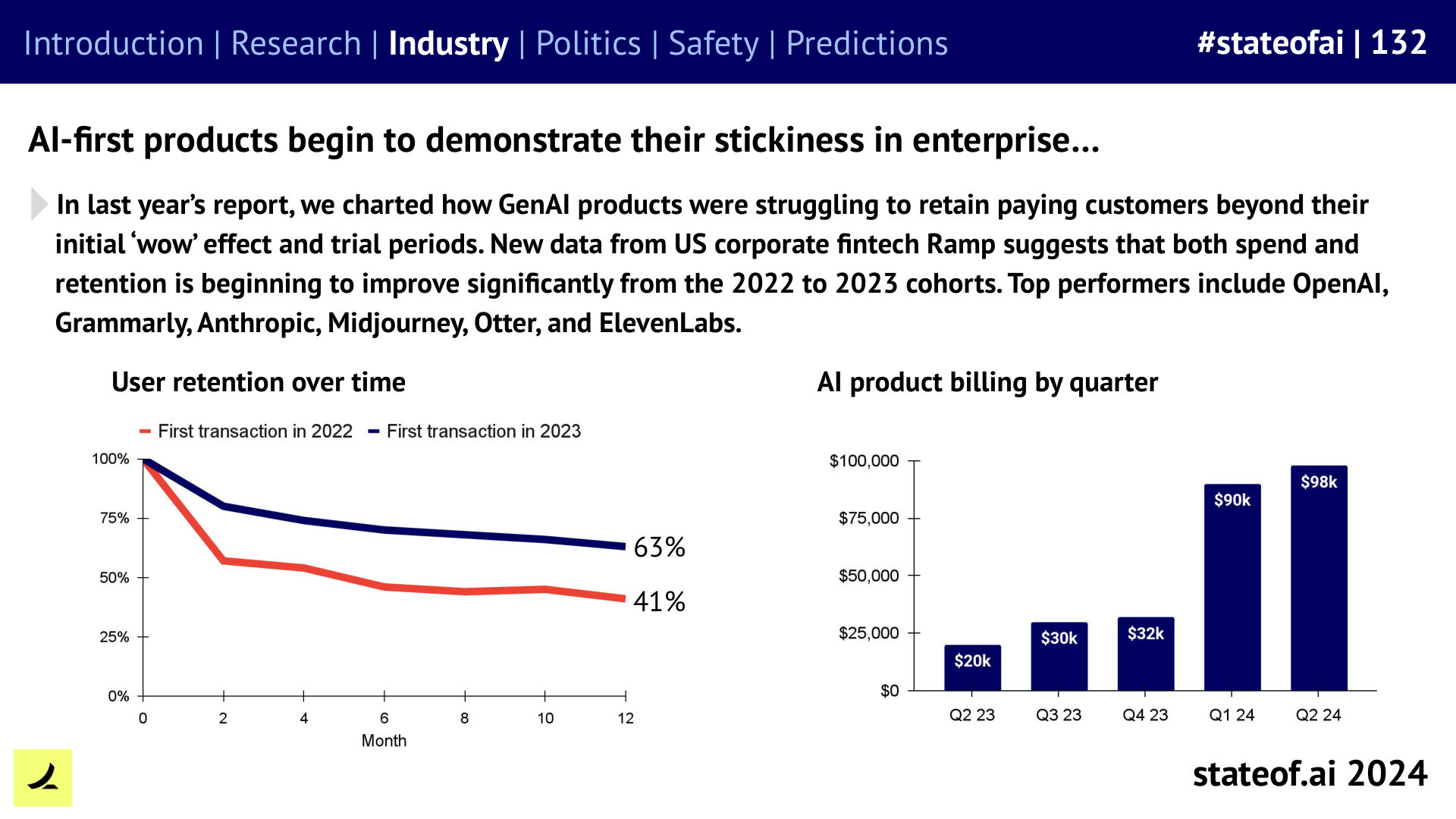
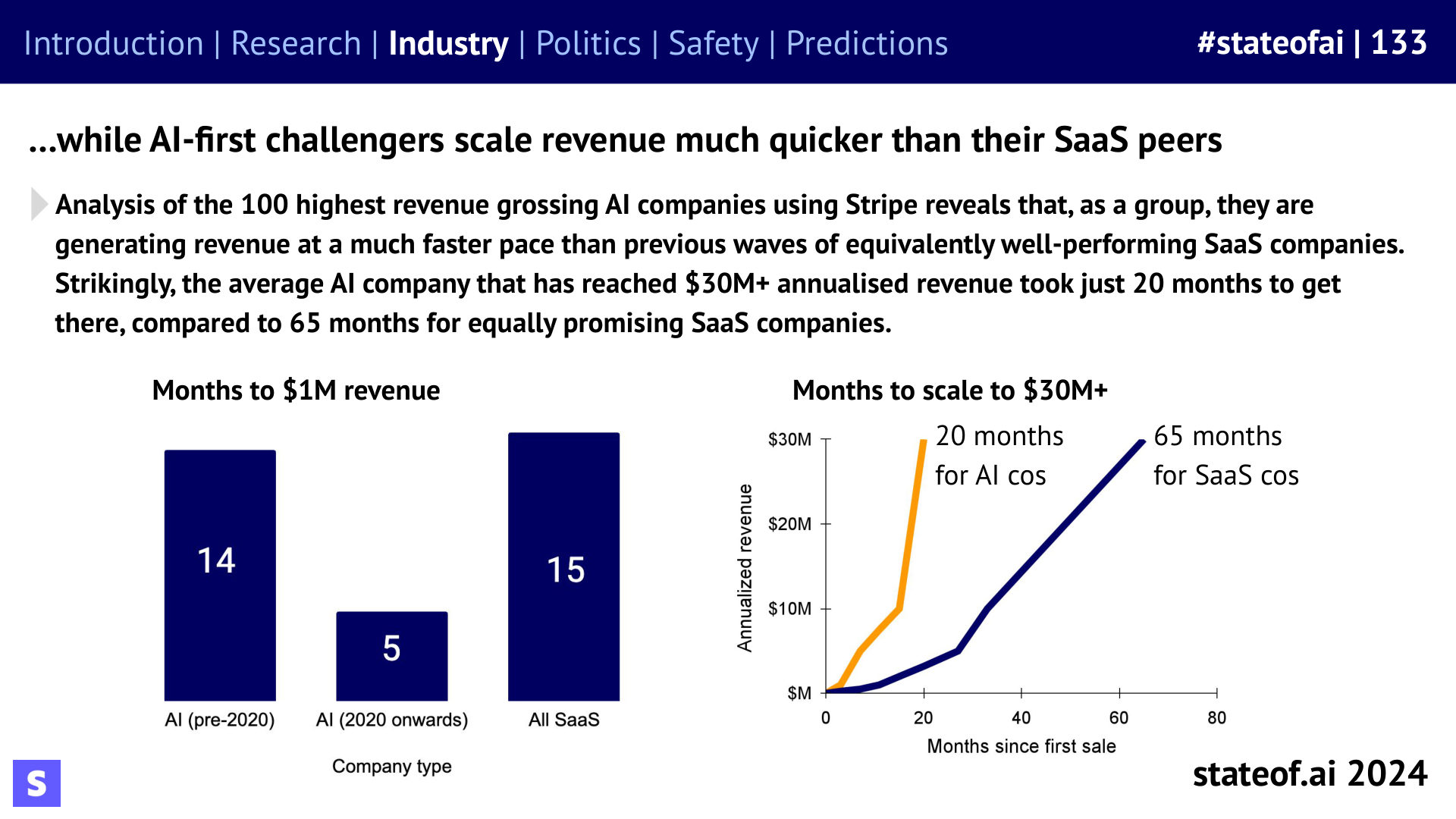
The commercial story shifted in 2024. The previous report had questioned whether generative AI products could retain users after the initial excitement. New evidence pointed to improving retention and spending, while some leading AI companies grew revenue much faster than an earlier generation of software businesses.
Ramp’s corporate spending data showed improved retention and billing for the 2023 cohort of AI products compared with the 2022 cohort. The report highlighted OpenAI, Grammarly, Anthropic, Midjourney, Otter, and ElevenLabs. This was evidence from a particular spending platform, rather than a census of all enterprise AI customers.
Leading AI companies reach revenue milestones faster
Among the highest-revenue AI companies on Stripe, companies that reached more than $30 million in annualized revenue took an average of 20 months to get there. The comparison group of promising SaaS businesses took 65 months. The result showed the pace of the strongest performers, not the expected outcome for a typical startup.
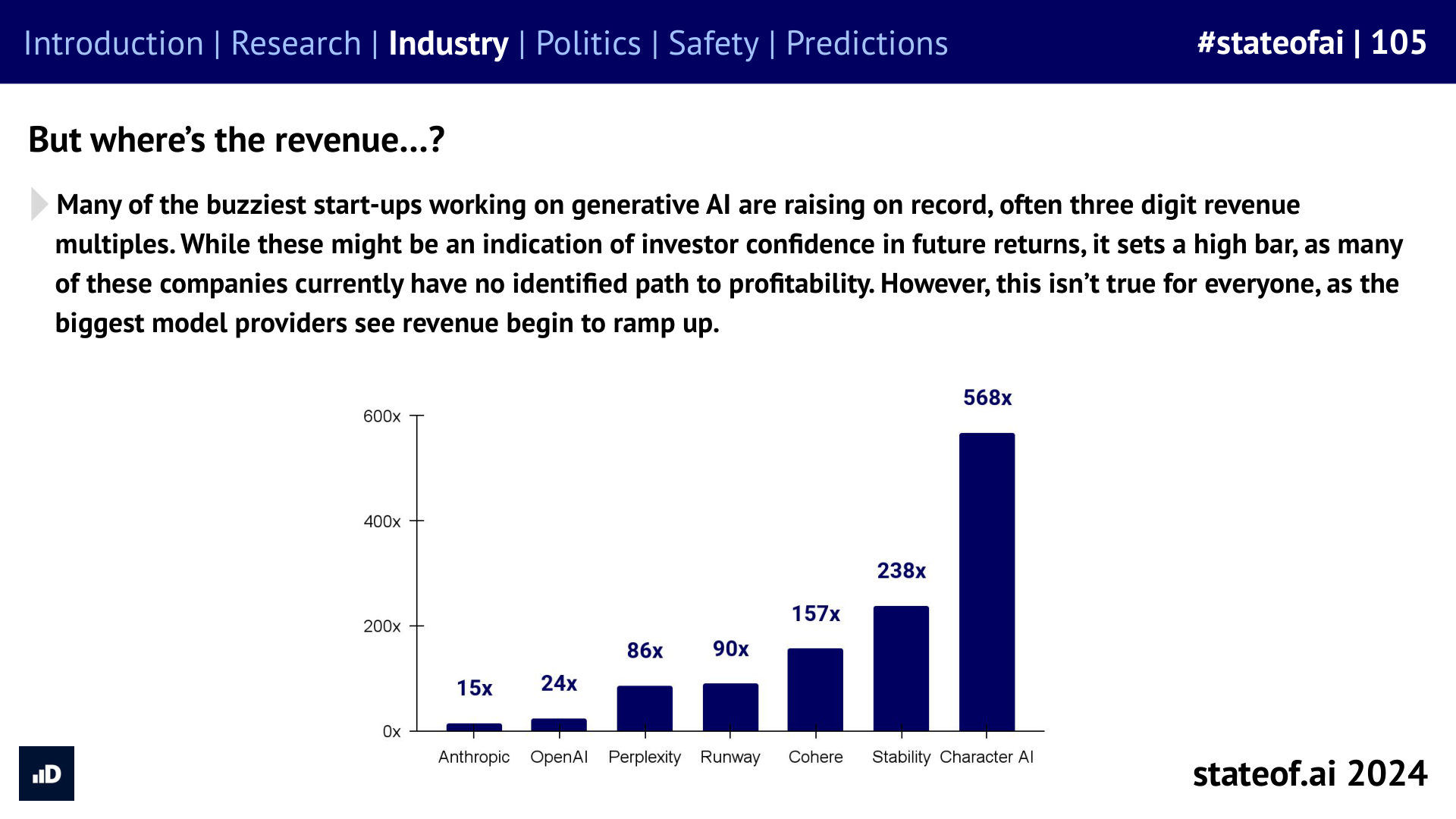
The largest model providers were growing revenue, but many prominent generative AI startups still lacked an identified route to profitability. High revenue multiples raised the bar for future performance. Adoption and rapid growth were becoming easier to demonstrate than durable margins.
The fastest-growing cohort was not the typical startup
Stripe’s analysis selected its highest-revenue AI companies and compared time to a revenue milestone among those that reached it. That was useful evidence of how fast leading businesses could grow. It did not estimate the probability that a new AI startup would reach the same milestone.
Evidence you can use
AI business in the 2024 report
Historical snapshot: October 2024. Dates and populations are specified per row.
Stripe’s analysis selects high-revenue companies and conditions the milestone comparison on reaching it. Ramp measures spending through its own platform. Neither dataset establishes market-wide adoption, profitability, or typical startup outcomes.
In the Stripe analysis cited by the report, AI companies that reached $30 million or more in annualized revenue did so in 20 months on average, compared with 65 months for the SaaS comparison group.
Ramp’s data suggested stronger retention and spending for the 2023 AI product cohort than for the 2022 cohort. This was platform-specific evidence, rather than a market-wide retention estimate.
The selection frame was Stripe’s 100 highest-revenue AI companies. That made the sample informative about strong performers but not representative of every AI startup.
It measured time to more than $30 million in annualized revenue among the selected AI companies reaching that milestone. It was not an expected time for an arbitrary newly founded company.
It was the reported time for the historical SaaS comparison group to reach the same revenue milestone. The result compared selected cohorts rather than identical companies under controlled conditions.
Its corporate spending records showed stronger retention and billing for the 2023 AI-product cohort than the 2022 cohort. The evidence reflected that platform’s customers and transactions.
The report described some startups raising at three-digit revenue multiples. Those valuations reflected expectations of future returns and set a demanding growth bar, particularly for companies without an identified path to profitability.
Historical snapshot published October 10, 2024. This web edition was prepared on October 10, 2026 from the online deck and original launch posts. Findings and forecasts retain their original time frame.
2024 report, slide 105 (PDF page 106)Original 2024 report. Printed slide numbers are one lower than PDF page numbers because the cover is unnumbered.
2024 report, slide 132 (PDF page 133)Original 2024 report. Printed slide numbers are one lower than PDF page numbers because the cover is unnumbered.
2024 report, slide 133 (PDF page 134)Original 2024 report. Printed slide numbers are one lower than PDF page numbers because the cover is unnumbered.