Open research still depends on concentrated hardware
By Nathan Benaich and Ian Hogarth · 2022 report
The 2022 report contrasted a wider range of AI labs with a highly concentrated hardware ecosystem. Researchers could share models and code, but access to accelerators and large training budgets still shaped who could run leading experiments.
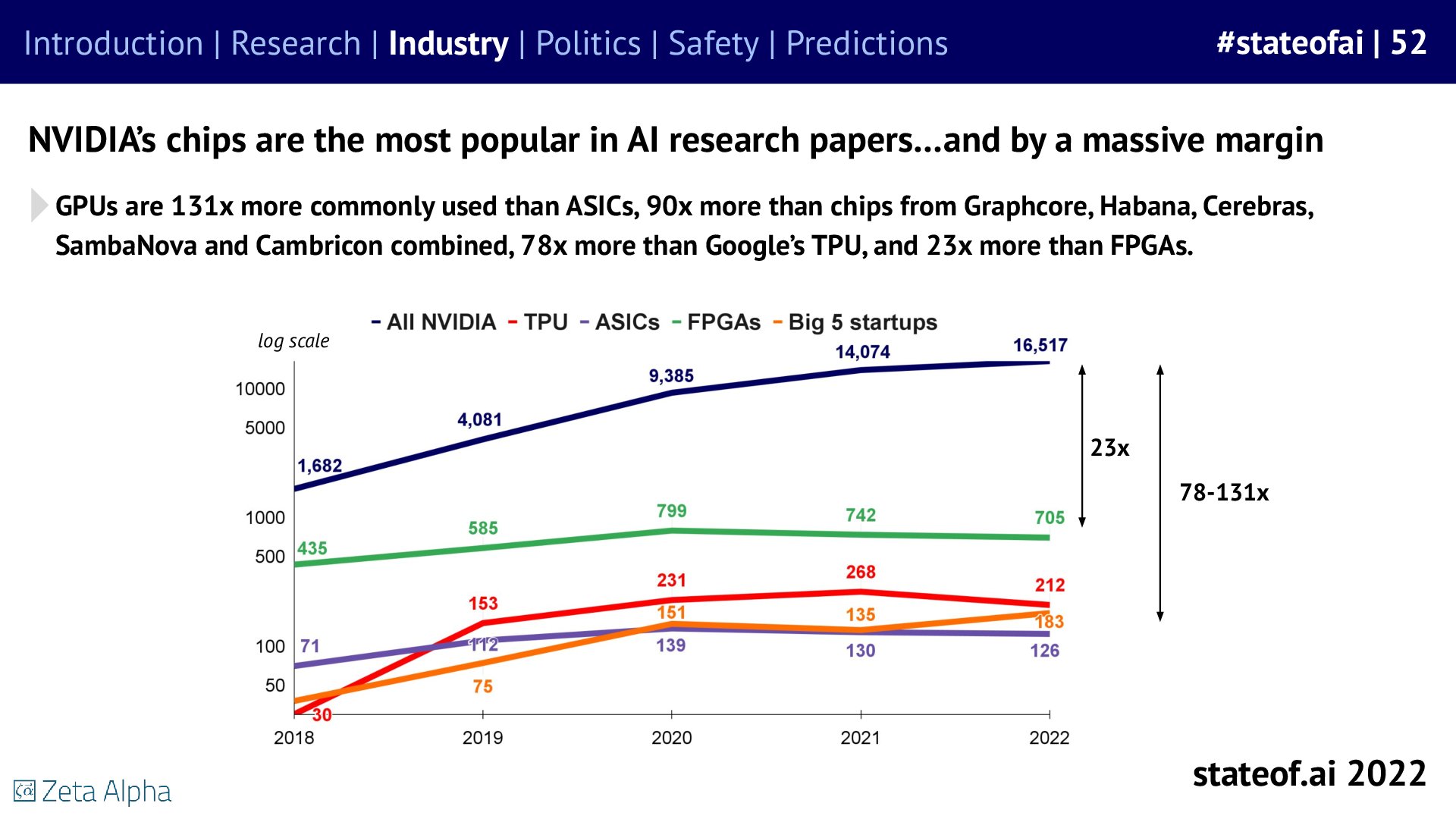
The report found GPUs used 78 times as often as Google TPUs and 90 times as often as chips from five named challengers combined in its research-paper analysis. This documented hardware mentions and usage in papers, not chip shipments or commercial market share.
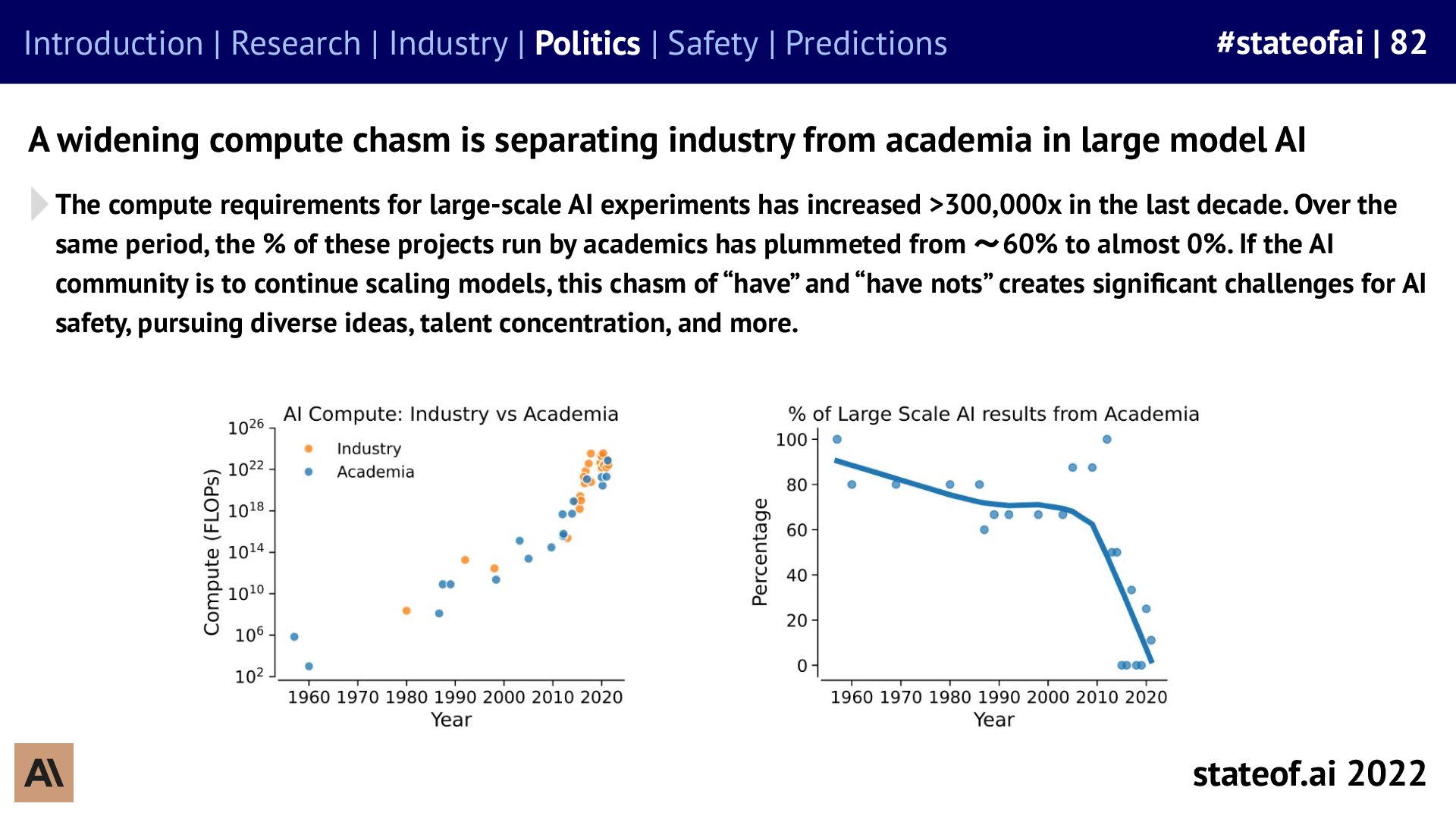
The report described a more than 300,000-fold increase in compute requirements for selected large-scale AI experiments over the prior decade. It connected this growth with a falling academic share of those projects, raising questions about public access to research infrastructure.
The hardware analysis looked at mentions or use in research papers, providing evidence about what researchers relied on. It was useful for understanding the ecosystem around an accelerator. It was not a direct measure of chips shipped, installed capacity, revenue, or utilization inside private data centers.
Evidence you can use
Compute in the 2022 report
Historical snapshot: October 2022. Dates and populations are specified per row.
Paper-based usage ratios are not sales or installed-capacity shares. The compute-growth estimate describes selected large experiments and should not be applied to every AI task.
It came from the report’s comparison of hardware use in research papers. It was not a ratio of accelerator revenue, global installed capacity, or performance per chip.
The report grouped Graphcore, Habana, Cerebras, SambaNova, and Cambricon for that comparison with GPU use. The denominator was the combined research-paper measure for those five vendors.
No. Research-paper visibility and private commercial deployment are different measures. The chart could not exhaustively describe workloads or customers that did not produce published research.
It described compute requirements for selected large-scale AI experiments over the prior decade. It was not an estimate of total worldwide electricity consumption or all AI workloads.
The report connected expensive large-scale experiments with a declining academic share of the selected projects. Access to funding and hardware constrained participation even when scientific ideas were publicly available.
In the report’s comparison, the academic share of the large-scale projects fell from around 60% to almost zero over the preceding decade. This concerned the selected large-compute experiments, not the share of all AI research performed at universities.
Historical snapshot published October 11, 2022. This web edition was prepared on 2026-10-11 from the online deck and original launch posts. Findings and forecasts retain their original time frame.
Benaich, Nathan, and Ian Hogarth. “Open research still depends on concentrated hardware.” State of AI Report 2022. Historical report snapshot; web edition prepared 2026-10-11.