Protein structure prediction takes a major step forward
By Nathan Benaich and Ian Hogarth · 2021 report
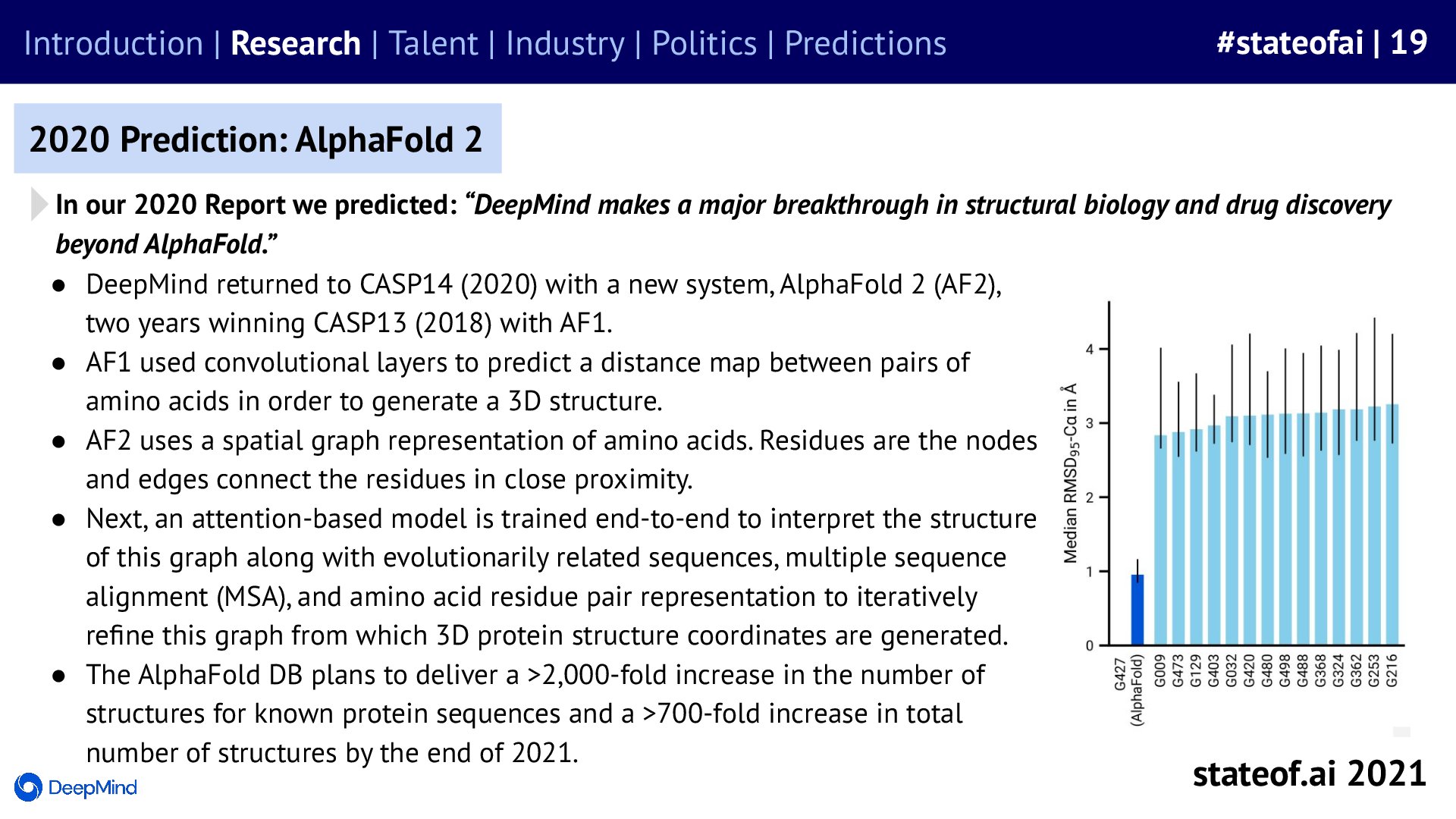
Protein shape helps explain biological function, but measuring structures experimentally is difficult. The 2021 report described AlphaFold 2 as a major advance in predicting structures and followed how related ideas quickly spread to academic systems.
AlphaFold 2 changes the structure-prediction approach
The system combined sequence information, relationships between residues, and attention-based processing to refine a predicted structure. The report described plans for a major expansion of available predicted structures. Predictions complemented experimental biology rather than replacing every experiment.
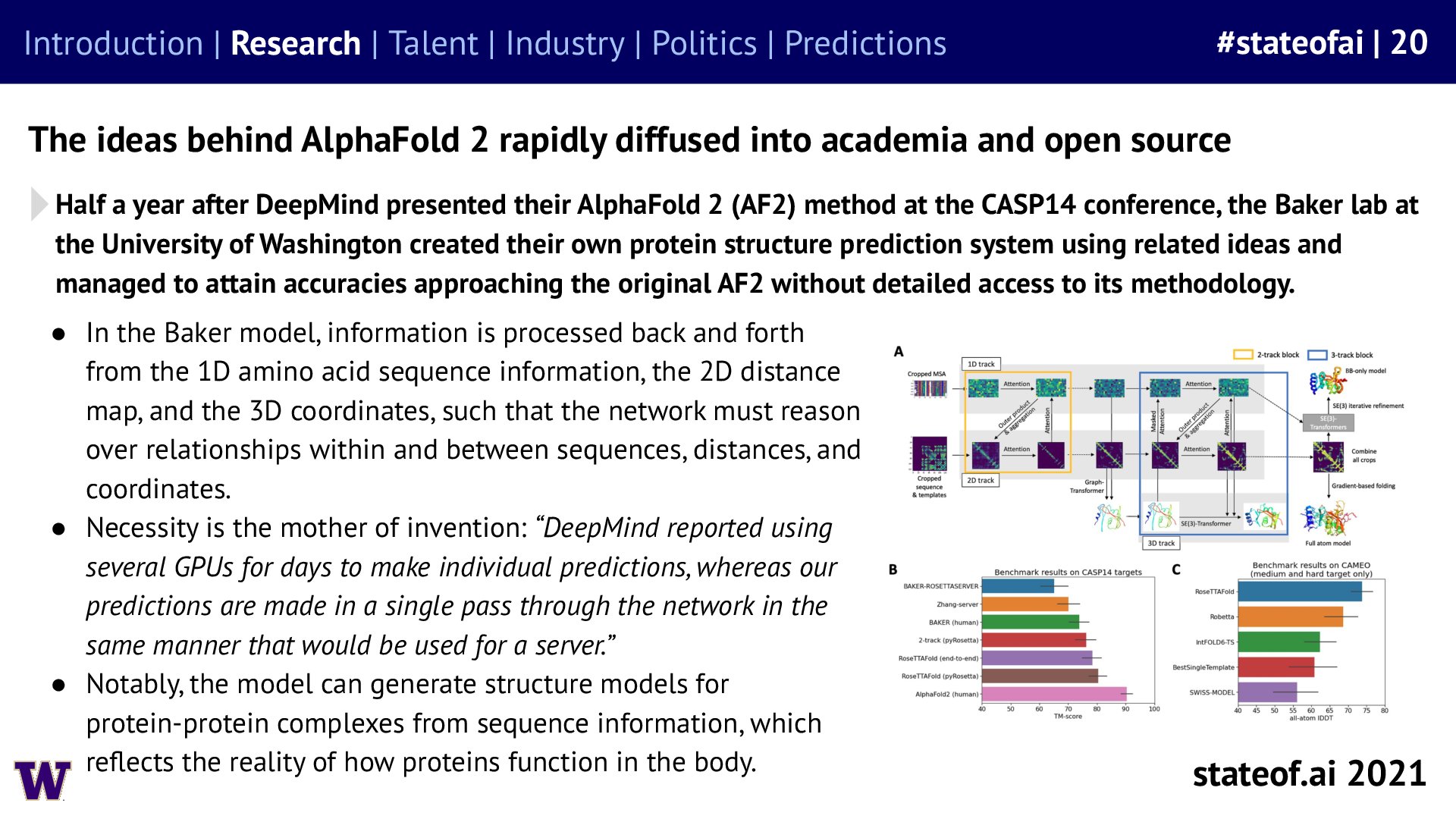
RoseTTAFold connects sequence, distance, and structure
The University of Washington team built a system that exchanged information between one-dimensional sequences, two-dimensional distance maps, and three-dimensional coordinates. It approached the original AlphaFold 2 performance without detailed access to that method and could model protein complexes.
Methods could spread beyond the first breakthrough
RoseTTAFold showed how related ideas could be developed by another research group after AlphaFold 2’s CASP14 result. Its joint treatment of sequence, pairwise relationships, and three-dimensional coordinates illustrated the technical direction. The significance was broader research access, not a claim that every biological problem had become tractable.
Evidence you can use
AI for science in the 2021 report
Historical snapshot: October 2021. Dates and populations are specified per row.
Structure prediction is distinct from experimentally proving a protein’s function or a drug’s benefit. This page describes the methods and evidence available in October 2021.
It substantially advanced protein-structure prediction using an attention-based system that integrated sequence and residue relationships, opening new possibilities for biological research.
It passed information between sequence, distance-map, and three-dimensional representations, allowing the model to reason across these views of a protein.
The report discussed AlphaFold 2’s performance at CASP14 in 2020. It was a major result reviewed in the 2021 edition, rather than a benchmark conducted for the first time in 2021.
The report described a shift toward predicting protein structure end to end, using evolutionary information and attention-based processing. It contrasted that with an earlier distance-prediction approach.
The report described using evolutionary relationships across sequences as part of the input to structure prediction. Those patterns helped inform the model’s estimate of a protein’s three-dimensional shape.
The report identified David Baker’s group at the University of Washington. It described the system as drawing on related ideas and making structure-prediction capabilities more widely available.
They represented the amino-acid sequence, pairwise relationships, and three-dimensional coordinates. Processing these together let information pass between different descriptions of the same protein.
No. Predicting molecular structure and showing that a treatment benefits patients are different kinds of evidence. The report’s examples concerned research tools and biological modeling.
Historical snapshot published October 12, 2021. This web edition was prepared on 2026-10-11 from the online deck and original launch posts. Findings and forecasts retain their original time frame.
Benaich, Nathan, and Ian Hogarth. “Protein structure prediction takes a major step forward.” State of AI Report 2021. Historical report snapshot; web edition prepared 2026-10-11.