The 2021 report included concrete deployments alongside research advances. A transformer-based forecast supported the UK electricity grid, and language models began appearing in developer workflows. The strongest examples measured an operational improvement or identified the specific work a model performed.
Better forecasts support the electricity control room
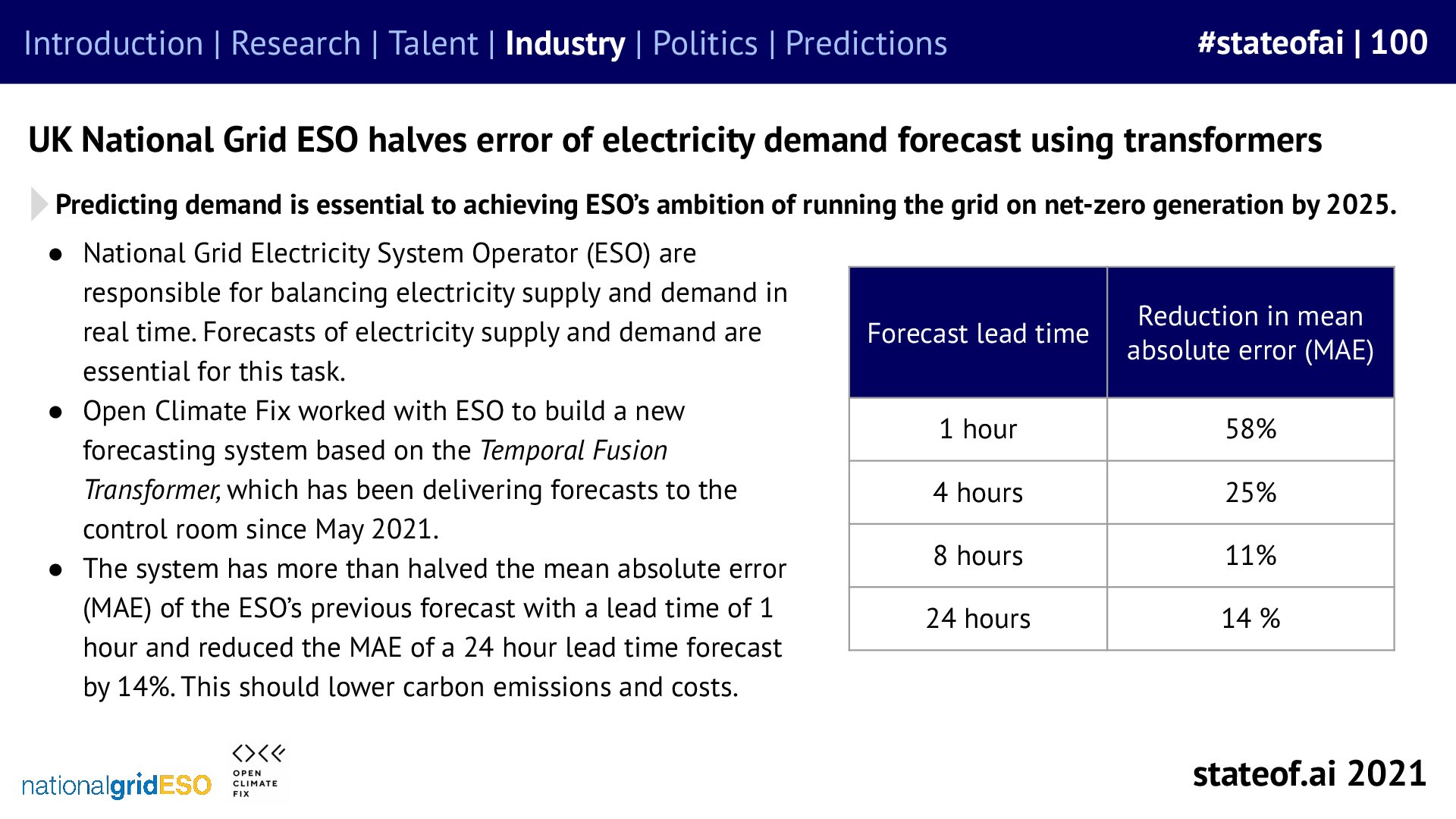
Open Climate Fix and National Grid ESO deployed a Temporal Fusion Transformer forecasting system. The report recorded a 58% reduction in mean absolute error at a one-hour lead time and 14% at 24 hours compared with the prior forecast. These were forecasting improvements, not measured reductions in electricity prices or emissions.
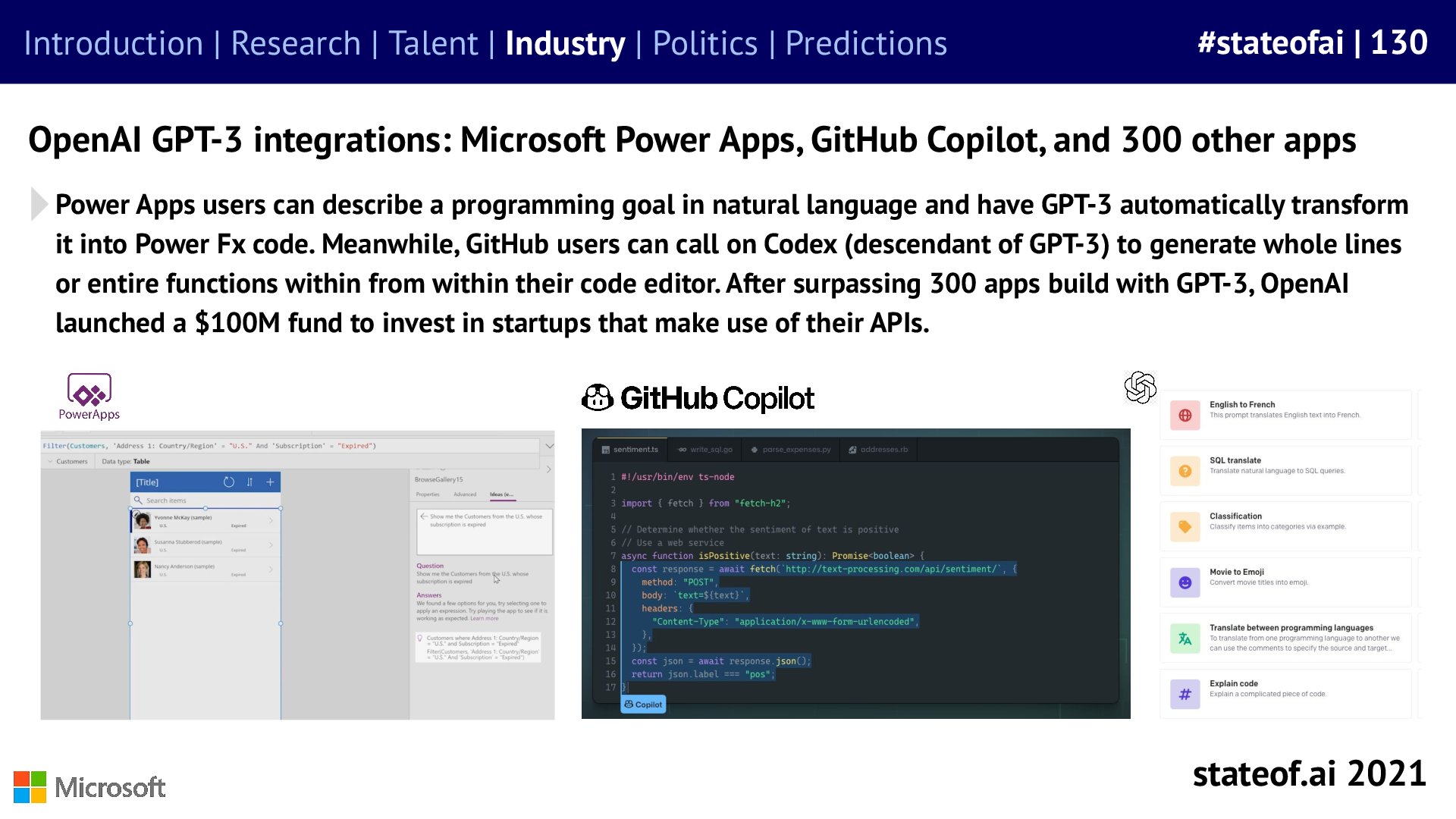
GPT-3 and Codex were integrated into products including Microsoft Power Apps and GitHub Copilot. The report described more than 300 GPT-3 applications. Integration showed a route from research to distribution, without proving that generated code was always correct.
Clinical applications combined prediction with measurement
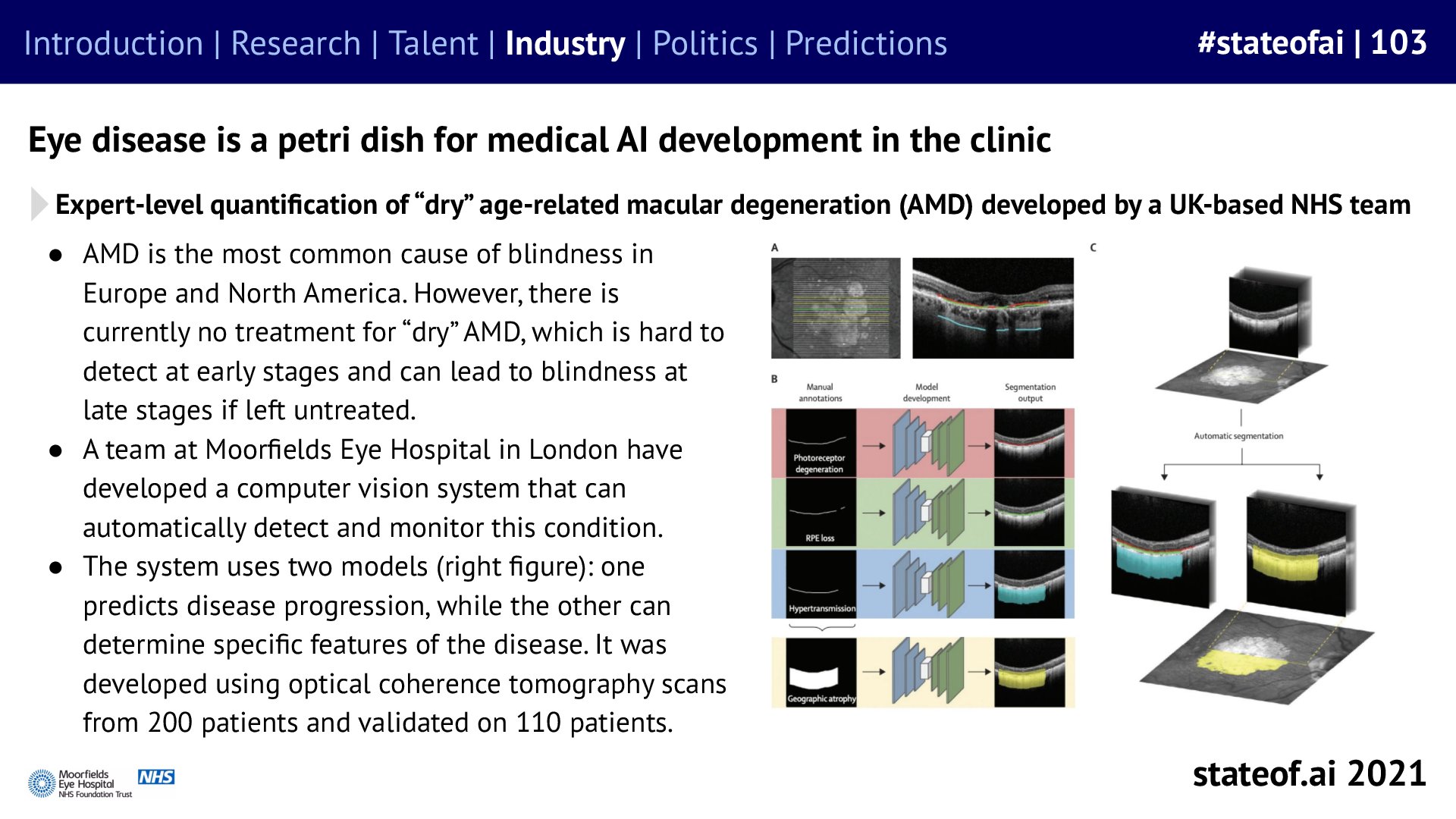
A Moorfields Eye Hospital team built a computer-vision system to detect and monitor dry age-related macular degeneration. One model predicted disease progression, while another measured features of the disease in optical coherence tomography scans. The report described development data from 200 patients and validation on 110 patients. That defined the evidence behind this particular clinical example.
Forecast error is not an emissions or cost-saving metric. Application counts are not paying-customer counts, and code-generation tools still require evaluation of their outputs.
It forecast electricity demand for National Grid ESO. The reported result concerned forecasting accuracy, rather than autonomous control of every part of the electricity system.
It reported reductions in mean absolute error against the previous forecast. That specifies both the measure and the baseline behind the claimed improvement.
They referred to different forecast lead times: 58% and 14% reductions in error, respectively. A result at one horizon should not be substituted for the result at another.
No. The report suggested that better forecasts could lower costs and emissions, but the stated percentages measured forecast error. They were not measured percentage reductions in carbon emissions.
The report highlighted Microsoft Power Apps and GitHub Copilot, alongside more than 300 applications built with GPT-3. These examples showed language-model capabilities reaching users through other software.
The report described a Moorfields system for dry age-related macular degeneration using optical coherence tomography scans. It was developed with data from 200 patients and validated on 110 patients, with separate models for progression and disease features.
Historical snapshot published October 12, 2021. This web edition was prepared on 2026-10-11 from the online deck and original launch posts. Findings and forecasts retain their original time frame.
Benaich, Nathan, and Ian Hogarth. “AI becomes part of operational infrastructure.” State of AI Report 2021. Historical report snapshot; web edition prepared 2026-10-11.