All topicsSTATE OF AI REPORT. 2020

The 2020 forecasts, in their original form

The pandemic-year forecasts covered model scale, vision transformers, drug discovery, defense startups, and the proposed NVIDIA-Arm deal. These are historical forecasts made at publication, not new predictions or retrospective claims of success.

Questions in this section

What did the 2020 report predict?Are these predictions graded on this page?How large did the report predict language models would become?What shift did the report predict for attention-based networks?What did the defense-startup forecast specify?What would satisfy the AI drug-discovery financing forecast?What did the report predict about NVIDIA and Arm?Were all eight predictions about model performance?

The original conditions define the call

The report published 8 predictions for the next twelve months. Several combined a technical or commercial development with a threshold, deadline, or named group of organizations. Those details matter: an event that meets only part of a prediction should not silently count as the whole outcome.
The original conditions define the call - 2020 report, PDF page 172
The original conditions define the call. 2020 report, PDF page 172

Keep forecasts separate from later grading

The complete list below preserves the wording of the original report, with PDF line breaks removed. The predictions scorecard provides subsequent assessment separately. This archive keeps the original publication-time claim visible so readers can compare it with later evidence.

A forecast can be specific without being certain

The 2020 list named technologies, organizations, financing thresholds, and a proposed acquisition. Those details made the predictions easier to assess later. They should remain visible even when subsequent events make a forecast look unusually prescient or clearly mistaken.

The eight forecasts, as published

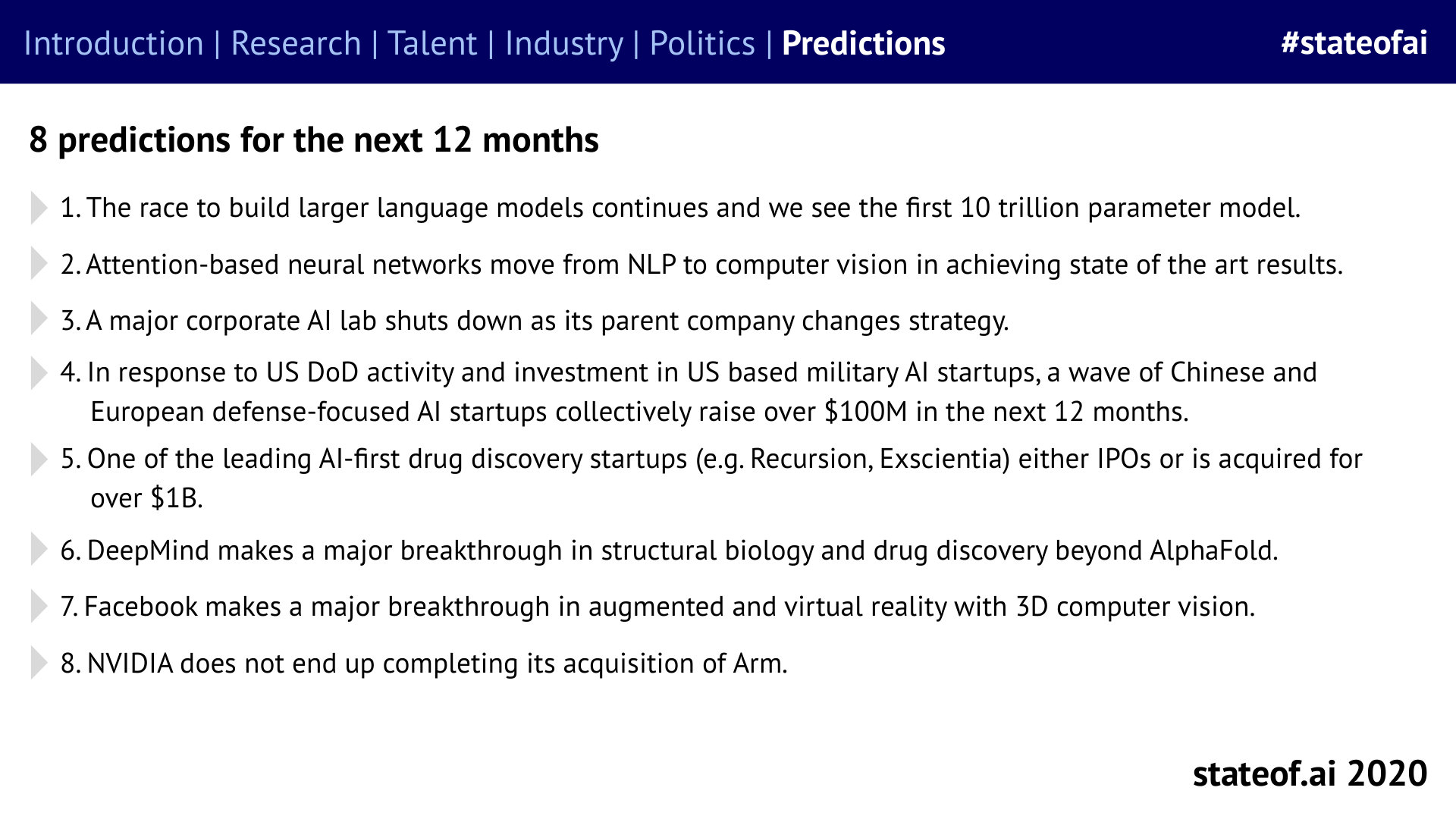
  1. The race to build larger language models continues and we see the first 10 trillion parameter model.
  2. Attention-based neural networks move from NLP to computer vision in achieving state of the art results.
  3. A major corporate AI lab shuts down as its parent company changes strategy.
  4. In response to US DoD activity and investment in US based military AI startups, a wave of Chinese and European defense-focused AI startups collectively raise over $100M in the next 12 months.
  5. One of the leading AI-first drug discovery startups (e.g. Recursion, Exscientia) either IPOs or is acquired for over $1B.
  6. DeepMind makes a major breakthrough in structural biology and drug discovery beyond AlphaFold.
  7. Facebook makes a major breakthrough in augmented and virtual reality with 3D computer vision.
  8. NVIDIA does not end up completing its acquisition of Arm.

2020 report, PDF page 172. See the predictions scorecard for subsequent grading.

Evidence you can use

Predictions in the 2020 report

Historical snapshot: October 2020. Dates and populations are specified per row.

Predictions in the 2020 report
MeasureReported valueDefinition and source
Number of original forecasts8Count of the numbered predictions on the source slide.2020 report, PDF page 172
Forecast horizonNext 12 monthsHorizon stated on the original prediction slide.2020 report, PDF page 172

Forecasts are prospective statements, not observed results. Preserve every threshold, named condition, and time window when grading. Original spelling is retained; PDF line wrapping and typographic ligatures are normalized.

Frequently asked questions

What did the 2020 report predict?

The pandemic-year forecasts covered model scale, vision transformers, drug discovery, defense startups, and the proposed NVIDIA-Arm deal. It published 8 forecasts for the next twelve months; the complete original list appears on the predictions topic page.

Source: 2020 report, PDF page 172.

Sources and dates

Historical snapshot published October 1, 2020. This web edition was prepared on 2026-10-11 from the online deck and original launch posts. Findings and forecasts retain their original time frame.

  1. 2020 report, PDF page 172Original 2020 report. This edition has no printed slide numbers. References use one-based PDF pages.
  2. State of AI Report 2020: online slides
  3. Nathan Benaich’s launch essayOctober 1, 2020.

Cite this page

Benaich, Nathan, and Ian Hogarth. “The 2020 forecasts, in their original form.” State of AI Report 2020. Historical report snapshot; web edition prepared 2026-10-11.