AI policy becomes a question of deployment and supply chains
By Nathan Benaich and Ian Hogarth · 2020 report
The 2020 report connected AI policy to concrete systems: police facial recognition and the semiconductor supply chain. Both exposed dependencies beyond the model itself, including institutional decisions, manufacturing capacity, and cross-border relationships.
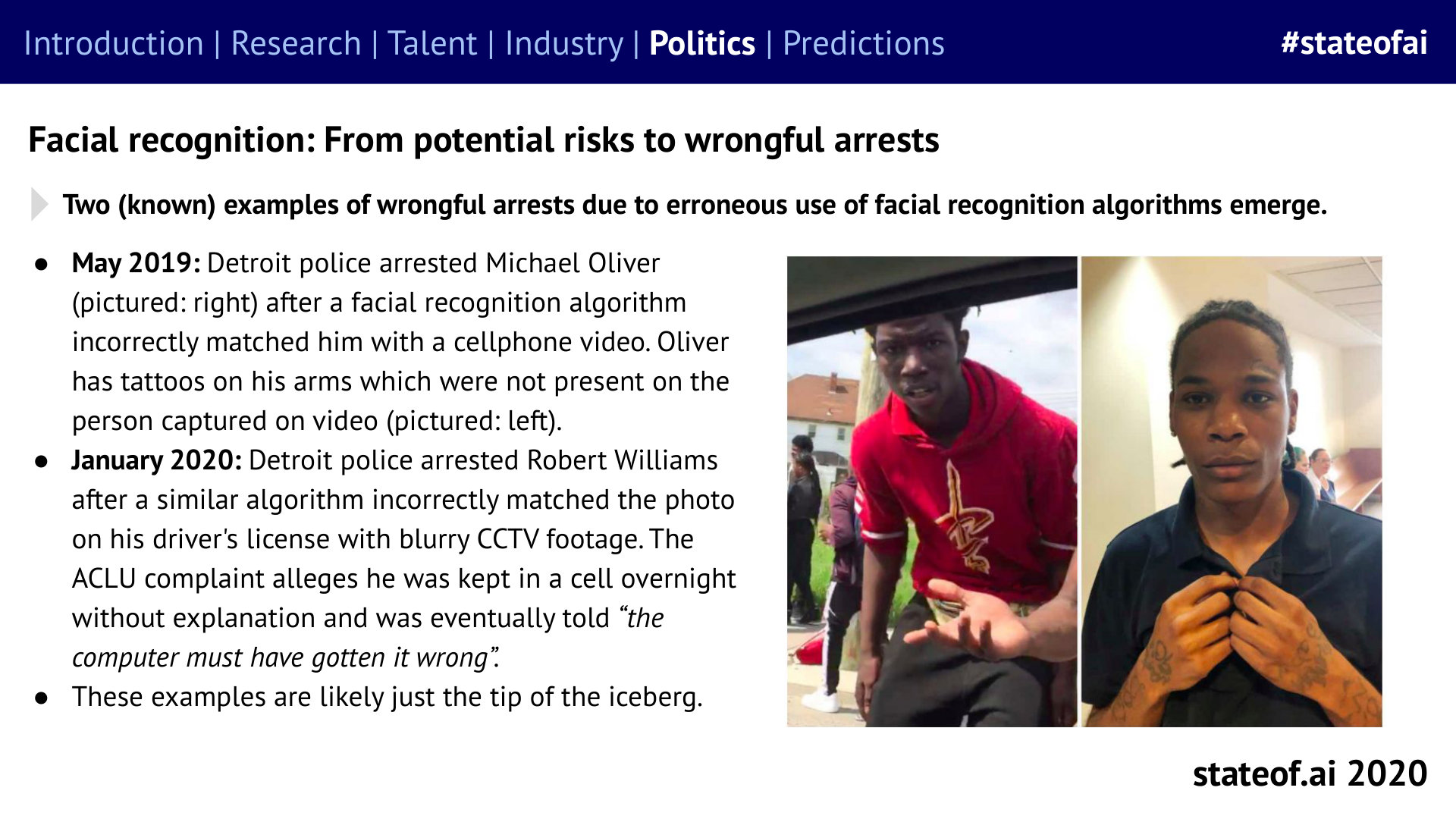
The report described wrongful arrests following incorrect facial-recognition matches. These examples showed why deployment procedures, human review, and accountability mattered alongside algorithmic performance. They were documented cases rather than an estimate of the overall wrongful-arrest rate.
The report highlighted TSMC’s importance to US technology companies and its announced $12 billion Arizona factory. It also noted that leading future manufacturing capabilities would remain in Taiwan. An investment announcement did not remove the existing concentration of advanced chip production.
The report described US reliance on advanced semiconductor manufacturing alongside TSMC’s substantial sales to US customers. That made the relationship more complex than a one-way dependency. Announced investment in Arizona was relevant to diversification, but an announcement did not mean production capacity was already available.
Evidence you can use
Politics in the 2020 report
Historical snapshot: October 2020. Dates and populations are specified per row.
This page describes the 2020 policy context, not current law or factory status. Selected cases cannot establish population rates; announced capital plans are distinct from completed capacity.
No. They were documented examples discussed in the report. They showed the potential consequences of erroneous recognition without providing an exhaustive count or a representative rate.
In the reported cases, incorrect identification contributed to wrongful arrests. That connected a technical error to a consequential decision about a person, rather than an isolated mistake on a test set.
The 2020 report described a planned 5-nanometer factory, with production intended to start in 2024. It contrasted that plan with the more advanced 3-nanometer process expected to begin production in Taiwan. These were the schedules and plans reported at the time.
No. The report described a $12 billion investment announcement and a future production plan. Announced capacity and available manufacturing output were different measures.
The report said US customers accounted for 60% of TSMC’s sales. It used the figure to illustrate mutual dependence between the US technology industry and the Taiwanese manufacturer.
No. The report still described TSMC’s technological edge as remaining in Taiwan. A planned overseas facility did not imply that the most advanced manufacturing capability had immediately relocated.
Historical snapshot published October 1, 2020. This web edition was prepared on 2026-10-11 from the online deck and original launch posts. Findings and forecasts retain their original time frame.
2020 report, PDF page 133Original 2020 report. This edition has no printed slide numbers. References use one-based PDF pages.
2020 report, PDF page 155Original 2020 report. This edition has no printed slide numbers. References use one-based PDF pages.
Benaich, Nathan, and Ian Hogarth. “AI policy becomes a question of deployment and supply chains.” State of AI Report 2020. Historical report snapshot; web edition prepared 2026-10-11.