The 2020 report highlighted two different stages of AI-assisted drug discovery: finding promising activity in preclinical experiments and advancing an AI-designed candidate into a human trial. Both mattered, but neither was equivalent to an approved treatment.
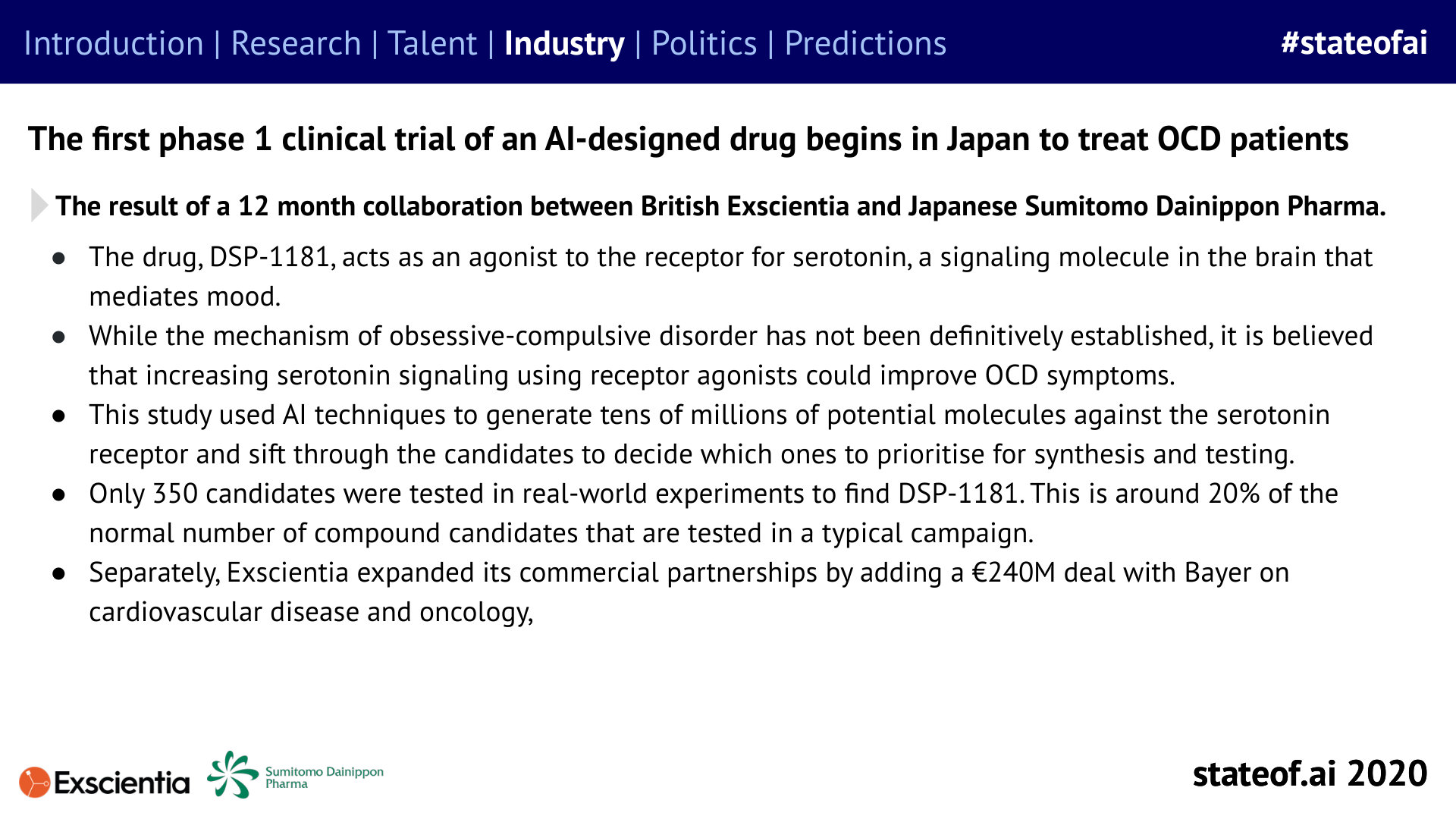
Exscientia and Sumitomo Dainippon Pharma advanced DSP-1181 into a trial for obsessive-compulsive disorder in Japan. The report described a 12-month collaboration and 350 experimentally tested candidates. The milestone was entry into clinical testing, not proof of clinical benefit.
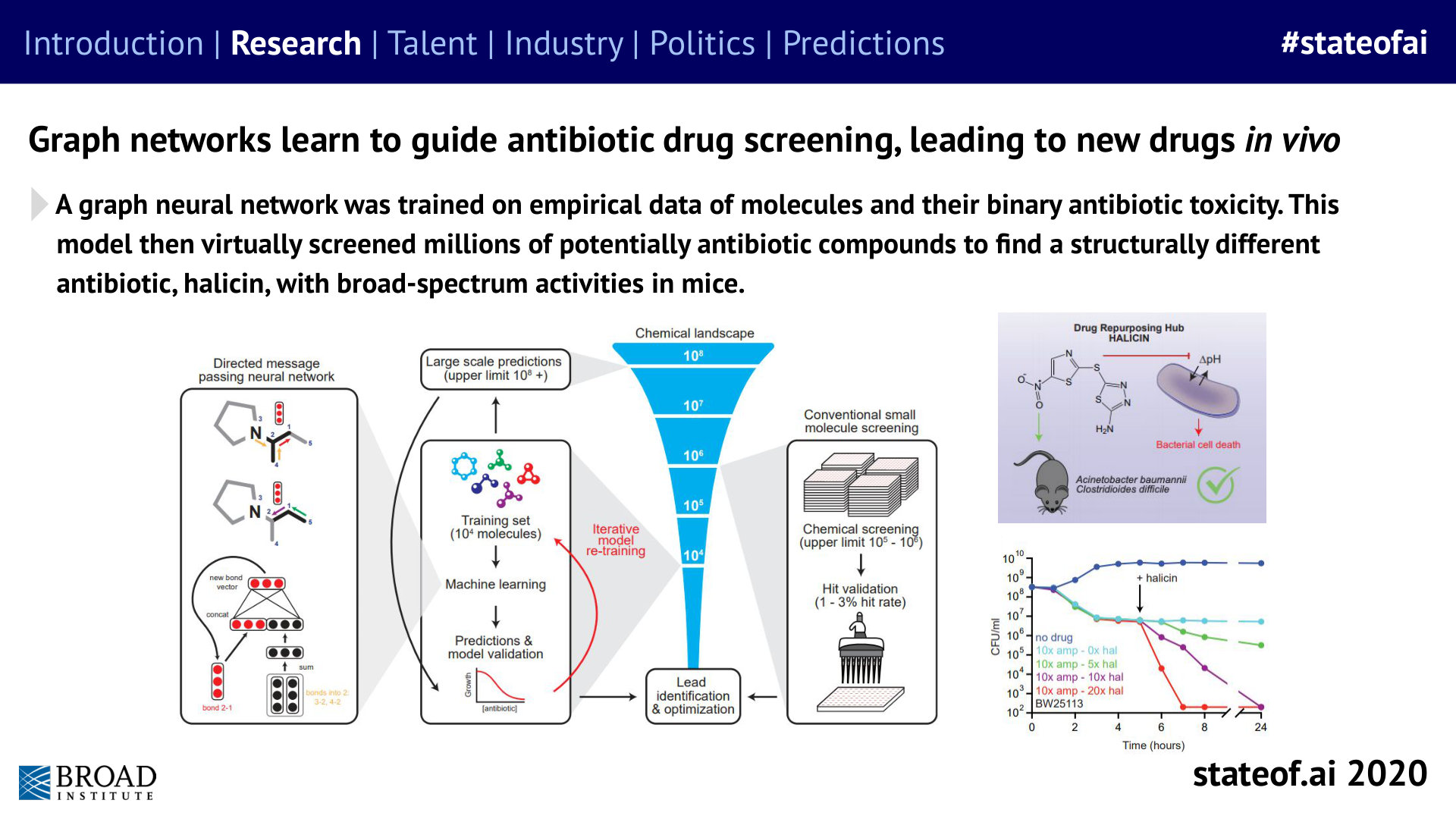
A graph neural network trained on molecular activity data helped screen millions of compounds and identify halicin. The report described broad-spectrum activity in mice. This was preclinical evidence and still left the substantial work needed to establish safety and efficacy in people.
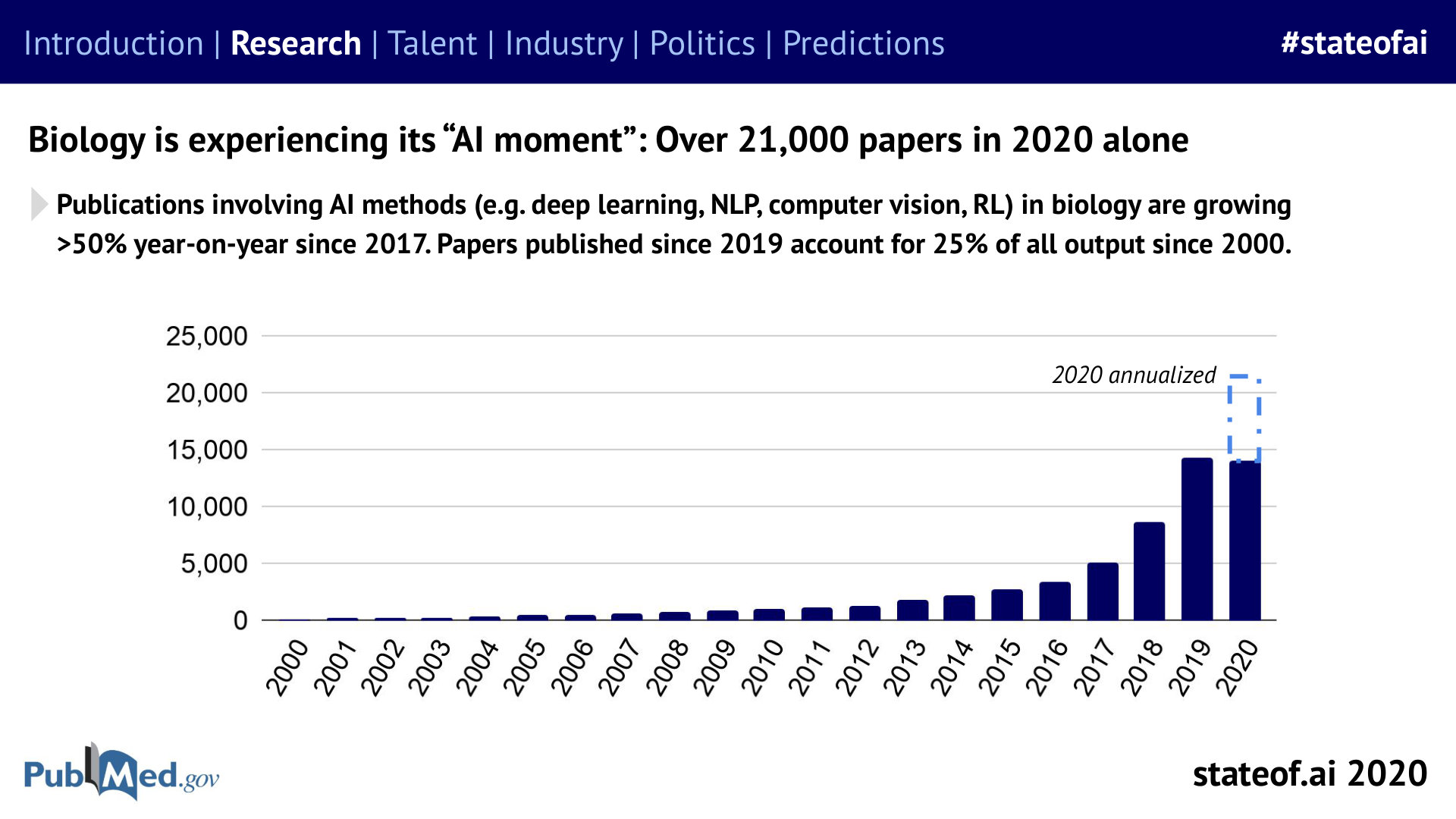
The report’s annualized estimate put biology publications using AI methods above 21,000 in 2020. It reported growth above 50% a year since 2017, covering methods such as deep learning, NLP, computer vision, and reinforcement learning. This measured the spread of a research toolkit across biology. It complemented individual discovery examples without establishing that every paper produced a validated biological result.
Discovery speed is specific to the reported campaign and does not establish a general reduction in drug-development time. Trial entry and animal activity are distinct stages; neither implies regulatory approval.
DSP-1181 entered a Phase 1 clinical trial in Japan. The report presented this as a milestone for AI-assisted discovery, not as an approved or proven treatment.
The report identified Exscientia and Sumitomo Dainippon Pharma. It described a twelve-month collaboration leading to the candidate entering a phase 1 trial in Japan.
The report cited 350 candidates. That number described the discovery campaign’s experimental testing, rather than the number of patients in a trial or approved medicines produced.
The report described it as a candidate for obsessive-compulsive disorder. The page reported entry into early clinical testing rather than establishing therapeutic benefit.
No. Trial entry was a development milestone. Testing whether the candidate benefited patients was still ahead, and the report noted that the underlying mechanism of obsessive-compulsive disorder had not been definitively established.
The report described a graph-network approach that helped identify a compound with antibacterial activity, including results in mice. It showed a route from model-based screening to experimental follow-up.
The report estimated more than 21,000 publications for 2020 on an annualized basis and growth above 50% year over year since 2017. The measure covered publications using AI methods; it did not count approved therapies or independently validated discoveries.
Historical snapshot published October 1, 2020. This web edition was prepared on 2026-10-11 from the online deck and original launch posts. Findings and forecasts retain their original time frame.
2020 report, PDF page 30Original 2020 report. This edition has no printed slide numbers. References use one-based PDF pages.
2020 report, PDF page 41Original 2020 report. This edition has no printed slide numbers. References use one-based PDF pages.
2020 report, PDF page 83Original 2020 report. This edition has no printed slide numbers. References use one-based PDF pages.
Benaich, Nathan, and Ian Hogarth. “AI-designed molecules reach clinical testing.” State of AI Report 2020. Historical report snapshot; web edition prepared 2026-10-11.