The first report organized commercial AI around practical tasks. Drug design, inventory planning, picking, and inspection each offered a different way to apply learning systems. The opportunity depended on improving a real workflow, not simply adding a model to a product.
Drug discovery creates several distinct opportunities
The report described both designing new compounds and finding new uses for existing drugs. Models could help prioritize molecules, propose combinations, or plan synthesis. These were routes to improving discovery, with experiments and clinical development still needed to establish whether a candidate worked.
Warehouse software and robots solve different problems
Machine learning in warehouse management could improve inventory, picking orders, and queues. Robots and drones addressed physical picking, packing, and inspection. The report distinguished better operational decisions from automating the physical work itself.
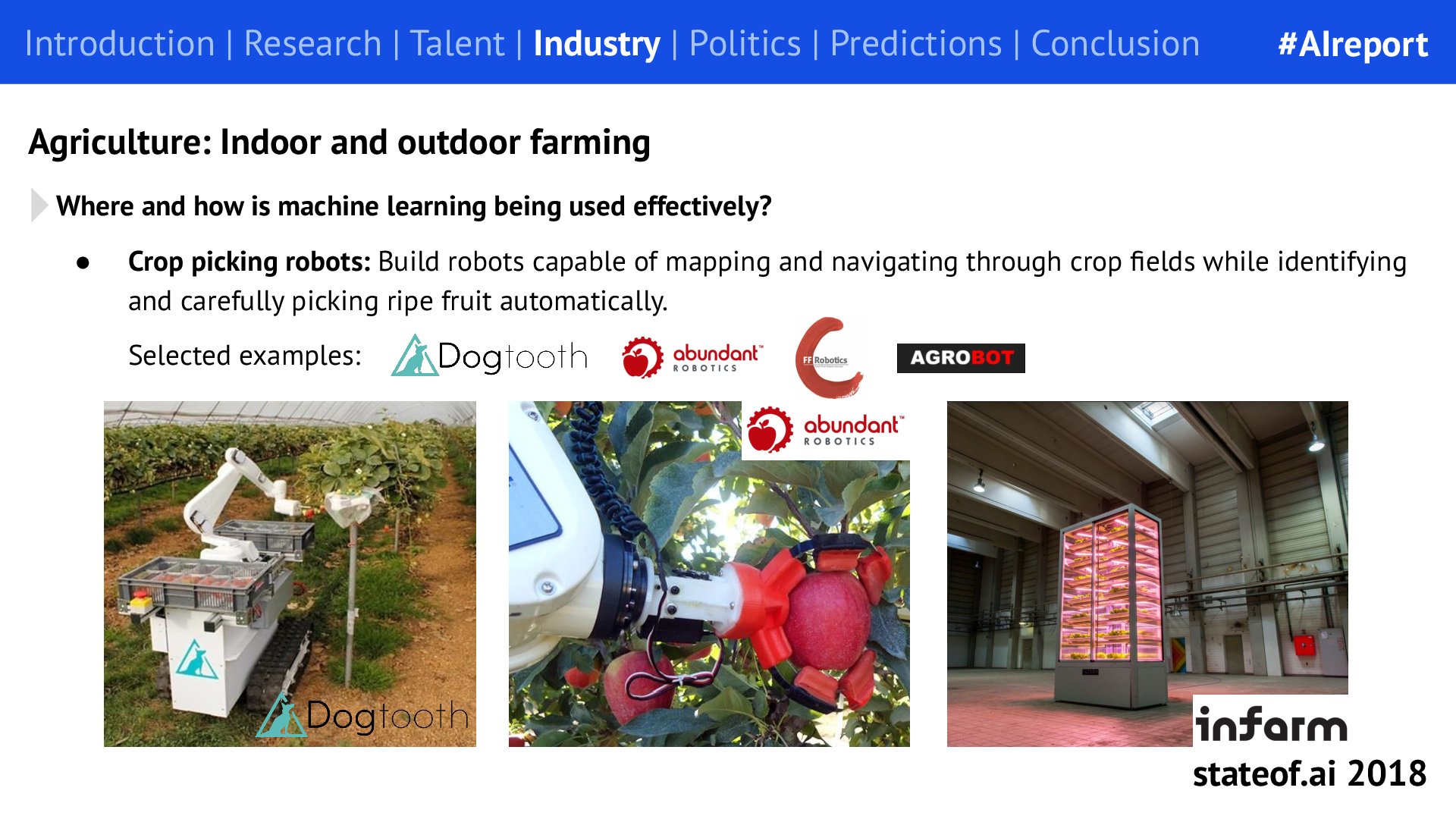
Agriculture tested perception and manipulation together
Crop-picking robots had to combine several capabilities: map a field, navigate through it, identify ripe fruit, and handle the crop carefully. The report used this application to show why physical automation required more than recognizing an object in a photograph. The machine also had to move and act in an environment that varied from one plant to the next.
This is a qualitative application map. It does not quantify adoption, revenue, clinical success, or labor displaced. Company examples in the original slides were illustrative.
The report mapped applications including drug discovery and warehouse automation. It distinguished software that improved decisions from robots that performed physical tasks.
Design sought new molecules with useful properties. Repurposing sought new uses for existing drugs by looking for relationships in biological and clinical data. The report treated them as separate application families.
Yes. The report discussed learning both molecular structures and the stepwise process of synthesizing molecules. It also described using models to improve existing drugs, generate new compounds, or propose combinations.
The report described learning connections among drugs, biological pathways, conditions, and side effects. These relationships could help identify new uses for existing drugs and guide further testing.
The report listed inventory management, picking, queue management, and inventory sequencing among the software tasks. These concerned organizing operations rather than necessarily performing the physical work.
Picking, packing, and inspection were examples of physical workflows discussed in the report. They complemented, rather than replaced, software for planning and managing warehouse operations.
The robot had to navigate a field, identify ripe fruit, and pick it carefully. The report presented these as linked requirements for automated harvesting, rather than treating image recognition alone as a complete solution.
Historical snapshot published June 29, 2018. This web edition was prepared on 2026-10-11 from the online deck and original launch posts. Findings and forecasts retain their original time frame.
2018 report, PDF page 75Original 2018 report. This edition has no printed slide numbers. References use one-based PDF pages.
2018 report, PDF page 92Original 2018 report. This edition has no printed slide numbers. References use one-based PDF pages.
2018 report, PDF page 100Original 2018 report. This edition has no printed slide numbers. References use one-based PDF pages.
Benaich, Nathan, and Ian Hogarth. “AI moves into industry-specific workflows.” State of AI Report 2018. Historical report snapshot; web edition prepared 2026-10-11.