STATE OF AI REPORT 2018.
The most widely read and trusted analysis of key developments in AI.

Explore the full report
The foundations of the modern AI industry
The inaugural State of AI Report examined a field moving from research demonstrations into products. Transfer learning made models easier to adapt, specialized chips accelerated training, and a small pool of researchers drew intense competition. Governments were beginning to treat AI and semiconductors as strategic assets, while the economic effects of automation remained uncertain.
Published on June 29, 2018, this edition captures what we knew then. The findings and predictions below retain that historical perspective.
Read the original Stories from Air Street launch essay, or explore the 2018 report by topic.
Let’s dive into the key stories.
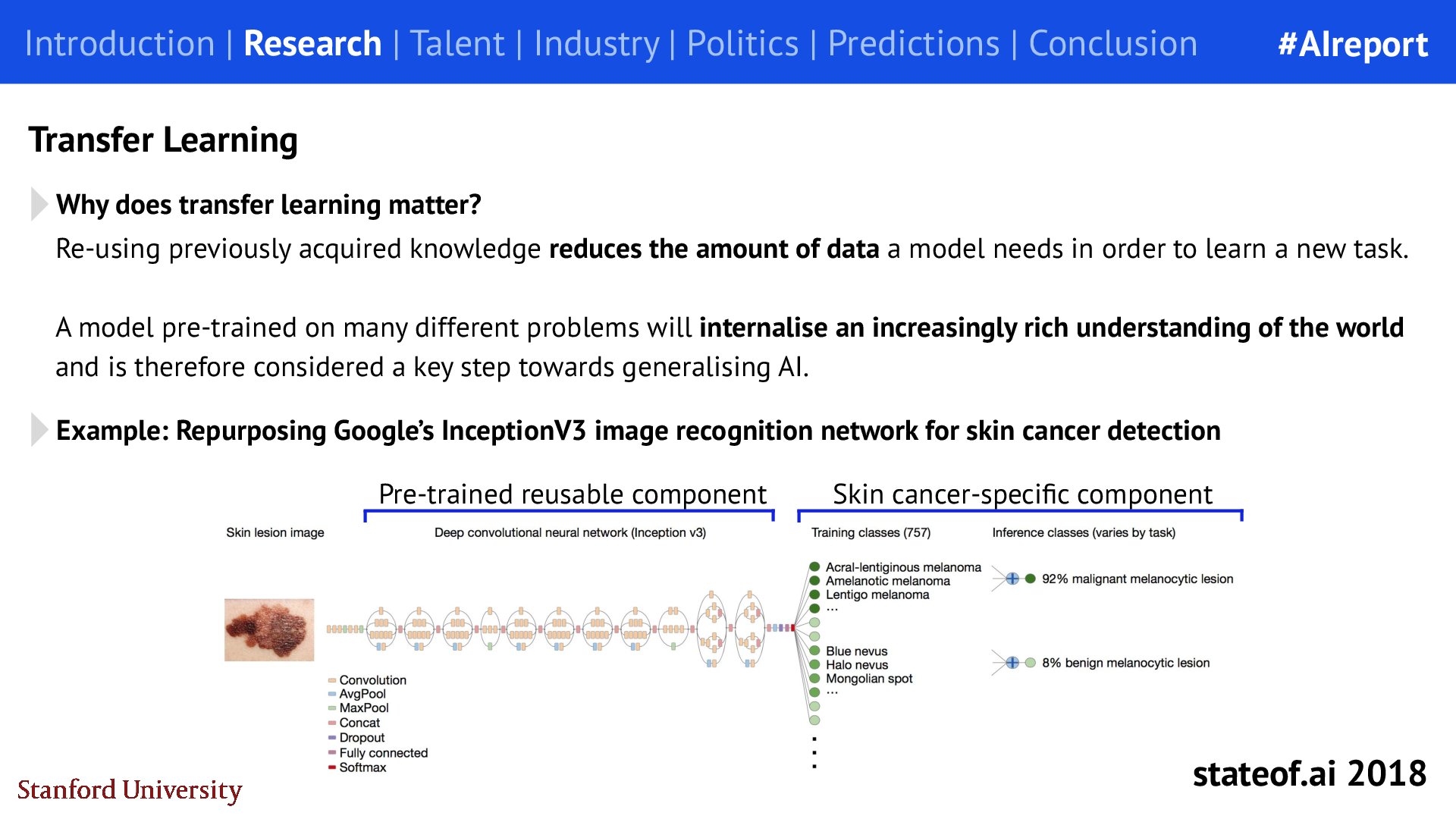
Learning once, adapting to new tasks
A model trained for one task need not start from scratch on the next. The 2018 report explained how reusing learned features could reduce the data required for new applications. Alongside this progress, experiments in games and attacks on image classifiers showed how uneven machine intelligence remained.
AlphaZero illustrated a different starting point from transfer learning: a system could improve by playing against itself instead of learning from historical human games. The report described a single neural network predicting moves and the chance of winning from a board position. Its success in Go showed what learning from experience could achieve in a game with clear rules and feedback.
Hardware becomes a constraint on AI progress
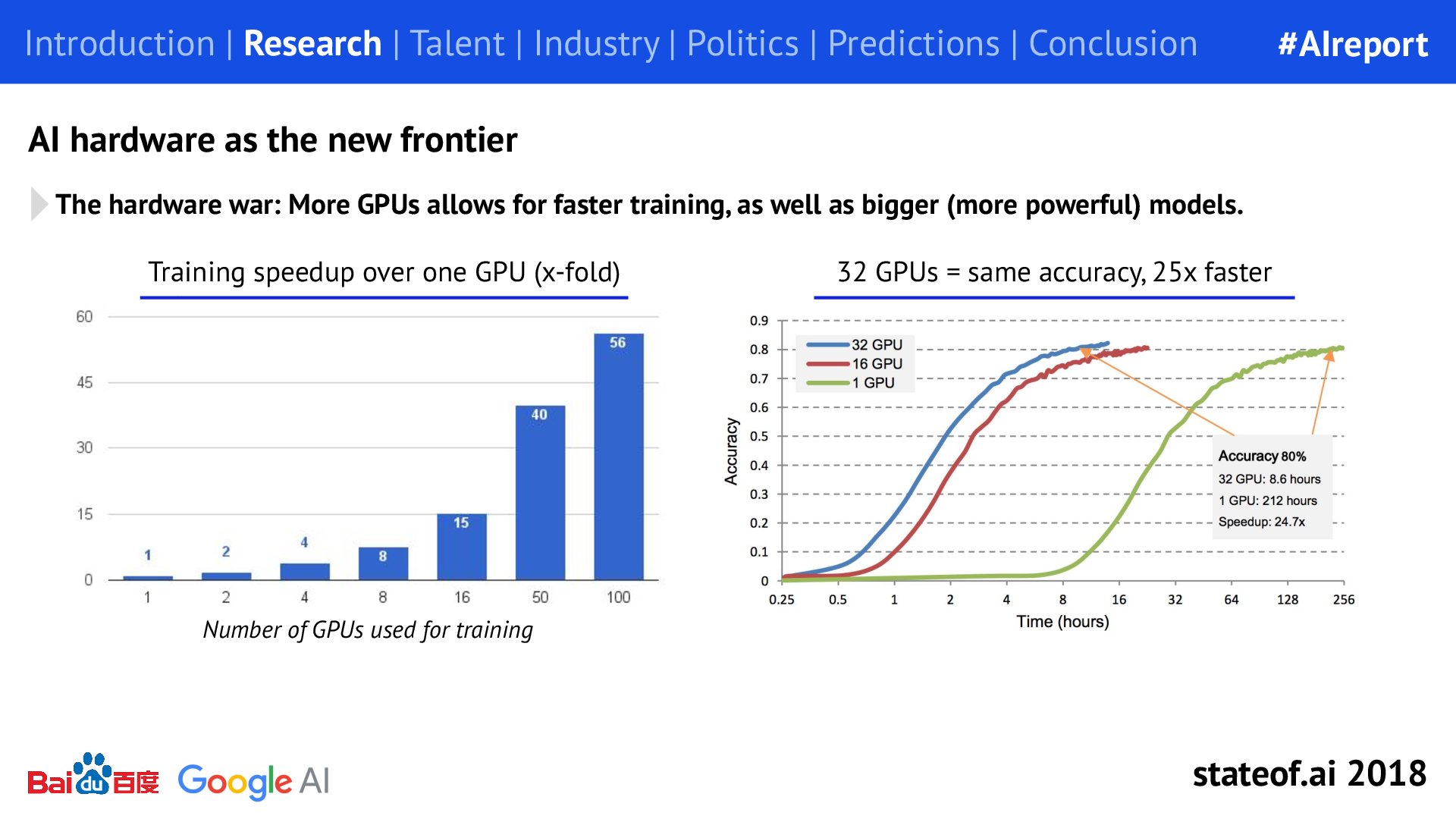
Training speed affected which experiments researchers could afford to run. The 2018 report followed the rise of GPUs and specialized accelerators, emphasizing that more expensive hardware could still be cheaper overall if it finished a training job sooner.
NVIDIA’s data-center business had passed a $2 billion revenue run rate and was growing more than 100% year over year in the report’s snapshot. It accounted for almost 20% of group revenue. These figures showed the commercial importance of data-center workloads alongside the technical comparisons of training speed and cost.
A small research community attracts intense competition
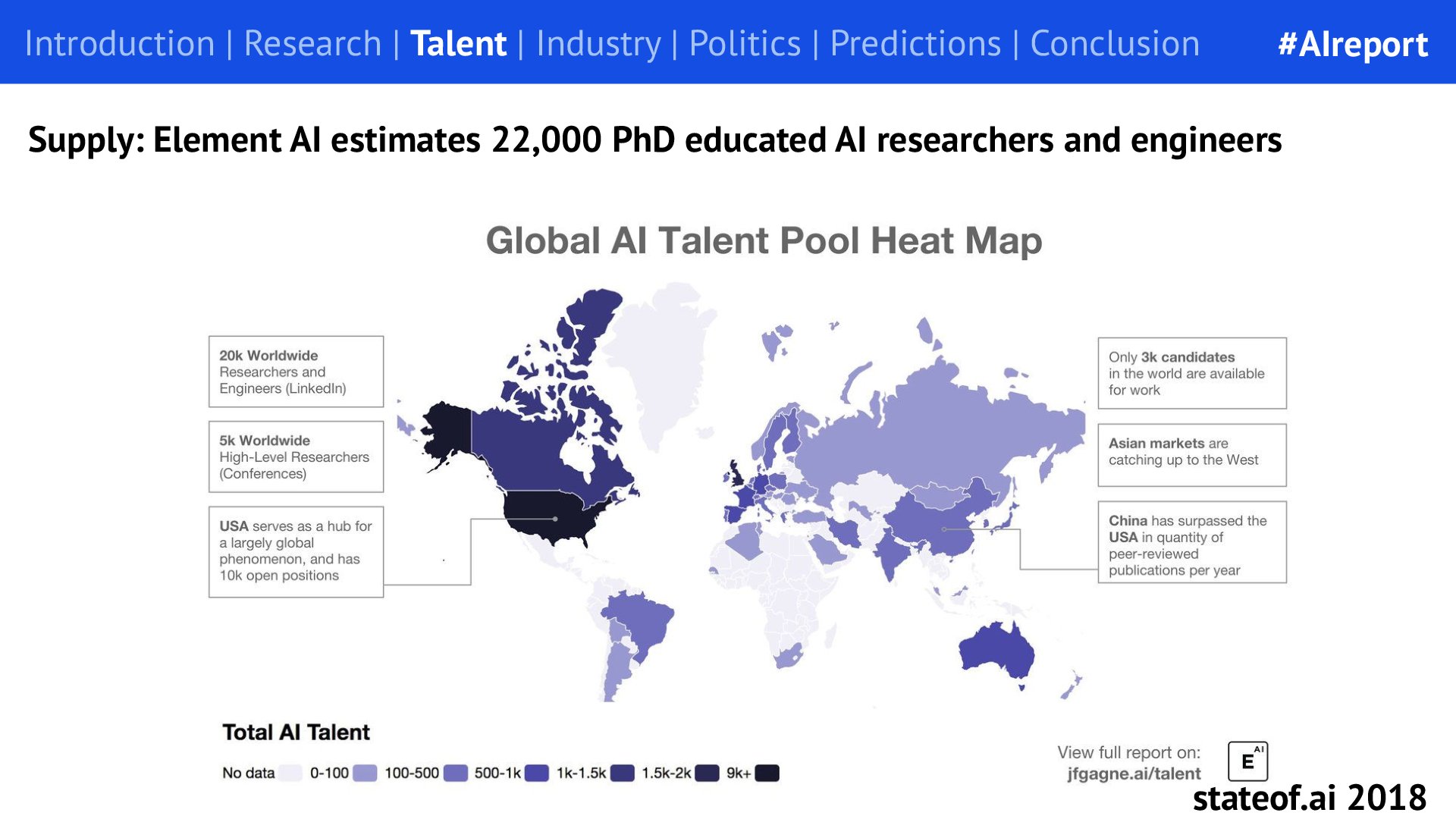
The 2018 report portrayed AI expertise as scarce and unevenly distributed. Large technology companies competed for researchers, and their presence in leading conferences illustrated their influence. The available diversity statistics covered only a limited view of the community.
The 6.3% figure used accepted ICML papers as its denominator and asked whether a Google or DeepMind author appeared on them. It captured one form of institutional influence. It did not count the entire AI workforce or establish how many researchers worked exclusively for those organizations.
AI moves into industry-specific workflows
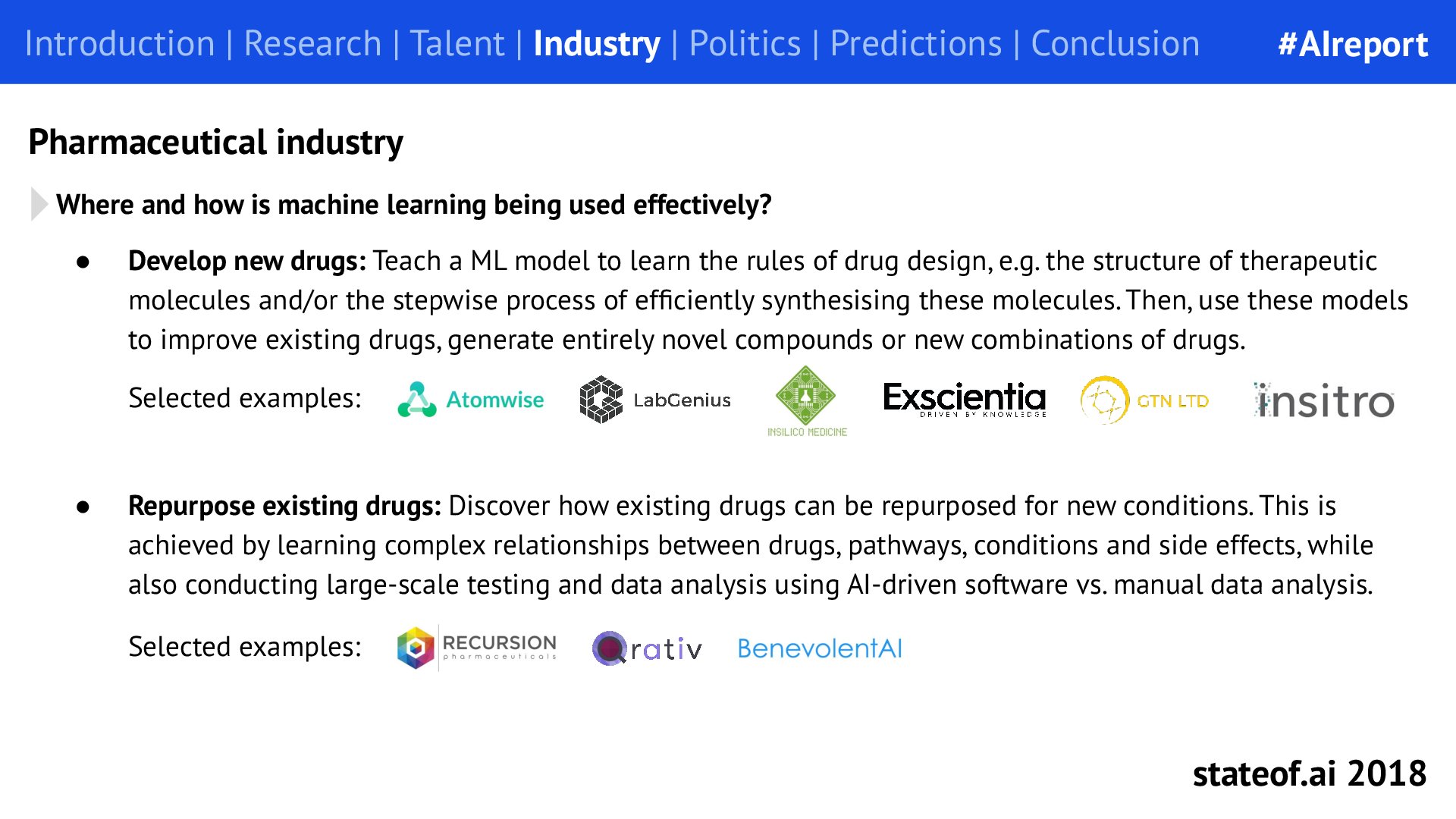
The first report organized commercial AI around practical tasks. Drug design, inventory planning, picking, and inspection each offered a different way to apply learning systems. The opportunity depended on improving a real workflow, not simply adding a model to a product.
Crop-picking robots had to combine several capabilities: map a field, navigate through it, identify ripe fruit, and handle the crop carefully. The report used this application to show why physical automation required more than recognizing an object in a photograph. The machine also had to move and act in an environment that varied from one plant to the next.
AI becomes a subject of national strategy
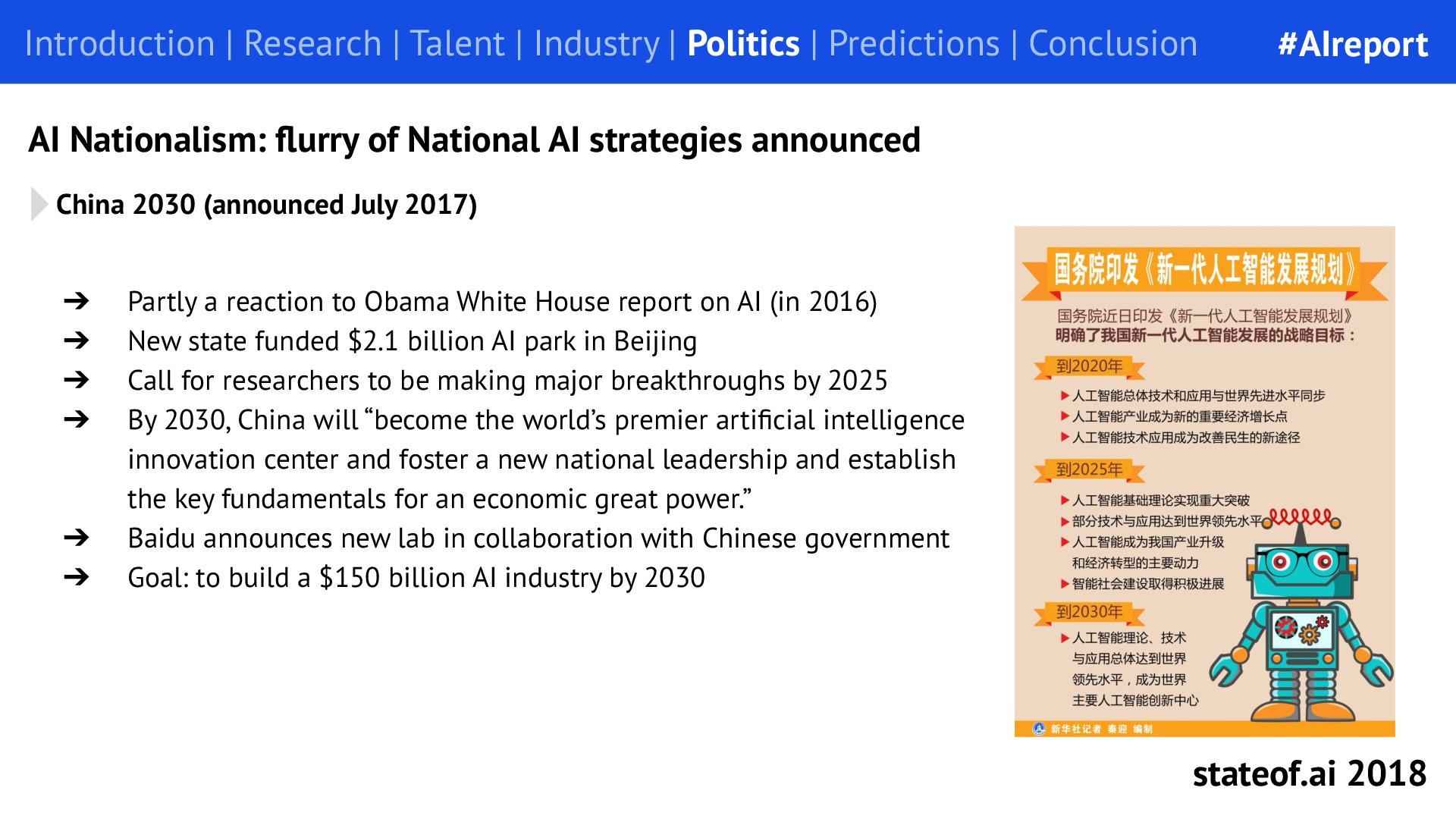
By 2018, governments were presenting AI as a source of economic and strategic advantage. National plans combined funding, skills, and industrial ambitions. The report also asked a more difficult question: how much of the changing labor market could actually be attributed to automation?
The report explicitly placed automation alongside globalization, financialization, consolidation, and demographic change when discussing work. That framing matters when reading historical forecasts: an observed labor-market change cannot be assigned to AI simply because AI capabilities improved over the same period.
The 2018 forecasts, in their original form
The inaugural forecasts linked research progress with drug discovery, acquisitions, and semiconductor geopolitics. These are historical forecasts made at publication, not new predictions or retrospective claims of success.
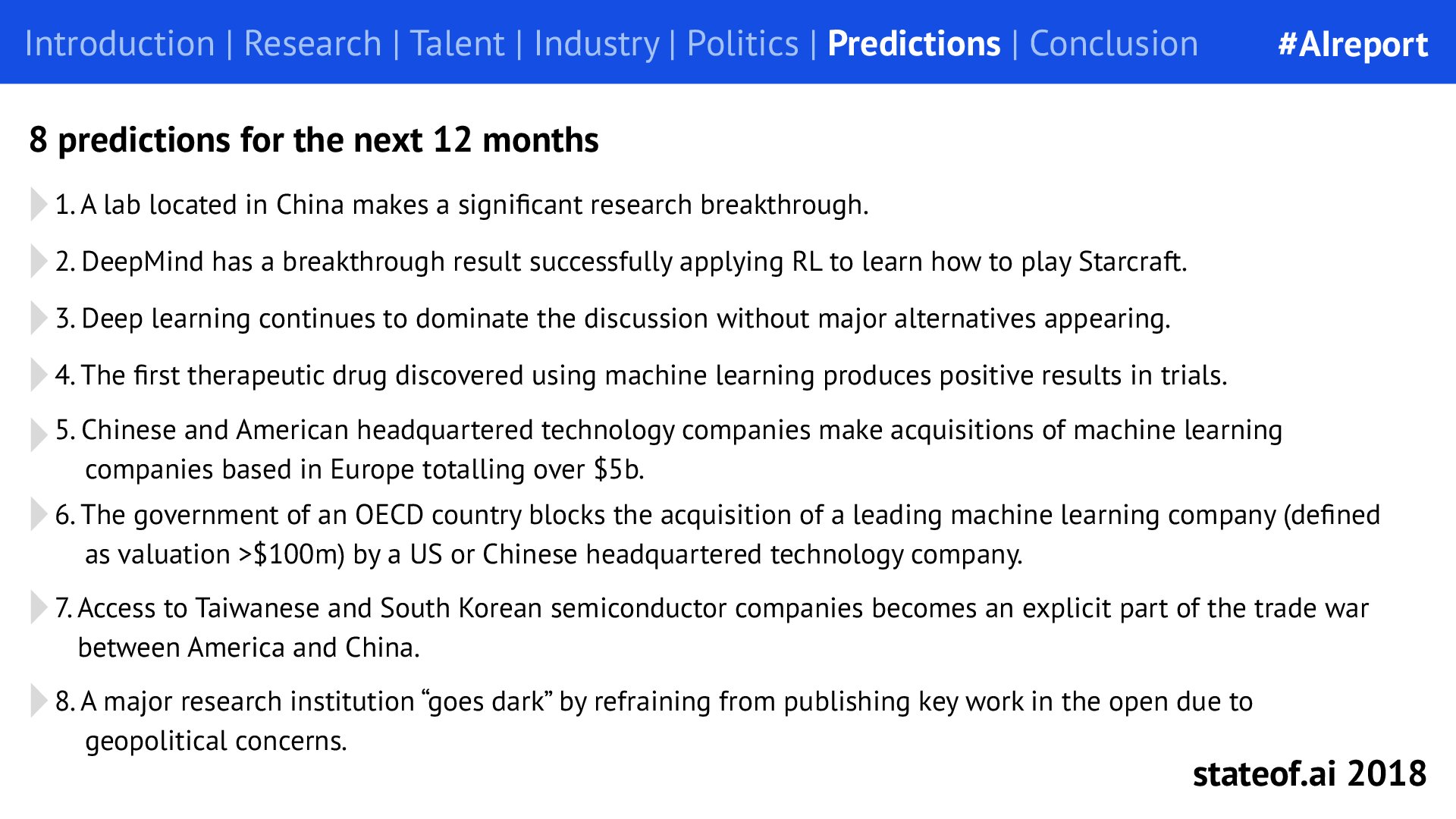
The forecasts included concrete qualifiers: acquisition value, company valuation, geography, and a twelve-month horizon. A later event resembling the topic would not necessarily meet the original prediction. Keeping those conditions visible makes retrospective assessment more useful than loosely matching a headline to a forecast.
Three of the forecasts published in 2018:
- A lab located in China makes a significant research breakthrough.
- DeepMind has a breakthrough result successfully applying RL to learn how to play Starcraft.
- Deep learning continues to dominate the discussion without major alternatives appearing.
The report is authored by Nathan Benaich and Ian Hogarth
For our writing throughout the year, subscribe to Air Street Press.
Cite the report
Benaich, N. and Hogarth, I. (2018). State of AI Report 2018. https://www.stateof.ai/2018