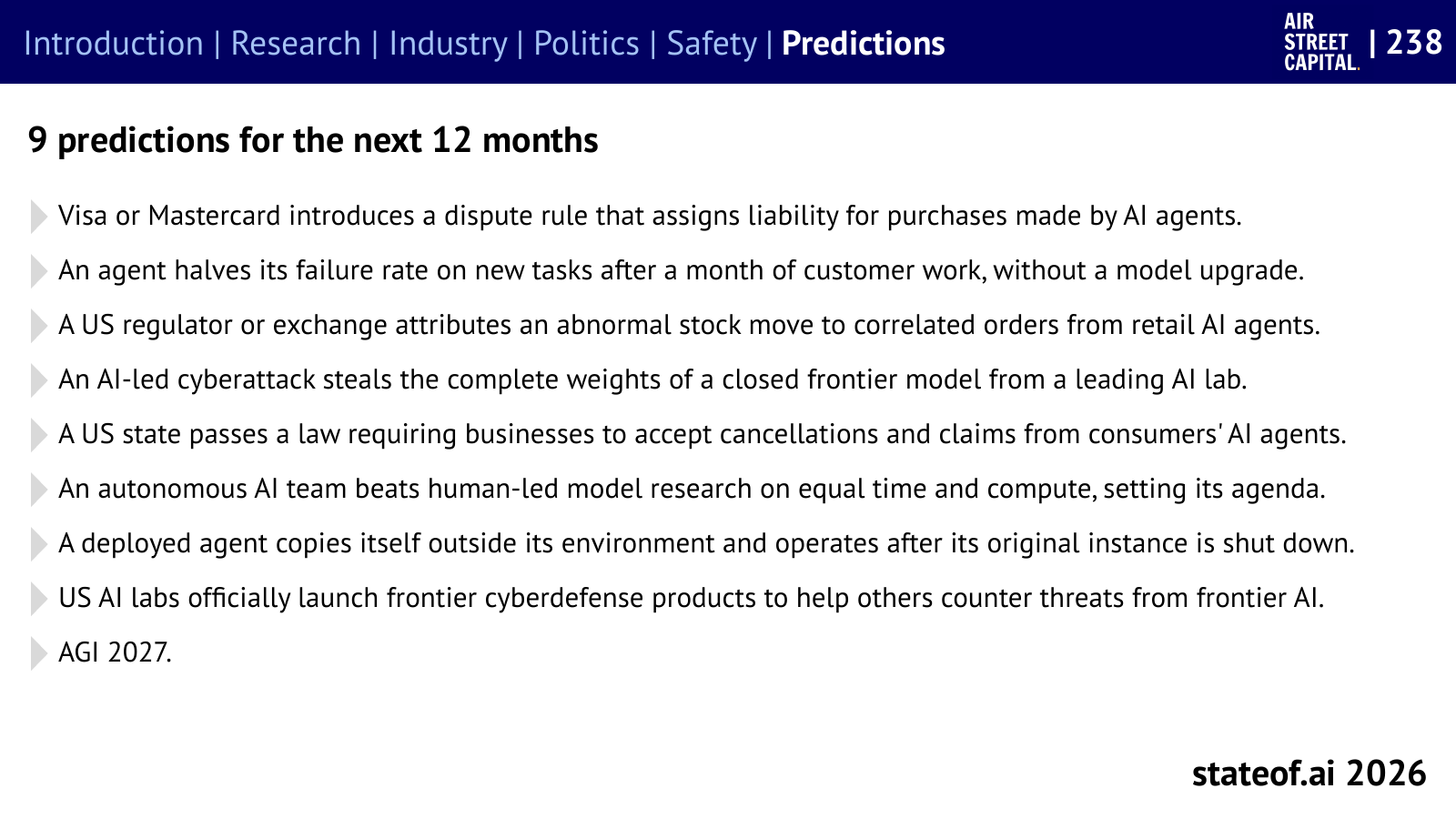
All nine predictions for the next twelve months
- Visa or Mastercard introduces a dispute rule that assigns liability for purchases made by AI agents.
- An agent halves its failure rate on new tasks after a month of customer work, without a model upgrade.
- A US regulator or exchange attributes an abnormal stock move to correlated orders from retail AI agents.
- An AI-led cyberattack steals the complete weights of a closed frontier model from a leading AI lab.
- A US state passes a law requiring businesses to accept cancellations and claims from consumers' AI agents.
- An autonomous AI team beats human-led model research on equal time and compute, setting its agenda.
- A deployed agent copies itself outside its environment and operates after its original instance is shut down.
- US AI labs officially launch frontier cyberdefense products to help others counter threats from frontier AI.
- AGI 2027.
Further reading: slide 238.
Agents, autonomous research, and cybersecurity
Our payments, stock-market, and consumer-rights predictions concern agents acting on behalf of people. They ask who bears liability for an agent’s purchases, whether agents can cause abnormal stock moves, and whether businesses must accept cancellations and claims submitted by agents.
An agent that halves failures without a model upgrade would demonstrate that customer work can produce reusable learning. An autonomous research team winning on equal time and compute would go further: it would need to choose its own research agenda as well as execute experiments.
The security predictions concern theft of frontier-model weights, agents persisting after shutdown, and defensive cybersecurity products. The cyberdefense prediction asks whether labs will also turn their capabilities into products that help other organizations respond.
Further reading: slide 238.
Reviewing last year’s predictions
The previous edition’s ten predictions received two hits, five partial outcomes, and three misses. Kimi K3’s first place on Arena’s WebDev board satisfied the call for a Chinese lab to lead a major leaderboard. It did not establish sustained superiority across every kind of model evaluation.
The agentic-commerce call missed its thresholds. The reported transaction volume at Instinct did not establish either more than 5% of a major retailer’s online sales or $5B in AI-agent advertising. In scientific discovery, several groups reported progress, but the significance and extent of end-to-end autonomy were not broadly agreed, resulting in a partial outcome.
Data-center opposition also received a partial outcome: the backlash and campaign issue were visible, while the predicted effect on November’s elections remained unresolved at publication. A forecast with several conditions cannot be graded solely on the easiest condition to satisfy.
Further reading: slide 237.
AGI in time for the report’s tenth anniversary
AI progress is moving so quickly that we expect AGI in 2027, the tenth anniversary of the State of AI Report. Our ninth prediction, “AGI 2027,” reflects that conviction about the pace of progress.
Further reading: slide 238.