All topicsSTATE OF AI REPORT.

Practitioners pay for AI and report productivity gains

The first State of AI practitioner survey added a user perspective to the report. Most respondents used generative AI, many paid personally, and 92% reported increased productivity. The findings describe an engaged practitioner sample, rather than the general population.

Questions in this section

How many people took the 2025 survey?Did the survey prove that AI increases productivity by 92%?How many respondents paid for AI themselves?Was the survey representative of all workers?

Who answered

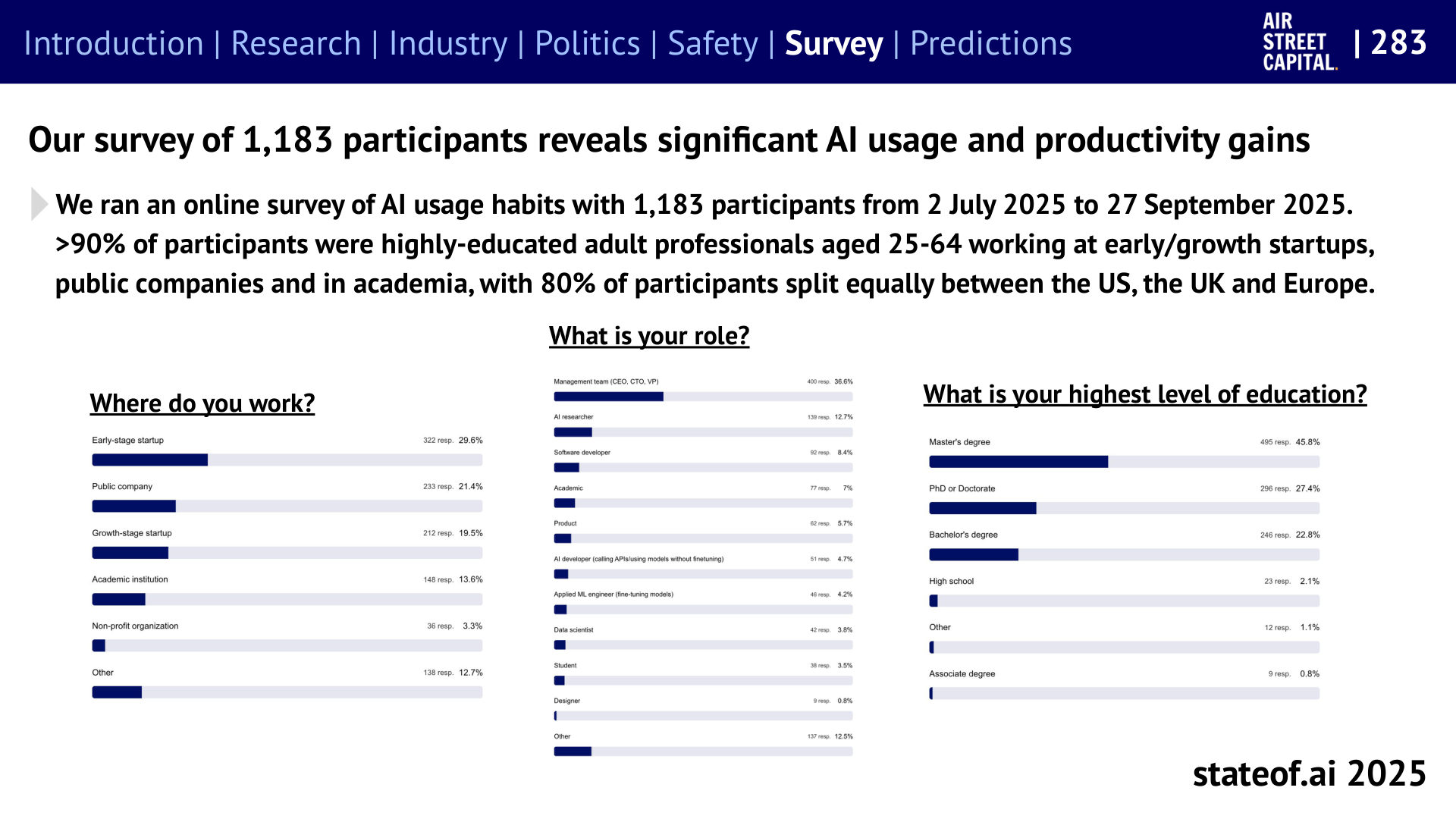
The deck records 1,183 participants surveyed online from July 2 to September 27, 2025. More than 90% were highly educated professionals aged 25-64, working in startups, public companies, or academia. Around 80% were distributed across the US, UK, and Europe. The launch posts rounded the sample to 1,200; the deck supplies the more precise count used here.
Who answered - 2025 report, slide 283
Who answered. 2025 report, slide 283 (PDF page 284)

People spend their own money

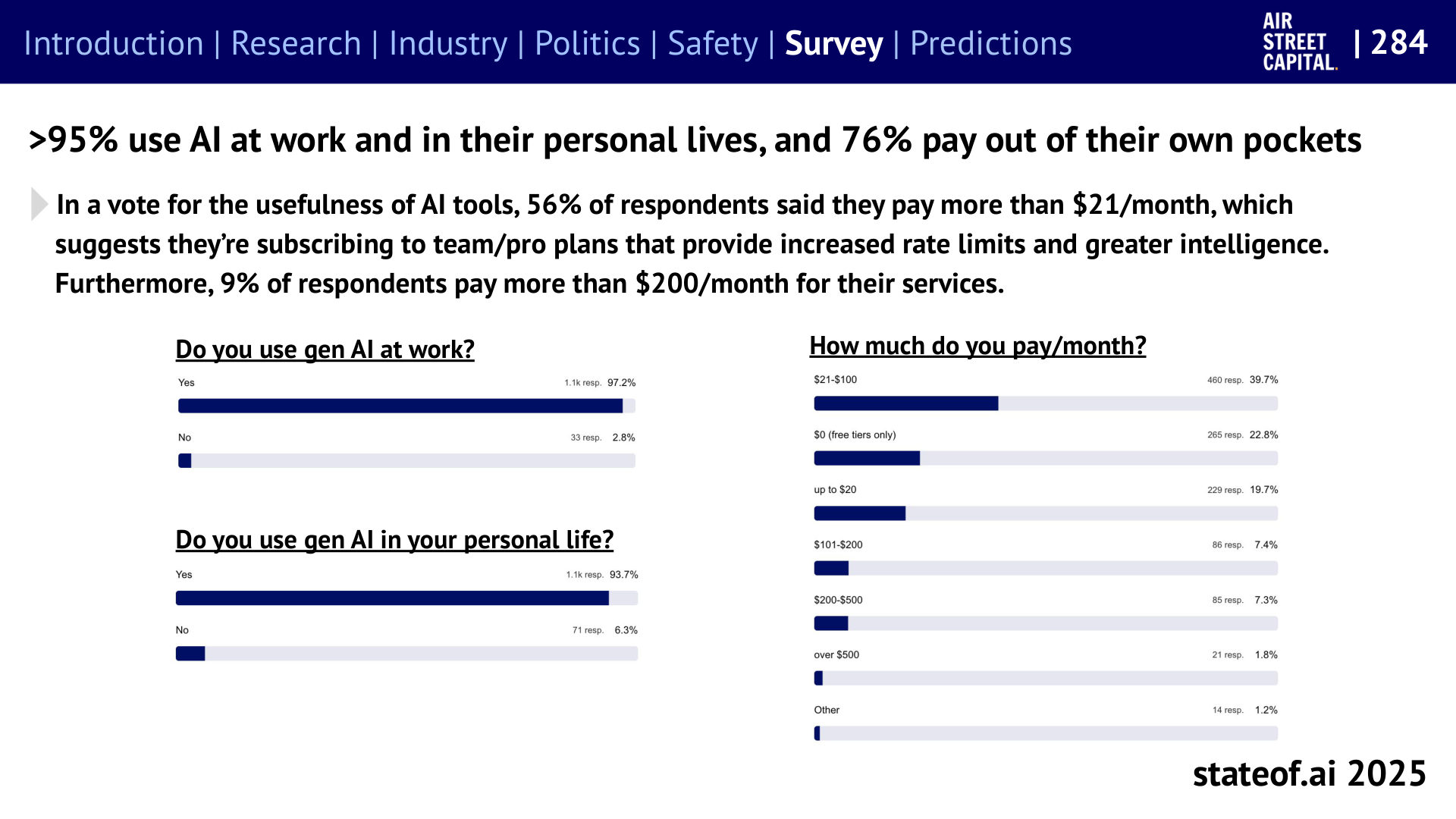
The report found more than 95% using AI at work and in their personal lives, and 76% paying out of pocket. Fifty-six percent reported spending more than $21 a month, while 9% spent more than $200. This was evidence of perceived usefulness among people already engaged with AI, rather than an estimate of national consumer adoption.
People spend their own money - 2025 report, slide 284
People spend their own money. 2025 report, slide 284 (PDF page 285)

Productivity gains are reported, not experimentally measured

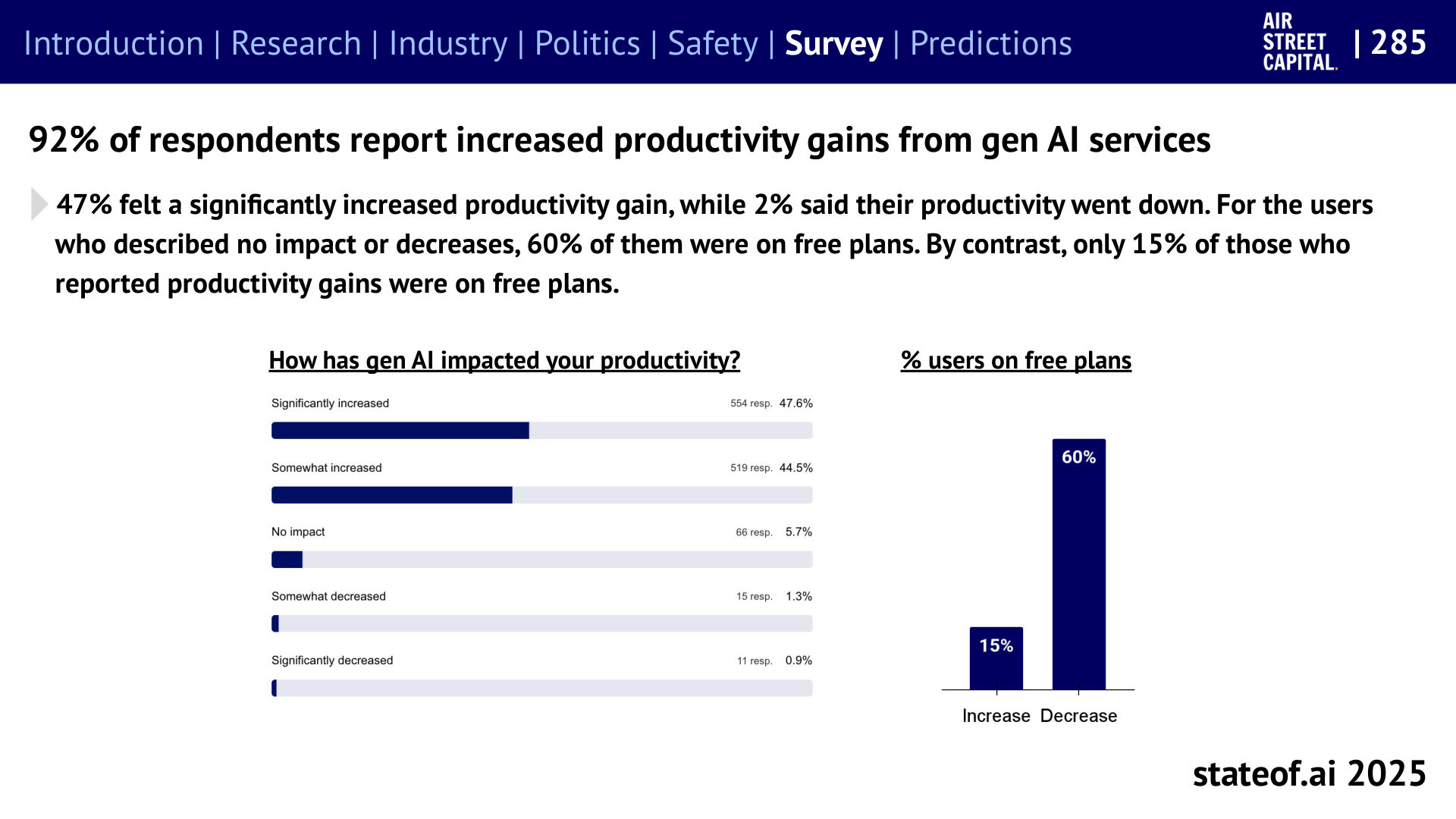
Ninety-two percent said their productivity had increased, including 47% reporting a significant increase. Two percent reported a decrease. These are respondents’ assessments, not a randomized measurement of output or time saved. The difference matters when comparing the survey with workplace experiments.
Productivity gains are reported, not experimentally measured - 2025 report, slide 285
Productivity gains are reported, not experimentally measured. 2025 report, slide 285 (PDF page 286)

The barriers move from access to implementation

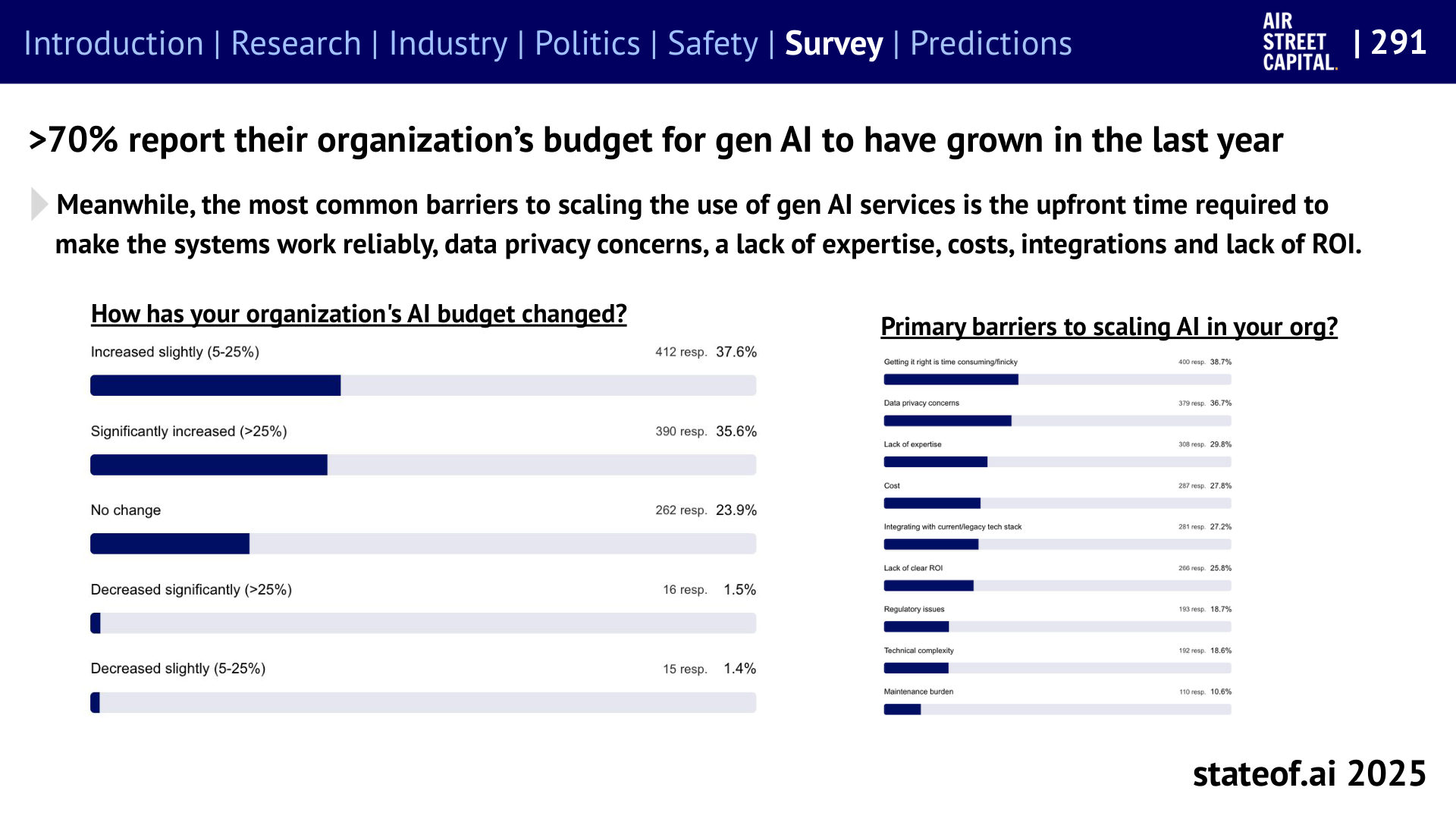
More than 70% reported growth in their organization’s generative-AI budget. Barriers included the time needed to make systems reliable, privacy concerns, lack of expertise, costs, integrations, and uncertain return on investment. The survey suggests that buying access and embedding useful AI into everyday work were different stages of adoption.
The barriers move from access to implementation - 2025 report, slide 291
The barriers move from access to implementation. 2025 report, slide 291 (PDF page 292)

Evidence you can use

State of AI practitioner survey findings

Fieldwork: July 2 to September 27, 2025

State of AI practitioner survey findings
MeasureReported valueDefinition and source
Participants1,183Online practitioner survey2025 report, slide 283 (PDF page 284)
Pay out of pocket76%Share of respondents reported in deck2025 report, slide 284 (PDF page 285)
Report increased productivity92%Self-reported increase2025 report, slide 285 (PDF page 286)
Report significant productivity increase47%Share of all respondents reporting significant gains2025 report, slide 285 (PDF page 286)
Report decreased productivity2%Self-reported decrease2025 report, slide 285 (PDF page 286)

This was an online practitioner sample concentrated among highly educated professionals in the US, UK, and Europe. Percentages are rounded as reported and question-level denominators are not provided in these slides. Do not back-calculate respondent counts or treat the sample as population-representative. Productivity is self-reported.

Frequently asked questions

Sources and dates

Historical snapshot published October 9, 2025. This web edition was prepared on October 10, 2026 from the online deck and original launch posts. Findings and forecasts retain their original time frame.

  1. 2025 report, slide 283 (PDF page 284)Original 2025 report. Slide numbers printed in the deck are one lower than PDF page numbers because the cover is unnumbered.
  2. 2025 report, slide 284 (PDF page 285)Original 2025 report. Slide numbers printed in the deck are one lower than PDF page numbers because the cover is unnumbered.
  3. 2025 report, slide 285 (PDF page 286)Original 2025 report. Slide numbers printed in the deck are one lower than PDF page numbers because the cover is unnumbered.
  4. 2025 report, slide 286 (PDF page 287)Original 2025 report. Slide numbers printed in the deck are one lower than PDF page numbers because the cover is unnumbered.
  5. 2025 report, slide 291 (PDF page 292)Original 2025 report. Slide numbers printed in the deck are one lower than PDF page numbers because the cover is unnumbered.
  6. 2025 report, slide 295 (PDF page 296)Original 2025 report. Slide numbers printed in the deck are one lower than PDF page numbers because the cover is unnumbered.
  7. 2025 report, slide 296 (PDF page 297)Original 2025 report. Slide numbers printed in the deck are one lower than PDF page numbers because the cover is unnumbered.
  8. 2025 report, slide 298 (PDF page 299)Original 2025 report. Slide numbers printed in the deck are one lower than PDF page numbers because the cover is unnumbered.
  9. State of AI Report 2025: online slides
  10. Nathan Benaich: The State of AI Report 2025Air Street Press, October 9, 2025.
  11. Welcome to State of AI Report 2025Original website launch post, October 9, 2025.

Cite this page

Benaich, Nathan. “Practitioners pay for AI and report productivity gains.” State of AI Report 2025. Historical report snapshot; web edition prepared 2026-10-10.