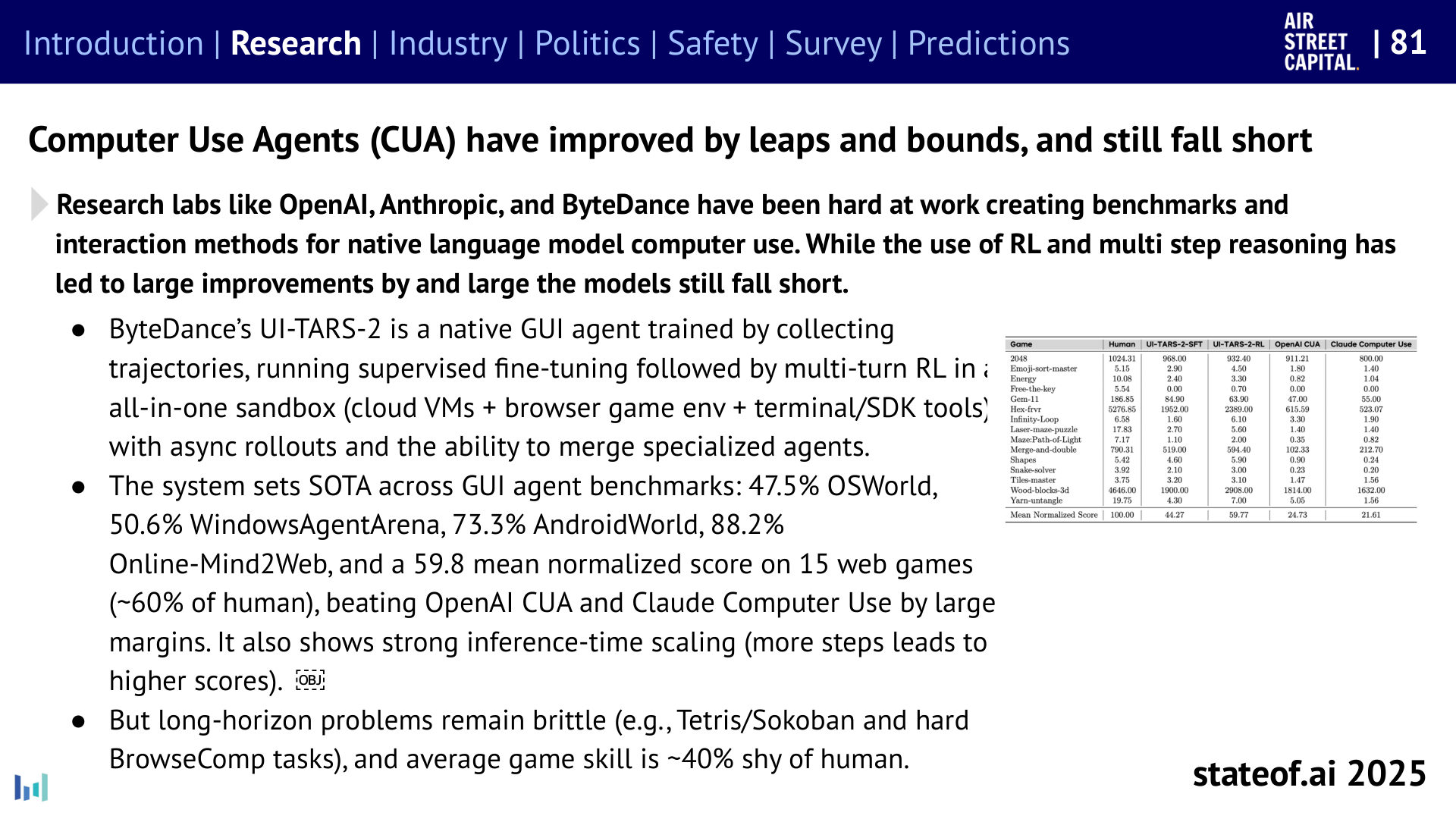
Computer use improves unevenly
ByteDance’s UI-TARS-2 combined demonstrations and reinforcement learning in environments containing computers, browsers, games, and developer tools. The report recorded substantial benchmark improvements, including 47.5% on OSWorld and 73.3% on AndroidWorld. Yet harder browsing and long-horizon games remained brittle. Progress on one interface did not establish general reliability across computer work.
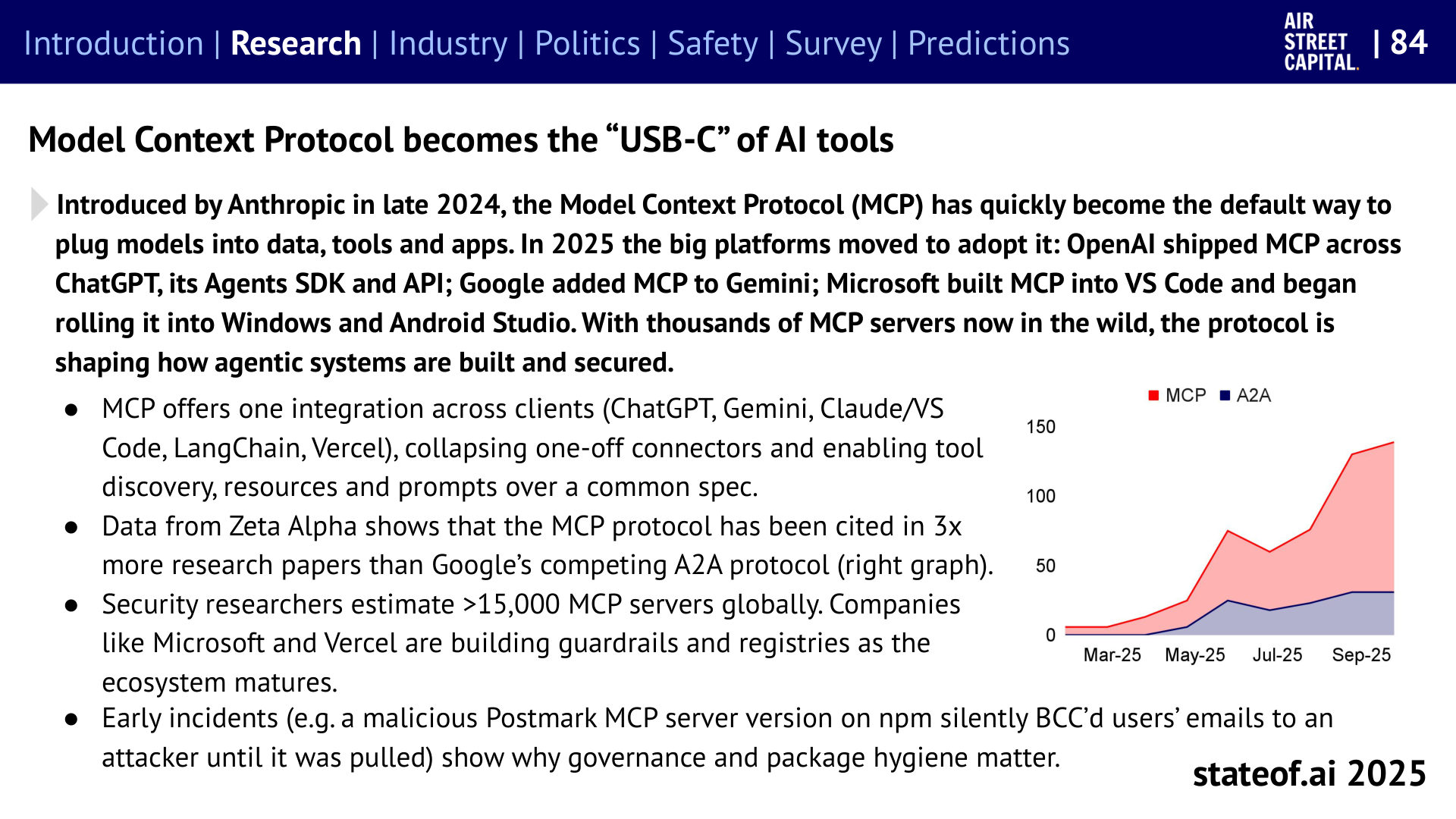
A common connection to tools takes shape
Anthropic’s Model Context Protocol gave applications a common way to expose tools and data to models. By the report’s publication, OpenAI, Google, and Microsoft had adopted it across major products. This reduced the need to build a separate connector for every pairing of model and service. It also made the trustworthiness of tool servers and their software dependencies part of the agent’s security boundary.
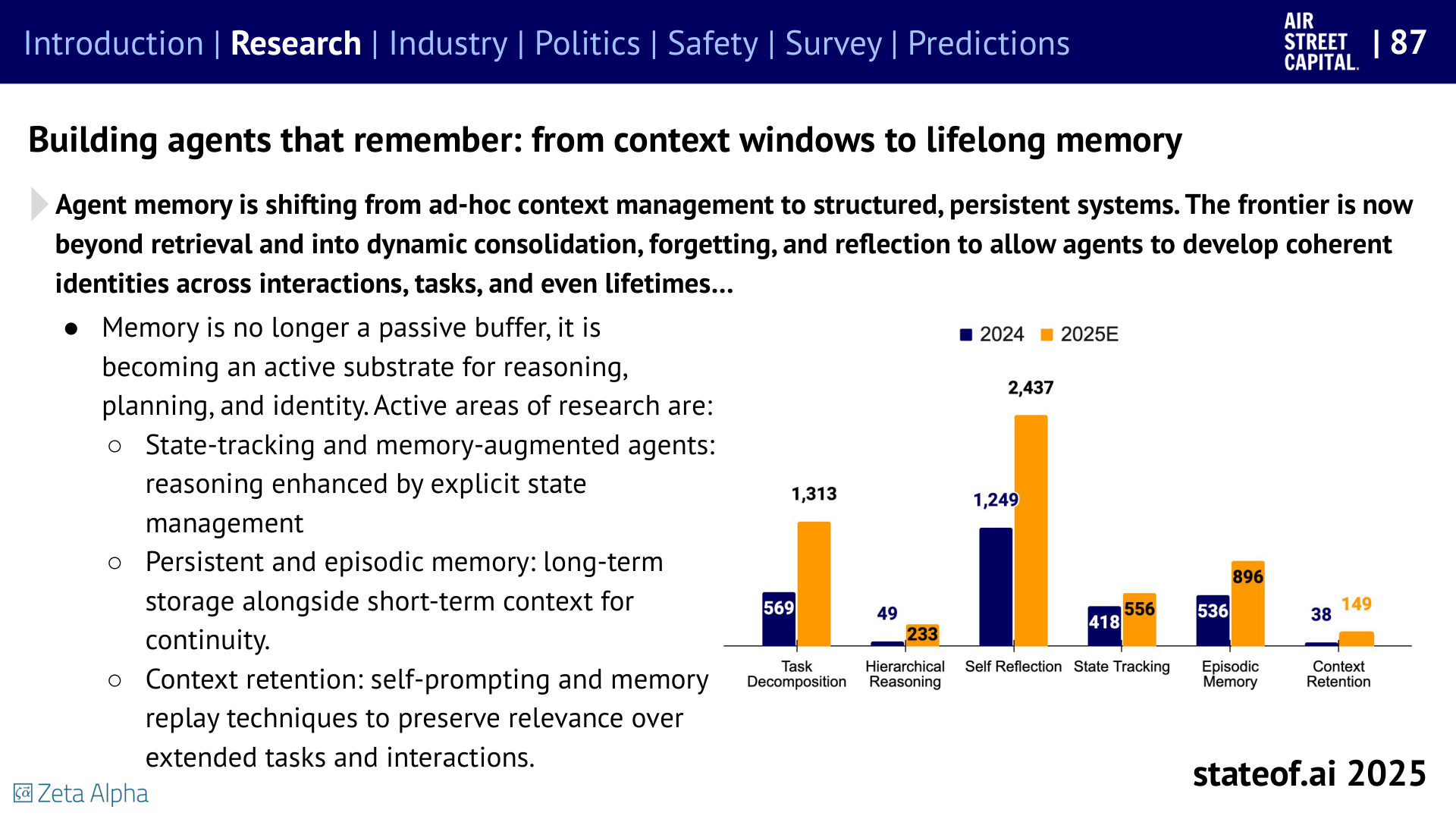
Memory becomes part of the system
Research moved from filling a context window toward persistent records, state tracking, and ways to consolidate or forget information. These systems aimed to preserve useful context across longer work. They were research directions rather than proof of dependable lifelong learning. The report also called for domain experts to audit impressive agent results: an apparent speedup can hide an incorrect solution.