Language models begin to use tools and build skills
By Nathan Benaich (Air Street Capital) · 2023 report
The 2023 report followed language models beyond generating text. Tool use let them retrieve information, call software, and act in an environment. Systems such as Voyager showed how code execution and stored skills could support longer sequences of work, while leaving open how well those results would generalize.
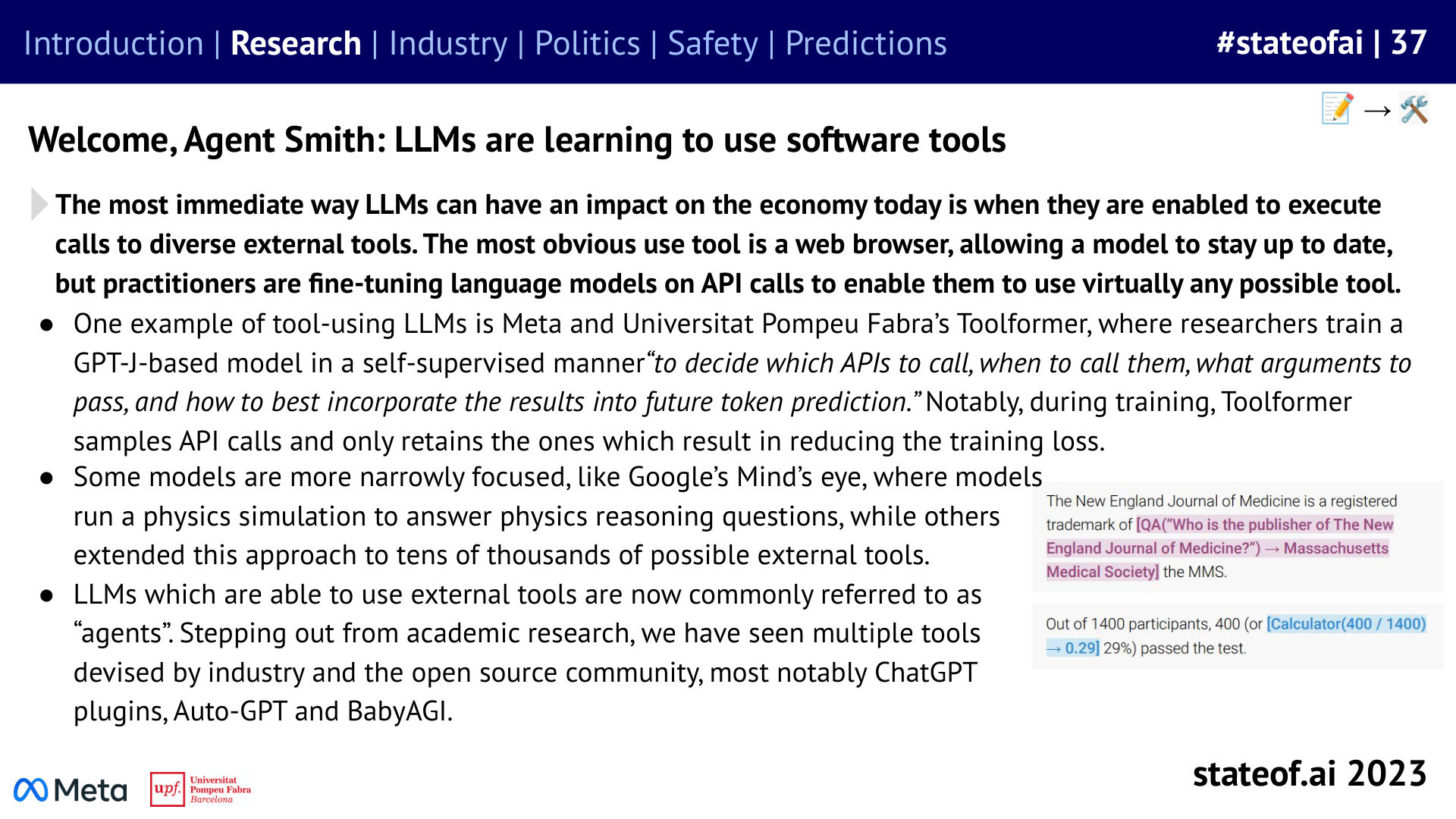
Toolformer trained a language model to decide when to call an API, which arguments to supply, and how to use the result. It retained training examples where an API call improved prediction. The report connected this research to ChatGPT plugins and early open agent projects, which attempted to make language models useful through actions as well as answers.
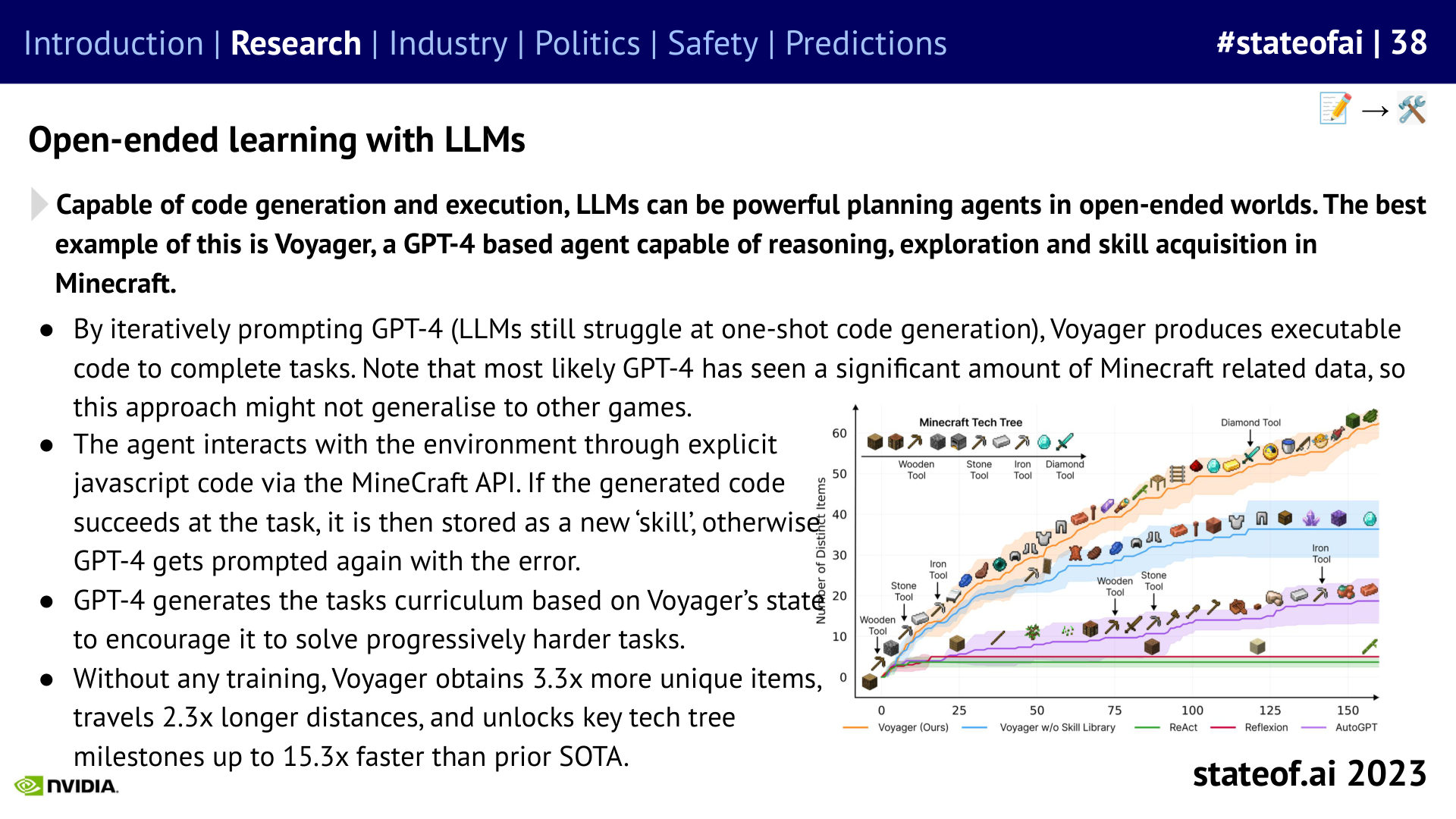
Voyager used GPT-4 to generate executable JavaScript, attempted tasks through the Minecraft API, and fed errors back into the model. Successful code became a stored skill. A generated curriculum encouraged further exploration. The system combined a model with memory and feedback rather than expecting one prompt to produce a complete solution.
Voyager collected more unique items and reached milestones faster than prior systems in the reported evaluation. The report also noted that GPT-4 had likely seen substantial Minecraft material during training. That familiarity mattered when interpreting whether the same method would work in a different game or an unfamiliar real-world workflow.
The agent’s memory was part of its capability
Voyager stored successful code as reusable skills, so later behavior depended on more than the language model alone. Its curriculum, environment feedback, and skill library formed an interacting system. This makes it important to evaluate the whole agent setup rather than attribute every outcome to a model’s next-token predictions.
Evidence you can use
AI agents in the 2023 report
Historical snapshot: October 2023. Dates and populations are specified per row.
All three ratios refer to the reported Minecraft comparison. They measure different outcomes and should not be averaged. The report explicitly raised possible training familiarity with Minecraft as a limit on generalization.
Voyager used GPT-4 to generate code for Minecraft, executed it, returned errors to the model, and stored successful code as reusable skills. A generated curriculum encouraged progressively harder tasks.
It was a model connected to external software, such as a search service or an API, so that it could obtain information or perform actions beyond generating text.
No. Its results were measured in Minecraft, and the report cautioned that GPT-4’s likely familiarity with the game could limit how well the approach generalized.
It retained examples in which an API call improved prediction. The training process therefore connected tool use to a measurable benefit rather than simply adding arbitrary calls to the text.
Successful executable code became a reusable skill. This library gave later attempts access to working behaviors instead of requiring the model to regenerate each solution from scratch.
It passed execution errors back to GPT-4 so the model could revise its code. The agent’s performance depended on this interaction with the environment, not only on the first proposed action.
It measured unique items collected relative to prior state of the art in the reported Minecraft evaluation. It was a task-specific exploration result, not a general productivity multiplier.
The report noted that GPT-4 had likely encountered substantial Minecraft material during training. That made transfer to an unfamiliar environment a separate question from success in the evaluated game.
Historical snapshot published October 12, 2023. This web edition was prepared on October 10, 2026 from the online deck and original launch posts. Findings and forecasts retain their original time frame.
Benaich, Nathan. “Language models begin to use tools and build skills.” State of AI Report 2023. Historical report snapshot; web edition prepared 2026-10-10.