By Nathan Benaich (Air Street Capital) · 2023 report
GPT-4 was the reference point for language-model capability in the 2023 report. At the same time, Llama 2 made capable models more accessible, and experiments with smaller models showed how much carefully chosen training data could matter. Progress came with growing uncertainty about what closed labs were actually building.
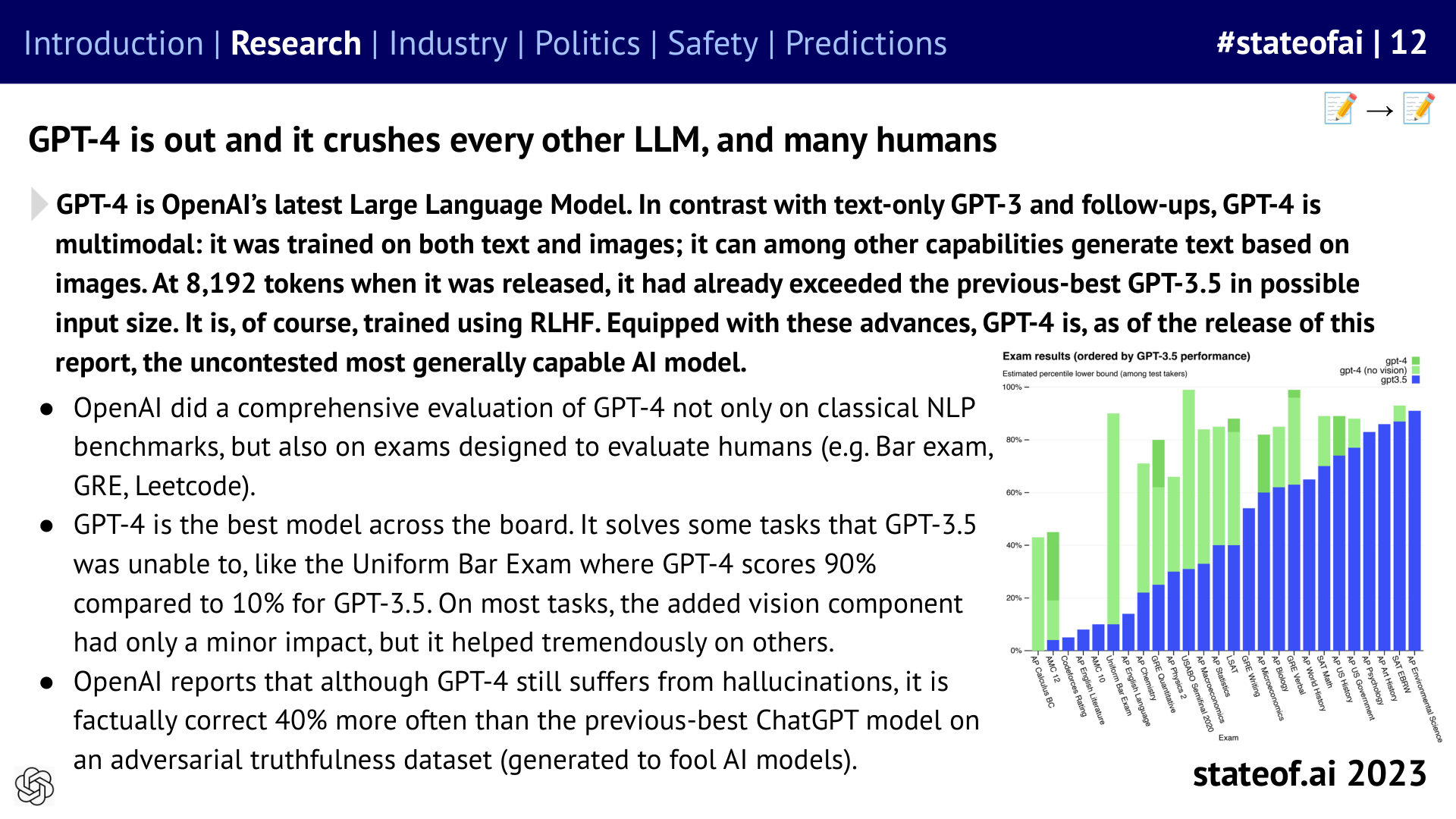
The report described GPT-4 as a substantial improvement over its predecessors, including stronger performance on reasoning and knowledge tasks. Reinforcement learning from human feedback improved some behaviors, but hallucinations remained. Better answers did not remove the need to examine how a model was evaluated or where it still failed.
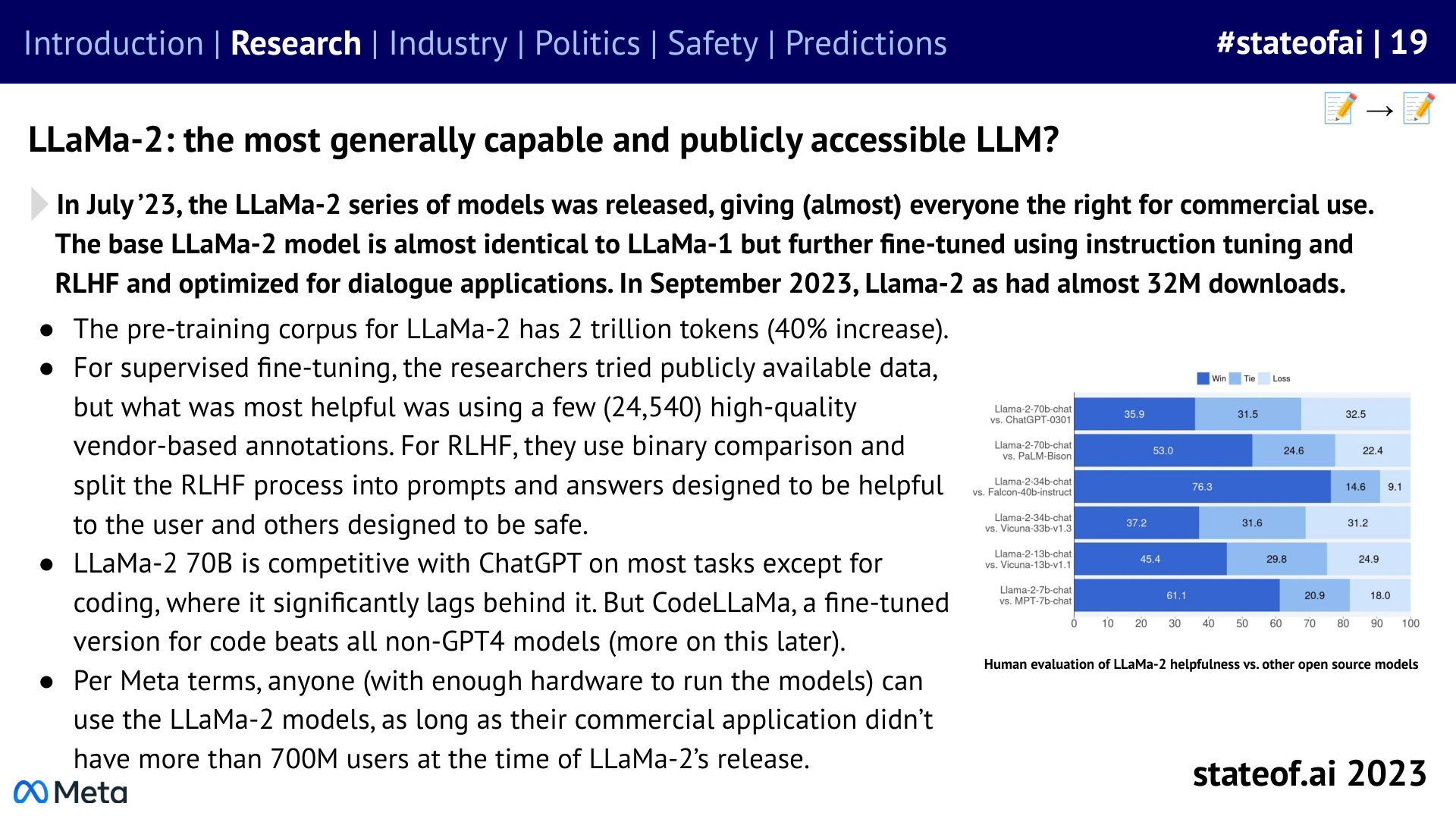
Meta’s Llama 2 used a two-trillion-token pretraining corpus and additional instruction tuning and human feedback. The 70B model was competitive with ChatGPT on many tasks but lagged in coding, where a specialized Code Llama variant performed better. The release permitted broad commercial use subject to license conditions, rather than unrestricted use by every company.
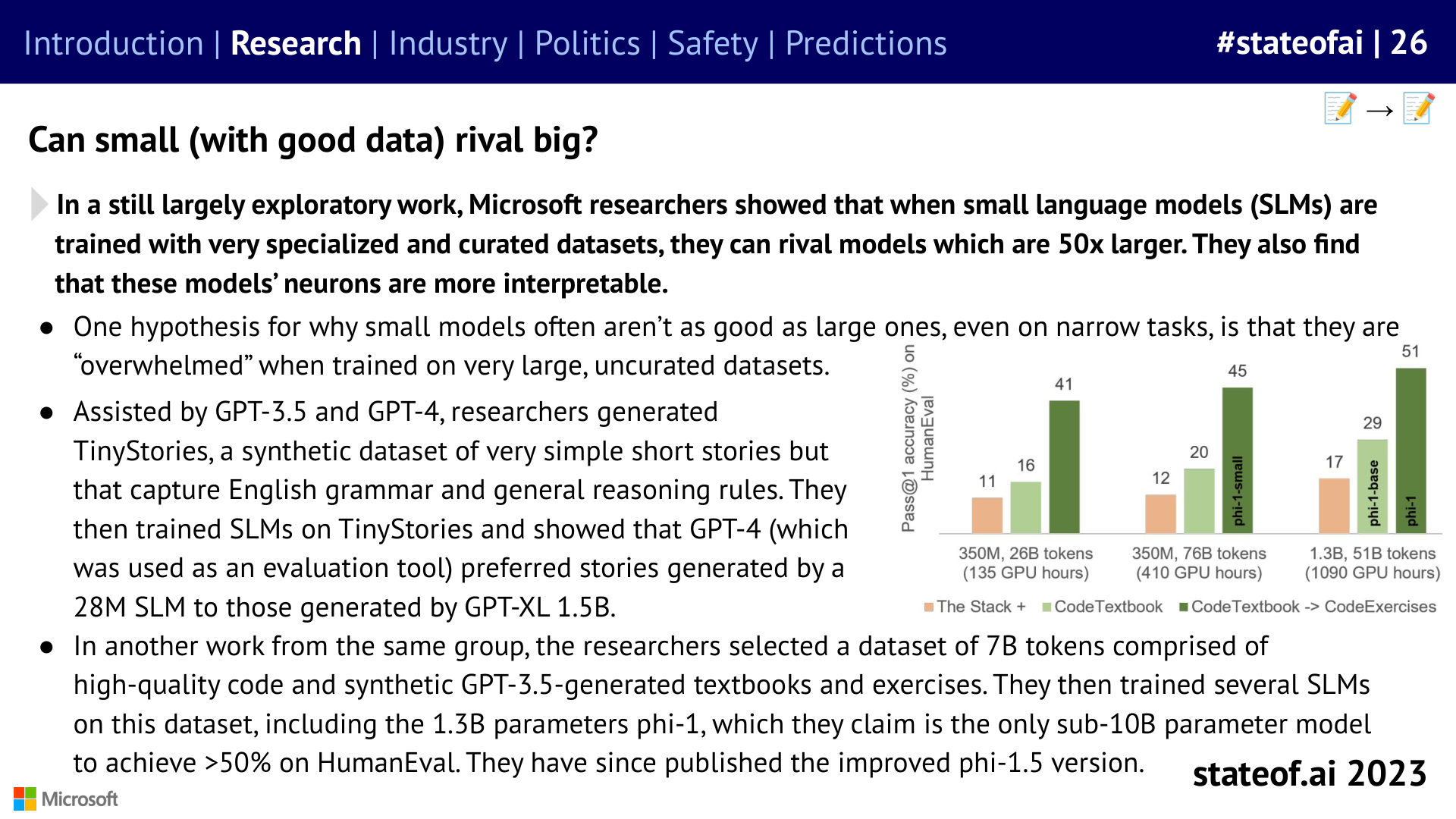
Microsoft’s TinyStories and phi work explored whether narrow, curated datasets could produce useful capabilities in much smaller models. A 28-million-parameter story model compared favorably with a much larger model under a GPT-4-based evaluation. These were task-specific results; they did not establish that a small model could replace a frontier model across all uses.
Curated training data made small models surprisingly useful on selected tasks. The evaluation setup mattered as much as the size comparison: a story-generation result assessed with GPT-4 was not the same experiment as testing broad reasoning or factual reliability. The report’s examples supported specialization, rather than universal equivalence with larger models.
Evidence you can use
AI progress in the 2023 report
Historical snapshot: October 2023. Dates and populations are specified per row.
Model size and corpus size are specifications, not quality scores. Comparisons in the report used different tasks and evaluators. Llama’s availability was subject to its license; small-model findings were limited to the evaluated settings.
It gave a broad group of developers access to capable models with commercial-use permissions subject to license conditions. Its 70B model competed with ChatGPT on many tasks, while coding remained a weakness for the general model.
No. The report described improved factual performance alongside continuing hallucinations. Stronger average results did not make every answer reliable.
On selected tasks, models trained with specialized, curated data could compare favorably with much larger models. The report treated this as exploratory, task-specific evidence.
The report cited two trillion tokens, a 40% increase over its predecessor. That number described the pretraining corpus, rather than the length of a single prompt or conversation.
No. The release permitted broad commercial use subject to conditions. The report’s account should not be read as permission for every organization or use case without checking the applicable license.
The general 70B model lagged on coding in the comparisons discussed, while the specialized Code Llama variant performed better. Capability depended on both the model and the task.
The report highlighted curated code and synthetic educational material for a 1.3-billion-parameter model. The example focused attention on data selection as well as model size.
Unlike the text-only predecessors discussed in the report, GPT-4 was trained on text and images and could generate text based on image inputs. The report noted that vision helped substantially on some tasks and had only a minor effect on others.
Historical snapshot published October 12, 2023. This web edition was prepared on October 10, 2026 from the online deck and original launch posts. Findings and forecasts retain their original time frame.