How to read this finding
Model specifications are not direct quality scores. The scaling finding applies to the studied training regime, while generative-image examples reflect the state of the field before ChatGPT’s public launch.
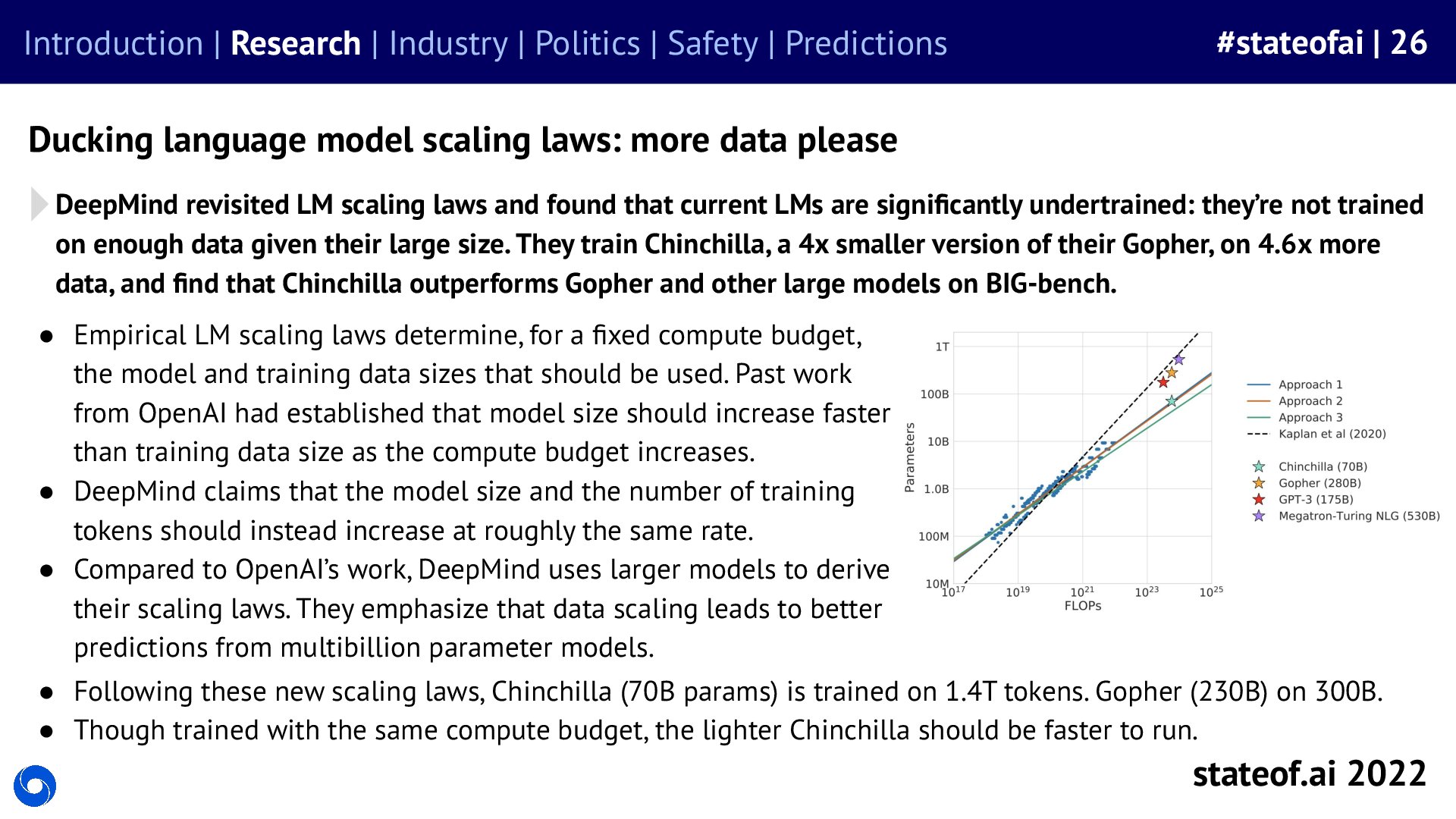
It showed the importance of training on more data for a given compute budget. The report described a 70B-parameter model trained on 1.4T tokens, rather than treating parameter count alone as the route to better performance.
Model specifications are not direct quality scores. The scaling finding applies to the studied training regime, while generative-image examples reflect the state of the field before ChatGPT’s public launch.
Evidence you can use
Historical snapshot: October 2022. Dates and populations are specified per row.
| Measure | Reported value | Definition and source |
|---|---|---|
| Chinchilla model size | 70B parameters | Model specification in the scaling-law discussion.2022 report, slide 26 (PDF page 26) |
| Chinchilla training data | 1.4T tokens | Training token count reported for Chinchilla.2022 report, slide 26 (PDF page 26) |
| Image-generation method | Diffusion | Family of methods discussed for DALL-E 2, Imagen, and Stable Diffusion.2022 report, slide 30 (PDF page 30) |
Model specifications are not direct quality scores. The scaling finding applies to the studied training regime, while generative-image examples reflect the state of the field before ChatGPT’s public launch.
Historical snapshot published October 11, 2022. This web edition was prepared on 2026-10-11 from the online deck and original launch posts. Findings and forecasts retain their original time frame.
Benaich, Nathan, and Ian Hogarth. “What did Chinchilla change about scaling language models?” State of AI Report 2022. Historical report snapshot; web edition prepared 2026-10-11.