More countries train AI researchers, but resources remain uneven
By Nathan Benaich and Ian Hogarth · 2021 report
The 2021 report showed a widening geography of AI education and hiring. Growth in talent did not guarantee equal access to the resources needed for research. University labs continued to face constraints in compute budgets and staffing.
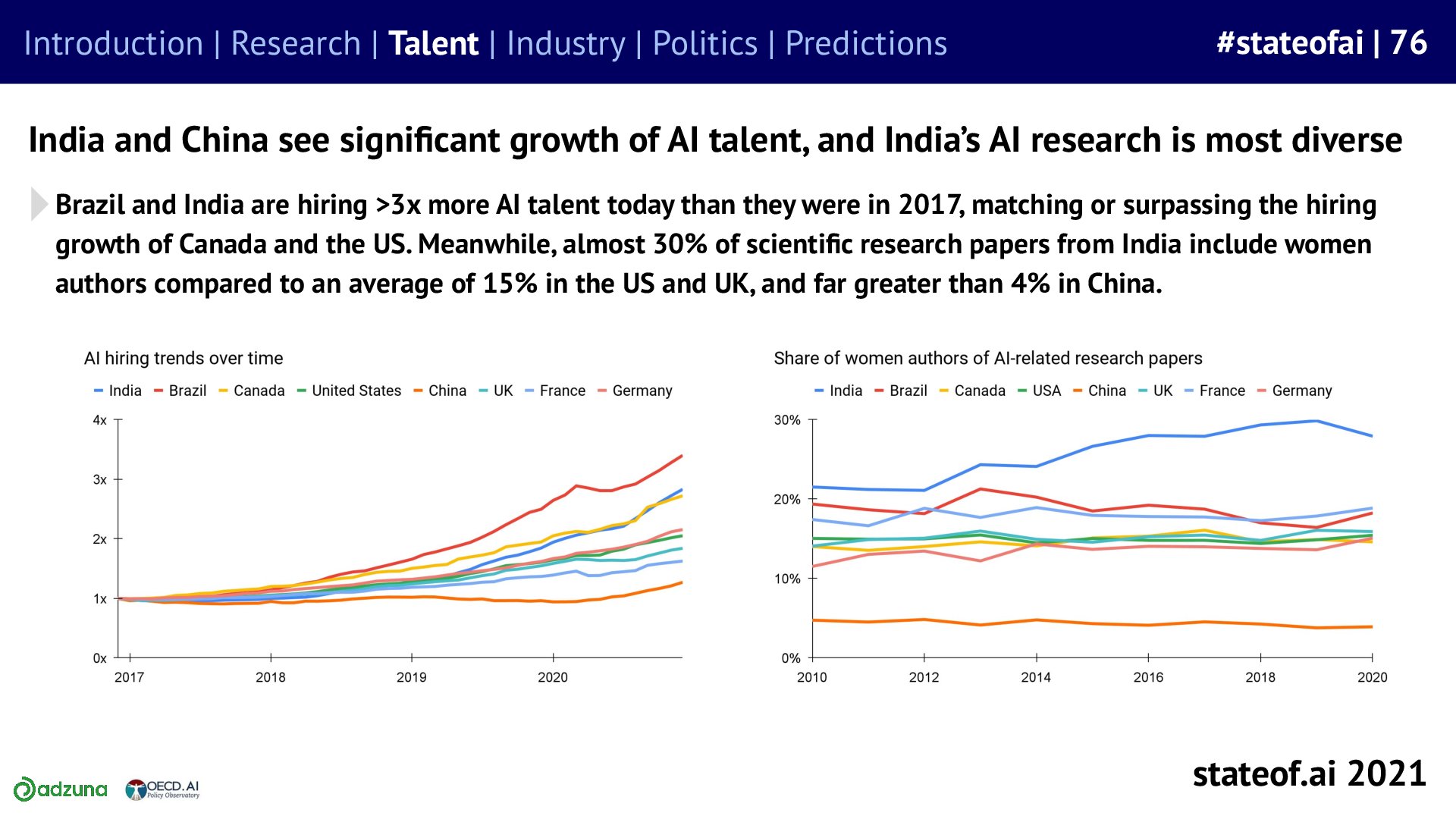
Brazil and India were hiring more than three times as much AI talent as in 2017 in the cited comparison. This described relative growth from each country’s starting point, rather than their absolute share of the global workforce.
Degree growth does not settle questions of capability
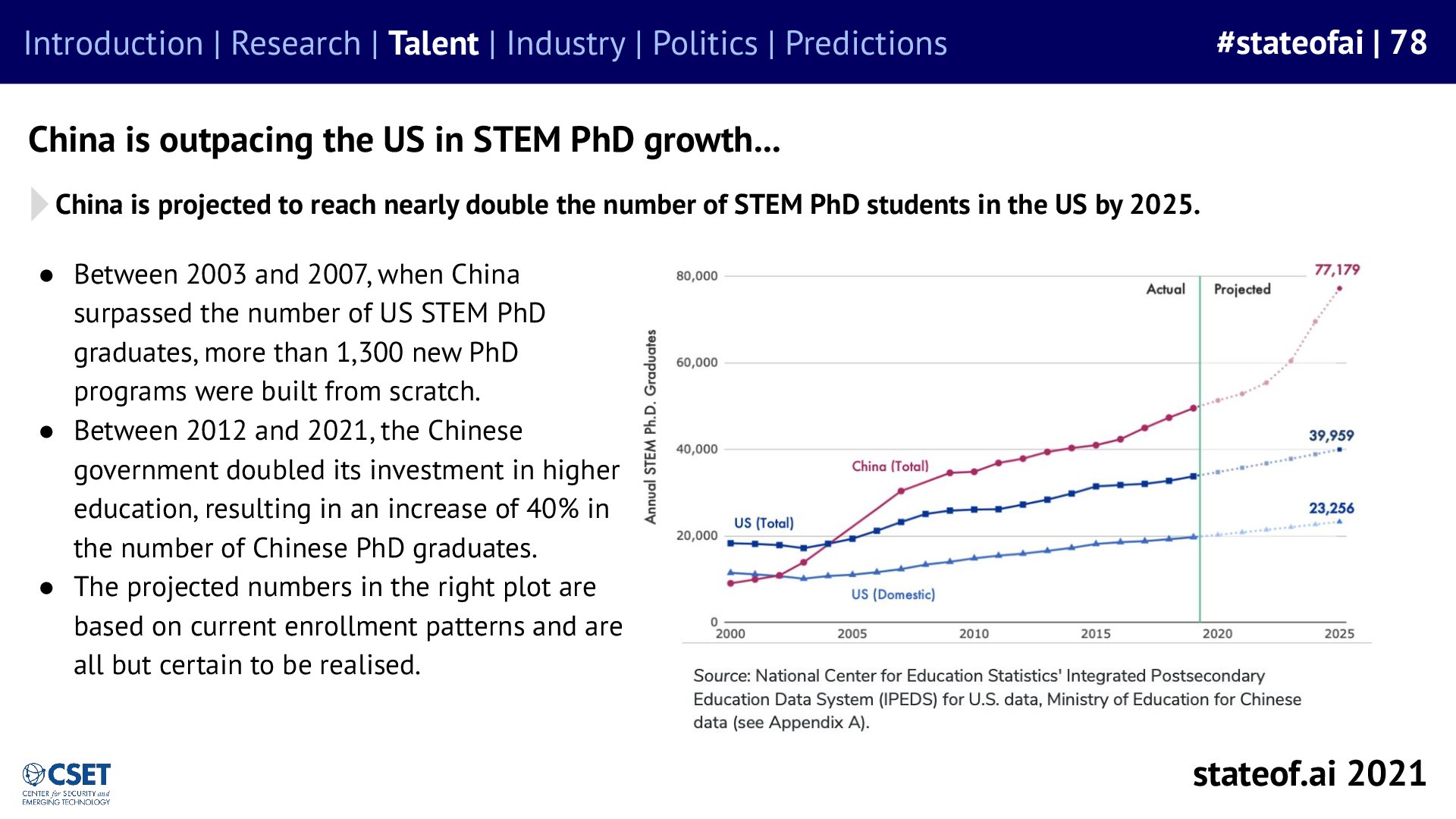
The report described strong growth in China’s STEM PhD pipeline and a projection of nearly twice the US number by 2025. STEM is broader than AI, and the forecast was not an observed 2025 outcome. The adjacent discussion also cautioned against equating larger programs with higher quality.
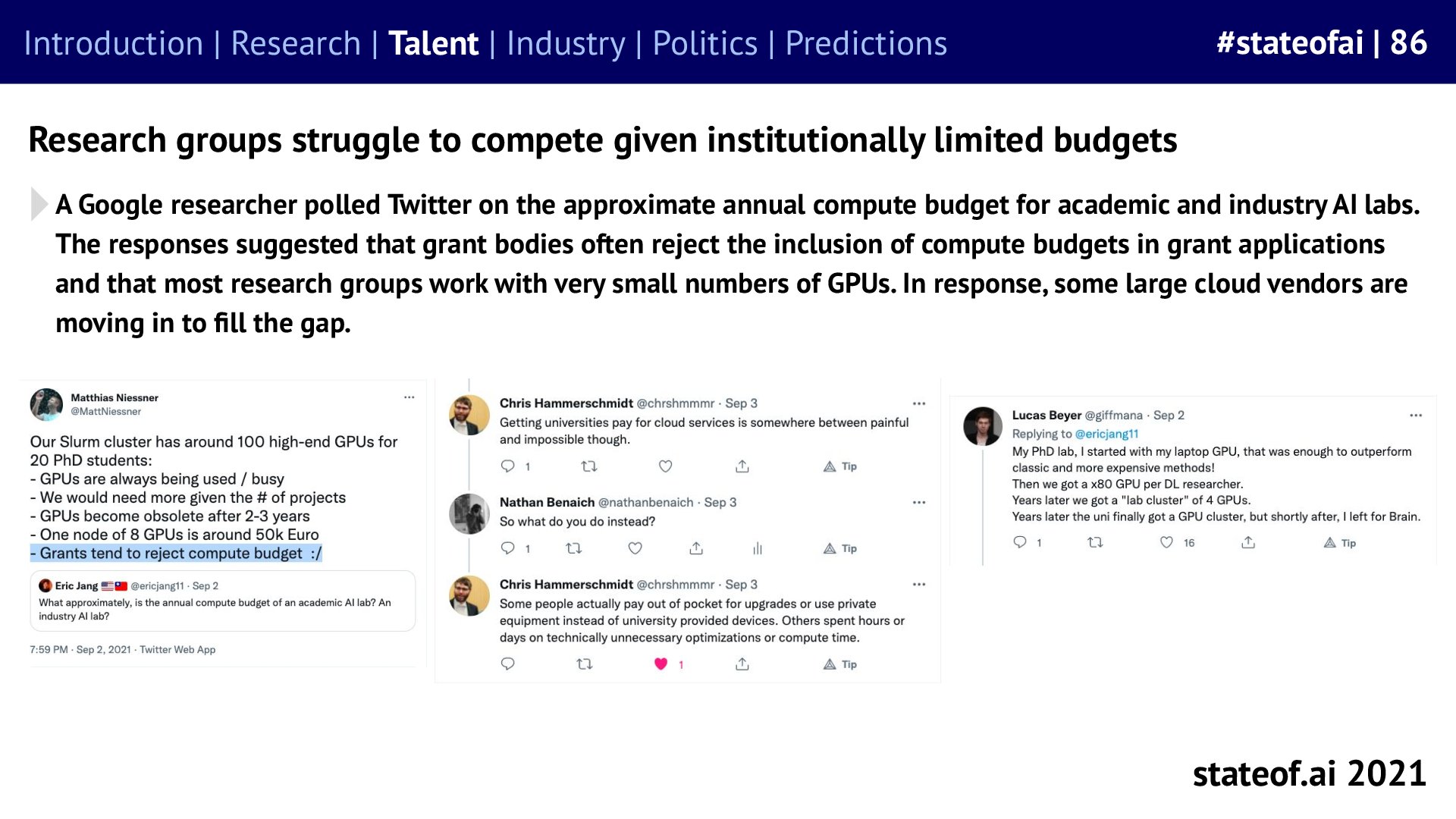
A researcher’s informal poll suggested that many academic groups had small GPU budgets and difficulty getting compute funded through grants. The report used it to illustrate a resource problem, not as a representative census of all university laboratories.
A growing pool of researchers did not ensure equal access to experimental resources. The report’s examples of small academic compute budgets illustrated a practical constraint on what teams could attempt. Because the examples came from an informal poll, they were evidence of the problem rather than a representative funding census.
Evidence you can use
Talent in the 2021 report
Historical snapshot: October 2021. Dates and populations are specified per row.
Relative hiring growth is not absolute workforce size. The PhD comparison is a historical projection, and informal polling of compute budgets is not a representative survey.
The comparison used each country’s 2017 AI hiring level. More than threefold growth therefore described change from a local baseline, not a comparison of absolute workforce size between countries.
No. Hiring growth measured one labor-market trend. It did not establish a ranking of research quality, model performance, or the total number of AI workers.
It projected that China would produce nearly twice as many STEM PhDs as the US by 2025. That was a forecast presented in 2021, not an observed 2025 count.
No. It concerned STEM doctorates, a broader category than artificial intelligence. Treating all of those graduates as AI researchers would overstate the measure’s scope.
The report discussed responses to an informal Twitter poll about compute budgets. Those responses illustrated difficulties faced by some groups but were not a statistically representative survey.
They restricted the scale of experiments teams could undertake. The report framed access to compute as an additional constraint that expertise or a larger graduate pipeline alone could not resolve.
Historical snapshot published October 12, 2021. This web edition was prepared on 2026-10-11 from the online deck and original launch posts. Findings and forecasts retain their original time frame.
Benaich, Nathan, and Ian Hogarth. “More countries train AI researchers, but resources remain uneven.” State of AI Report 2021. Historical report snapshot; web edition prepared 2026-10-11.