The 2021 report described a shift toward rules aimed at AI systems themselves. The EU proposed a risk-based AI Act, while military deployment made questions of autonomy and responsibility more immediate. This was the policy landscape at publication, before later legislation and events.
The April 2021 proposal distinguished prohibited, high-risk, and low-risk systems in the report’s summary. Its scope extended to systems used or placed in the EU, including foreign providers. The key change was an attempt to regulate uses of AI directly, rather than only the data used to build them.
The report described AI-guided drone swarms and other military systems moving beyond laboratory demonstrations. Such deployments made oversight and responsibility operational questions, while the evidence and autonomy level varied across the examples.
The proposed rules depended on what a system was used for
The report’s account of the EU proposal grouped systems by risk and application. That made use context central to the discussion. Readers should treat the page as a record of the 2021 proposal, rather than use its categories or examples as a guide to legal obligations today.
Evidence you can use
Politics in the 2021 report
Historical snapshot: October 2021. Dates and populations are specified per row.
This is a historical account, not current legal guidance. Military examples should not be treated as proof that every stage of targeting or decision-making was autonomous.
The report’s summary included manipulative subliminal techniques, targeting vulnerable groups, social scoring, and real-time remote biometric applications. This describes the April 2021 proposal as summarized in that edition, rather than the later adopted law.
It distinguished prohibited uses, high-risk applications, and lower-risk systems in the report’s summary. The intended oversight depended on potential consequences and application context.
The report listed safety components, public infrastructure, social welfare, medical services, and transportation systems. These were examples in its account of the proposal, not an exhaustive current legal classification.
The report said the proposal could reach foreign vendors operating in the EU. It therefore framed the initiative as consequential beyond the location of a developer’s headquarters.
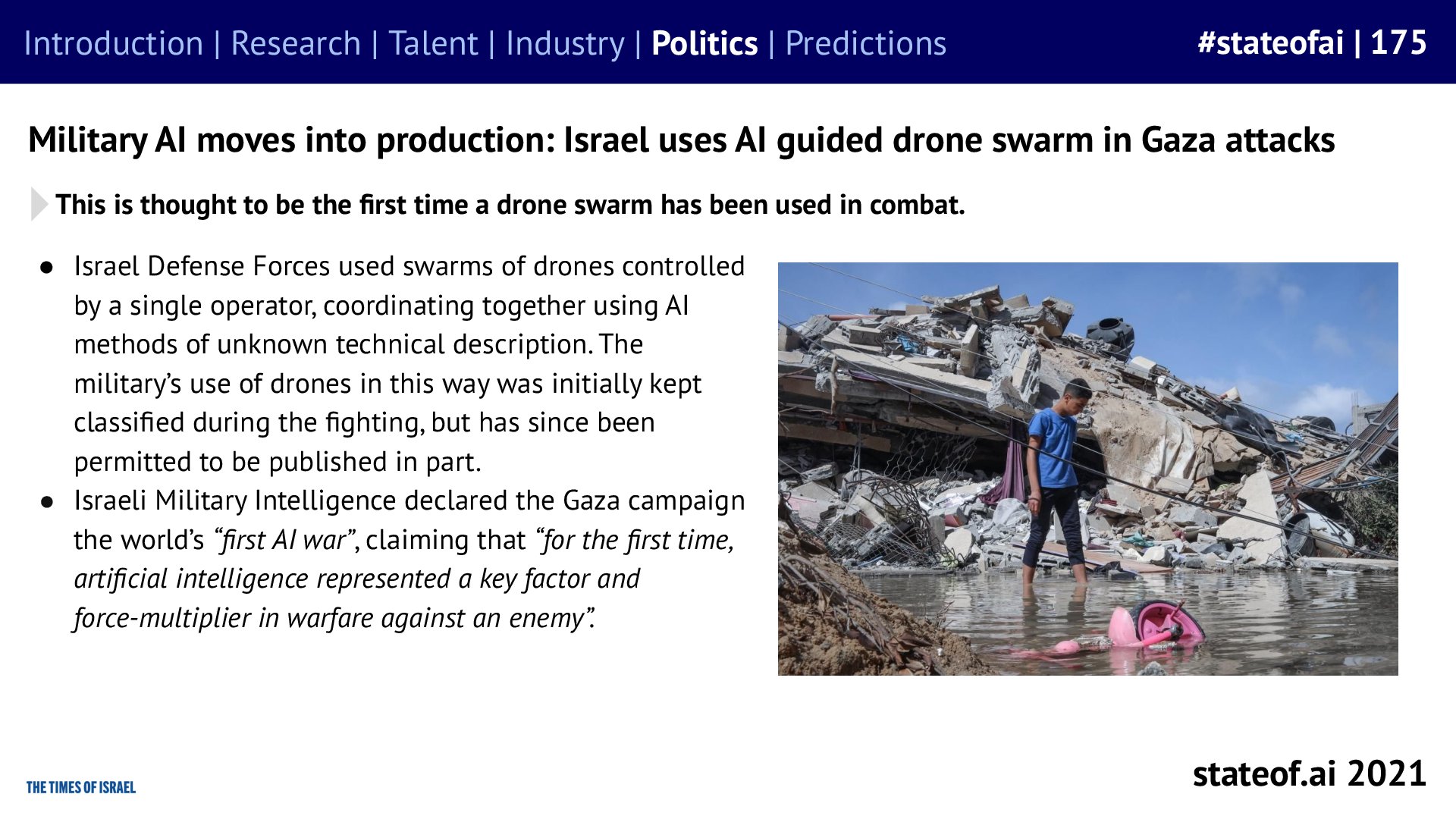
The report described an AI-guided drone swarm used by Israel during Gaza operations. It treated this as an example of military AI moving from development into reported operational use.
The report noted that military-drone details were often classified and that the account was only partly public. Its discussion should not be mistaken for an independent technical audit of the system.
Historical snapshot published October 12, 2021. This web edition was prepared on 2026-10-11 from the online deck and original launch posts. Findings and forecasts retain their original time frame.
Benaich, Nathan, and Ian Hogarth. “Governments begin regulating AI systems directly.” State of AI Report 2021. Historical report snapshot; web edition prepared 2026-10-11.