How to read this finding
Forecast error is not an emissions or cost-saving metric. Application counts are not paying-customer counts, and code-generation tools still require evaluation of their outputs.
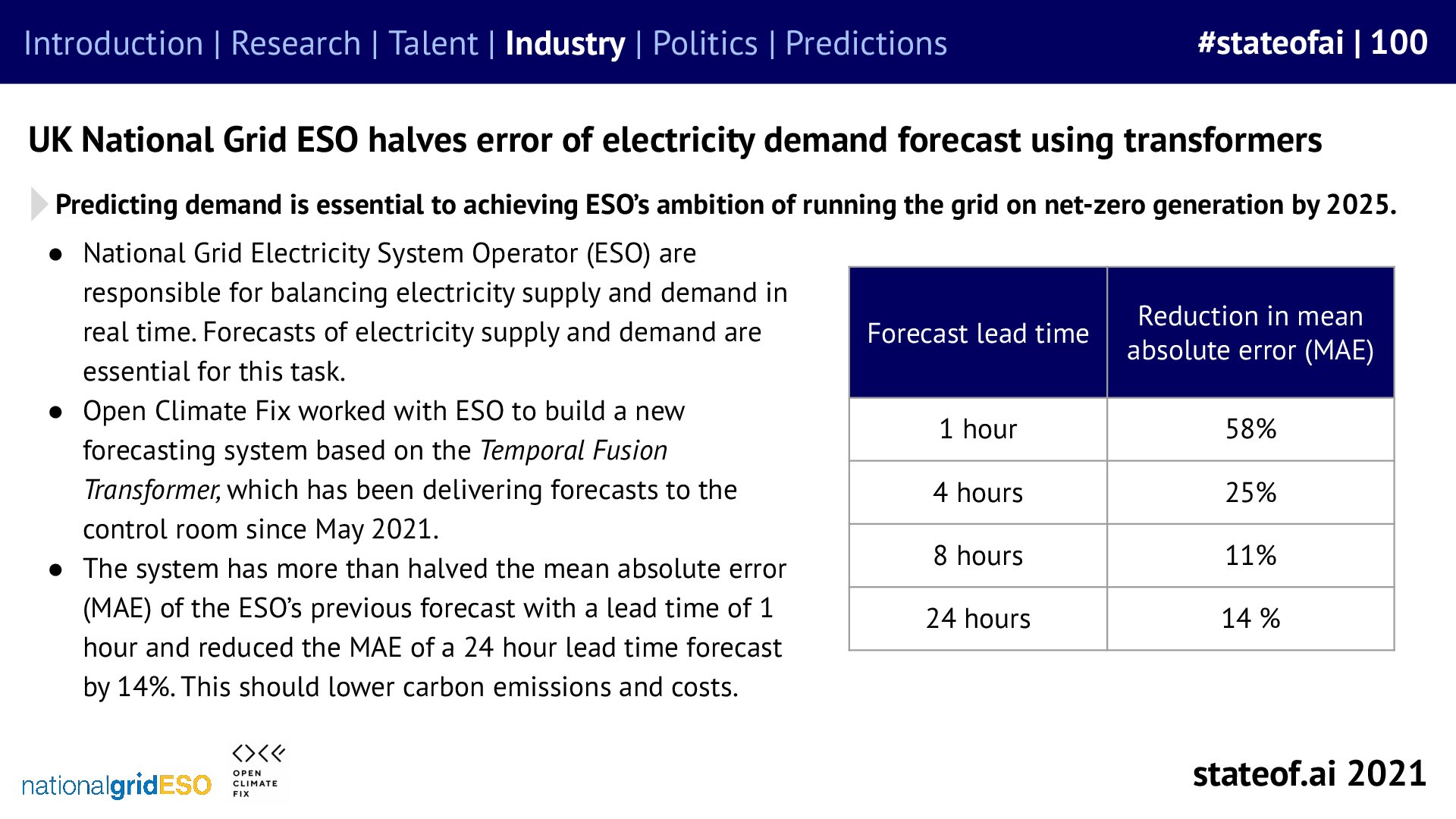
The deployed system reduced mean absolute error by 58% at a one-hour lead time and 14% at 24 hours compared with the previous forecast.
Forecast error is not an emissions or cost-saving metric. Application counts are not paying-customer counts, and code-generation tools still require evaluation of their outputs.
Evidence you can use
Historical snapshot: October 2021. Dates and populations are specified per row.
| Measure | Reported value | Definition and source |
|---|---|---|
| One-hour forecast error reduction | 58% | Reduction in mean absolute error against the previous ESO forecast.2021 report, slide 100 (PDF page 100) |
| 24-hour forecast error reduction | 14% | Same error metric at a different lead time.2021 report, slide 100 (PDF page 100) |
| GPT-3 applications | More than 300 | Application count reported in the integrations discussion.2021 report, slide 130 (PDF page 130) |
Forecast error is not an emissions or cost-saving metric. Application counts are not paying-customer counts, and code-generation tools still require evaluation of their outputs.
Historical snapshot published October 12, 2021. This web edition was prepared on 2026-10-11 from the online deck and original launch posts. Findings and forecasts retain their original time frame.
Benaich, Nathan, and Ian Hogarth. “How did AI improve the grid forecast in 2021?” State of AI Report 2021. Historical report snapshot; web edition prepared 2026-10-11.