How to read this finding
The warehouse example is site-specific and does not count every worker across JD.com’s supply chain. Citation indicators are proxies for research impact, and neither measure establishes overall national AI leadership.
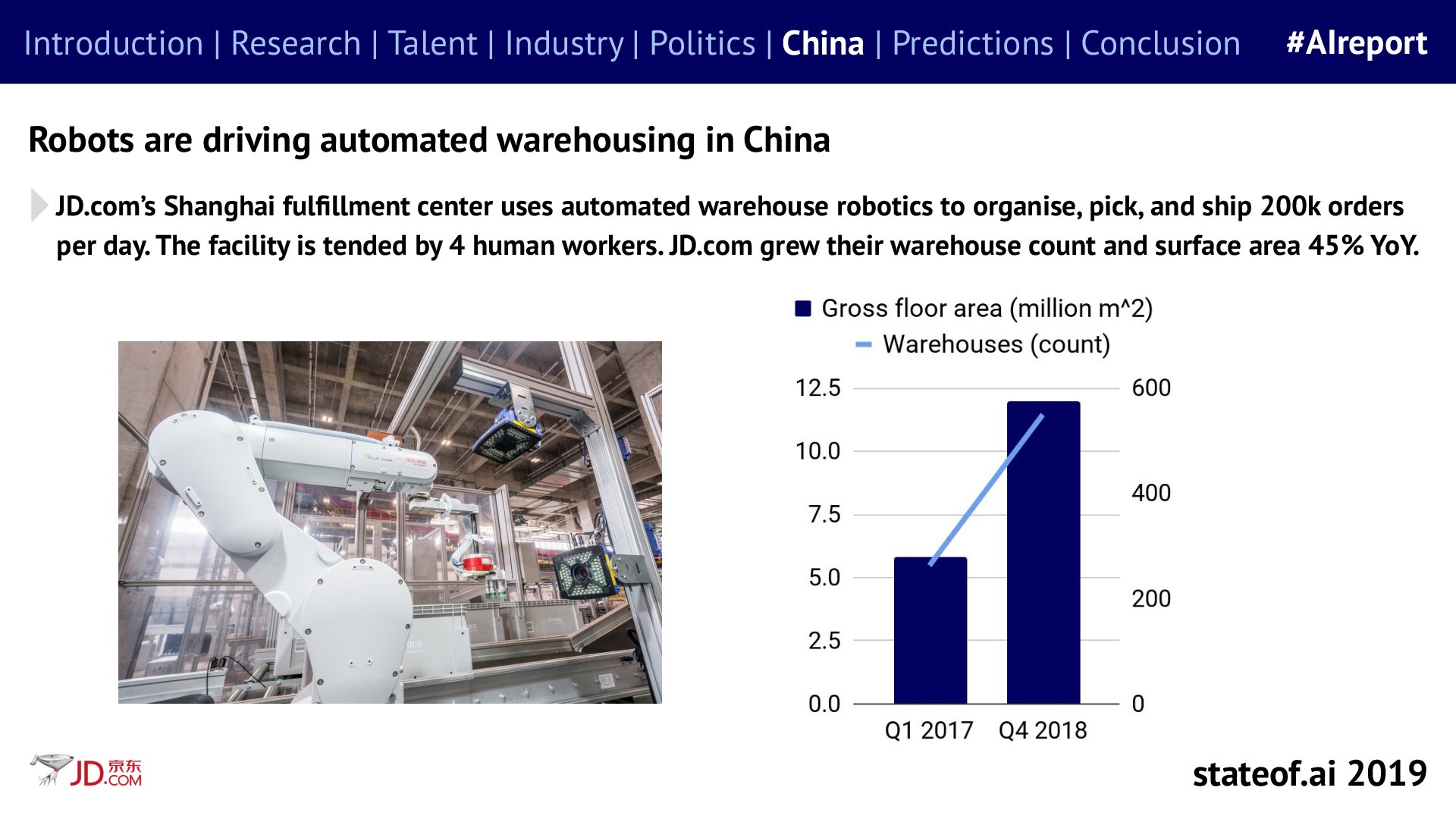
It highlighted a JD.com Shanghai facility reported to handle 200,000 orders per day with four workers tending it. The example described one facility, not the wider logistics workforce.
The warehouse example is site-specific and does not count every worker across JD.com’s supply chain. Citation indicators are proxies for research impact, and neither measure establishes overall national AI leadership.
Evidence you can use
Historical snapshot: June 2019. Dates and populations are specified per row.
| Measure | Reported value | Definition and source |
|---|---|---|
| JD.com selected facility throughput | 200,000 orders/day | Reported throughput at the Shanghai fulfillment center.2019 report, PDF page 125 |
| Workers tending the facility | 4 | Reported staffing for that selected automated facility.2019 report, PDF page 125 |
| Semiconductor position | Continuing trade deficit | Qualitative finding in the report’s sales and purchases comparison.2019 report, PDF page 123 |
The warehouse example is site-specific and does not count every worker across JD.com’s supply chain. Citation indicators are proxies for research impact, and neither measure establishes overall national AI leadership.
Historical snapshot published June 28, 2019. This web edition was prepared on 2026-10-11 from the online deck and original launch posts. Findings and forecasts retain their original time frame.
Benaich, Nathan, and Ian Hogarth. “What did the 2019 report say about China’s automated warehouses?” State of AI Report 2019. Historical report snapshot; web edition prepared 2026-10-11.