A model trained for one task need not start from scratch on the next. The 2018 report explained how reusing learned features could reduce the data required for new applications. Alongside this progress, experiments in games and attacks on image classifiers showed how uneven machine intelligence remained.
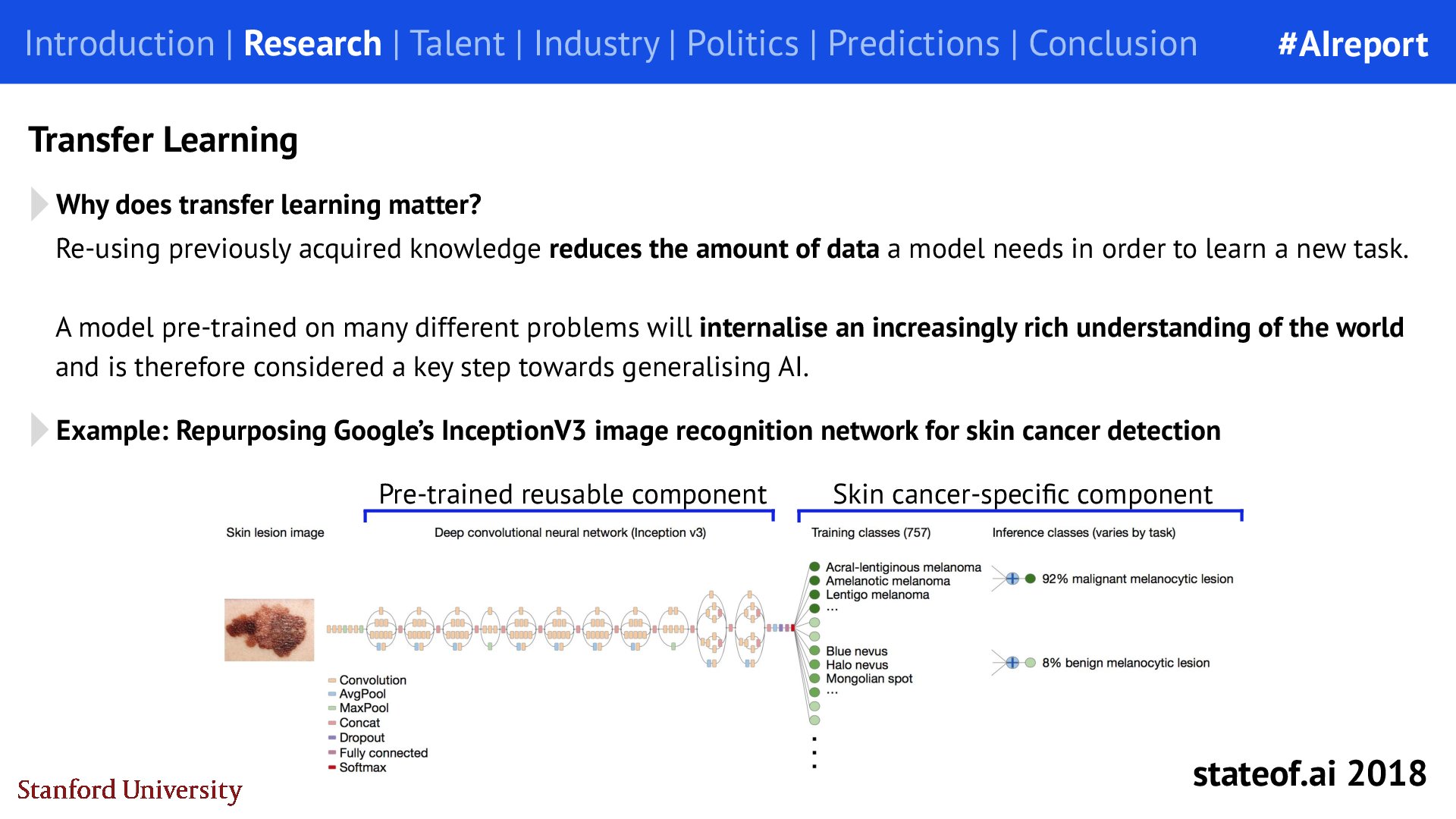
A pretrained image-recognition network can supply useful visual features for a new task, such as identifying skin lesions. The report used this example to explain why reusing knowledge could make AI practical with smaller specialist datasets. It did not mean a model could adapt to any task without new training or evaluation.
Seeing an object is different from understanding it
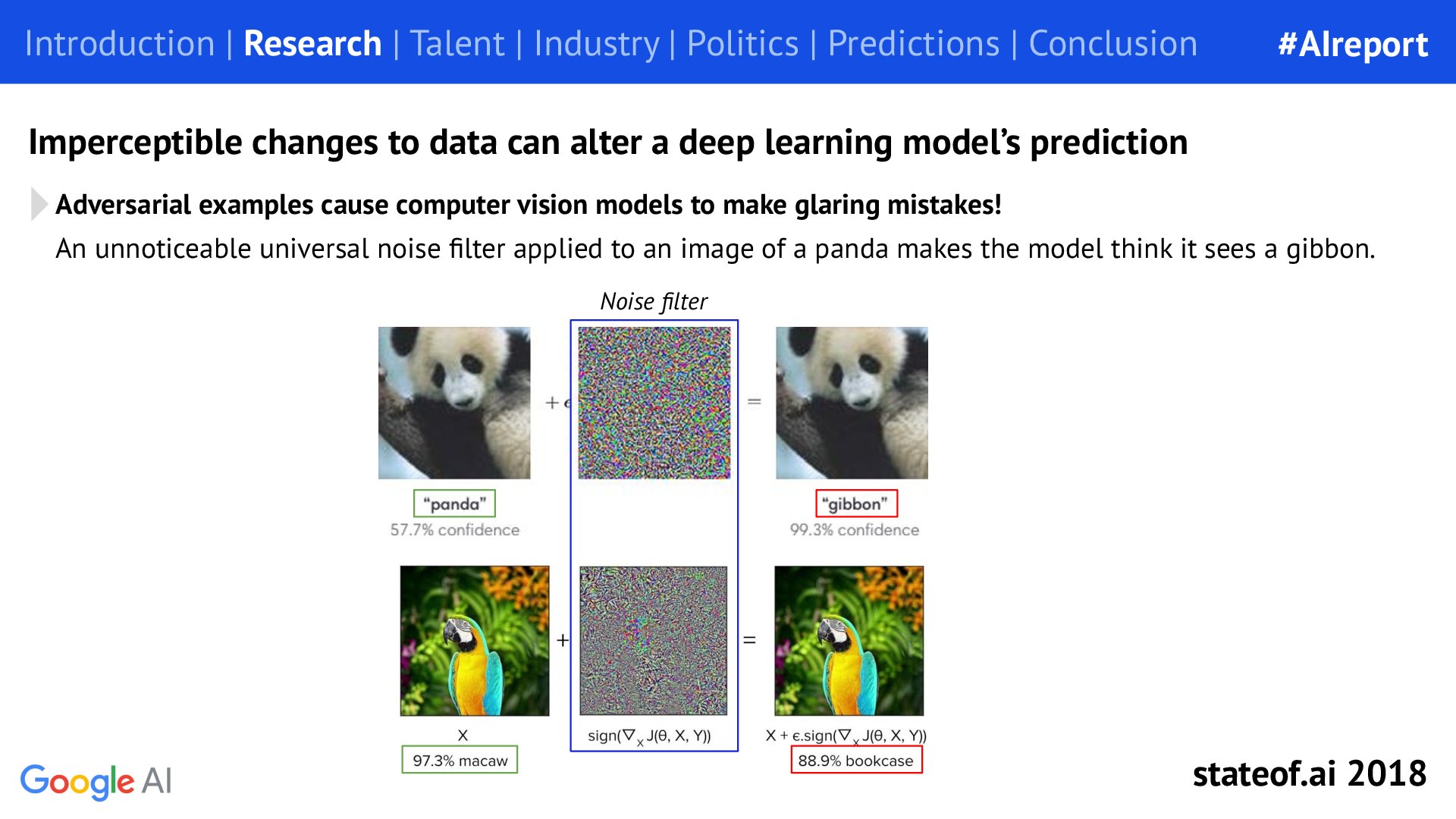
The report showed that small, deliberately chosen changes to an image could lead a classifier to a wrong answer. Such adversarial examples exposed a gap between high benchmark accuracy and reliable perception. They mattered for applications where an apparently minor input change could alter a consequential decision.
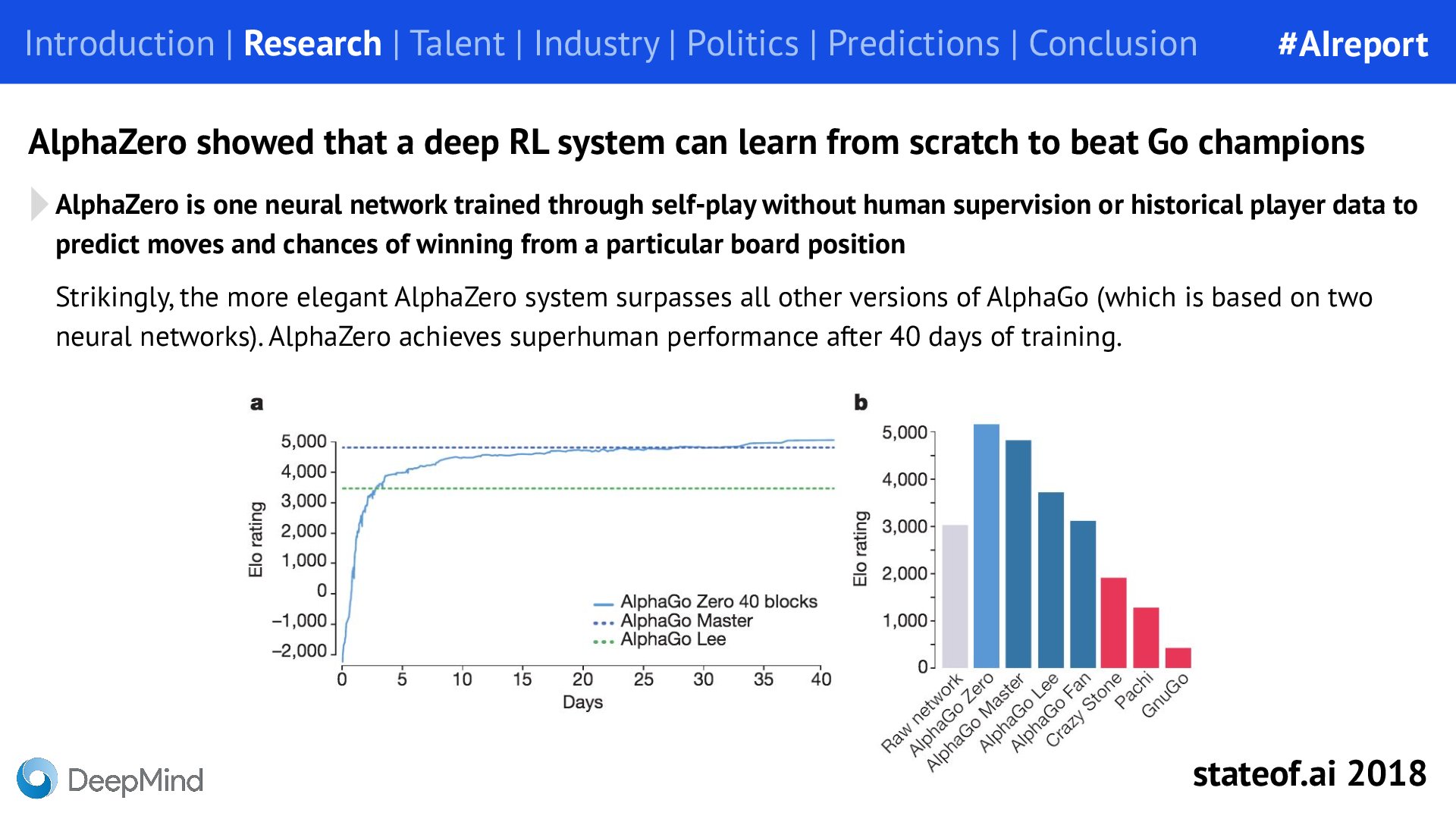
AlphaZero illustrated a different starting point from transfer learning: a system could improve by playing against itself instead of learning from historical human games. The report described a single neural network predicting moves and the chance of winning from a board position. Its success in Go showed what learning from experience could achieve in a game with clear rules and feedback.
Illustrated failure mode of image classifiers; not a population-wide error rate.2018 report, PDF page 48
These are research examples from 2018, not clinical recommendations or a measurement of general intelligence. Transfer performance depends on the relationship between the original and new tasks; adversarial examples illustrate vulnerabilities rather than normal-use error frequency.
It allowed a model to reuse features learned on one problem when training for another, potentially reducing the amount of new task-specific data needed. The report illustrated this with image-recognition features adapted to skin-lesion classification.
No. The report showed adversarial perturbations that caused incorrect classifications, demonstrating that ordinary accuracy benchmarks did not capture every failure mode.
It supplied visual features learned from an earlier task. A team could reuse those features and adapt the model to its own labels, rather than starting with an untrained network.
The report showed an InceptionV3 image-recognition network repurposed for skin-lesion classification. The example concerned adapting visual representations to a medical classification task.
No. Reusing a starting representation and adapting it to a particular problem were distinct steps. The report’s example retained a skin-cancer-specific component alongside the pretrained component.
It was an image altered so that a classifier changed its prediction even though the change could be difficult for a person to notice. The report illustrated this with image-recognition failures.
A model could classify familiar test images well and still fail after a carefully chosen perturbation. Accuracy and resistance to those perturbations tested different aspects of the system.
It generated experience through self-play. The report described a single neural network learning to predict moves and winning chances from board positions, with the results of games providing feedback.
Historical snapshot published June 29, 2018. This web edition was prepared on 2026-10-11 from the online deck and original launch posts. Findings and forecasts retain their original time frame.
2018 report, PDF page 8Original 2018 report. This edition has no printed slide numbers. References use one-based PDF pages.
2018 report, PDF page 37Original 2018 report. This edition has no printed slide numbers. References use one-based PDF pages.
2018 report, PDF page 48Original 2018 report. This edition has no printed slide numbers. References use one-based PDF pages.
Benaich, Nathan, and Ian Hogarth. “Learning once, adapting to new tasks.” State of AI Report 2018. Historical report snapshot; web edition prepared 2026-10-11.