How to read this finding
These shares refer to new monthly model derivatives on Hugging Face. They do not measure all model deployments, revenue, downloads, or the share of AI research. Approximate values are preserved as reported.
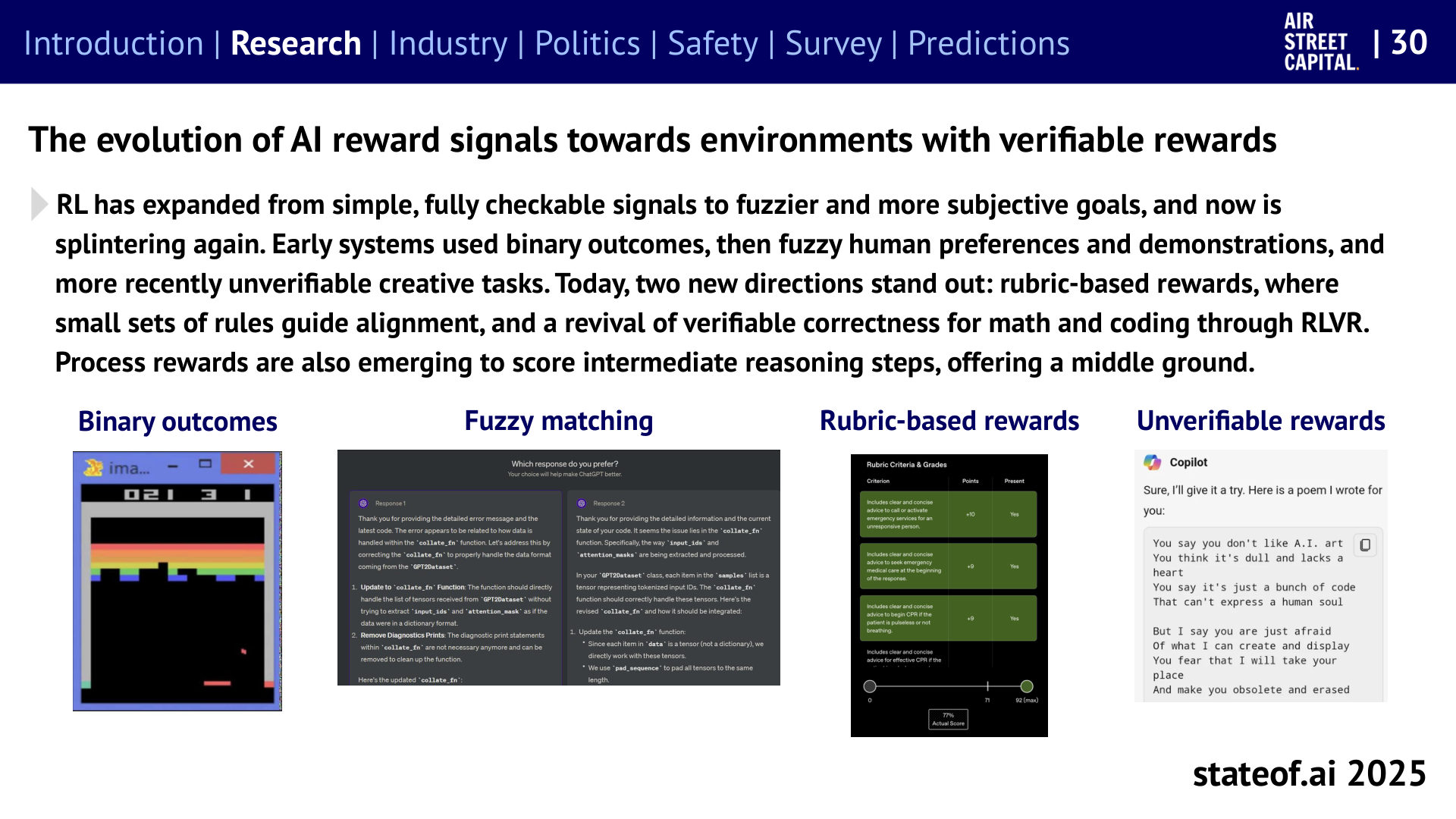
Models could improve difficult answers by spending more computation at inference time. Training with automatically verifiable rewards, especially in mathematics and programming, helped make those reasoning paths more useful.
These shares refer to new monthly model derivatives on Hugging Face. They do not measure all model deployments, revenue, downloads, or the share of AI research. Approximate values are preserved as reported.
Evidence you can use
2025 report snapshot; new monthly model derivatives
| Measure | Reported value | Definition and source |
|---|---|---|
| Qwen | More than 40% | Share of new monthly derivatives2025 report, slide 45 (PDF page 46) |
| Llama | About 15% | Share at the report snapshot2025 report, slide 45 (PDF page 46) |
| Llama, late 2024 | About 50% | Earlier comparison in the report2025 report, slide 45 (PDF page 46) |
These shares refer to new monthly model derivatives on Hugging Face. They do not measure all model deployments, revenue, downloads, or the share of AI research. Approximate values are preserved as reported.
Historical snapshot published October 9, 2025. This web edition was prepared on October 10, 2026 from the online deck and original launch posts. Findings and forecasts retain their original time frame.
Benaich, Nathan. “What changed with reasoning models?.” State of AI Report 2025. Historical report snapshot; web edition prepared 2026-10-10.