By Nathan Benaich (Air Street Capital) · 2024 report
By October 2024, the leading language models were looking increasingly alike on familiar benchmarks. OpenAI o1 changed the question from how much compute to spend training a model to how much it should spend working through a problem. At the same time, Meta showed that an openly available model could compete near the proprietary frontier.
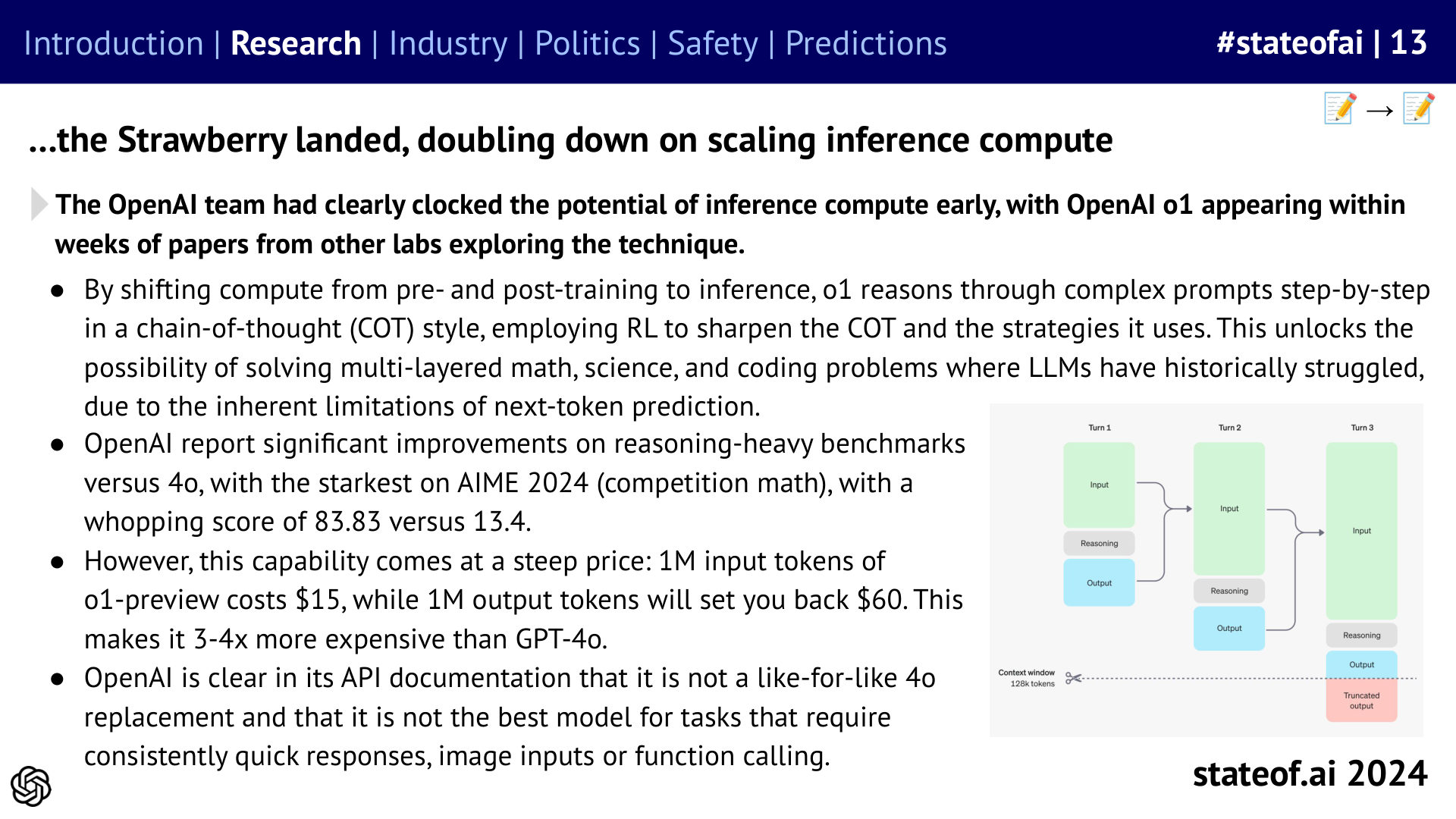
OpenAI o1 used reinforcement learning to improve step-by-step reasoning. The report highlighted large gains on competition mathematics, alongside a practical tradeoff: o1-preview was slower and more expensive than GPT-4o and lacked some of its features. More time spent reasoning created another way to improve performance, but did not make it the best model for every task.
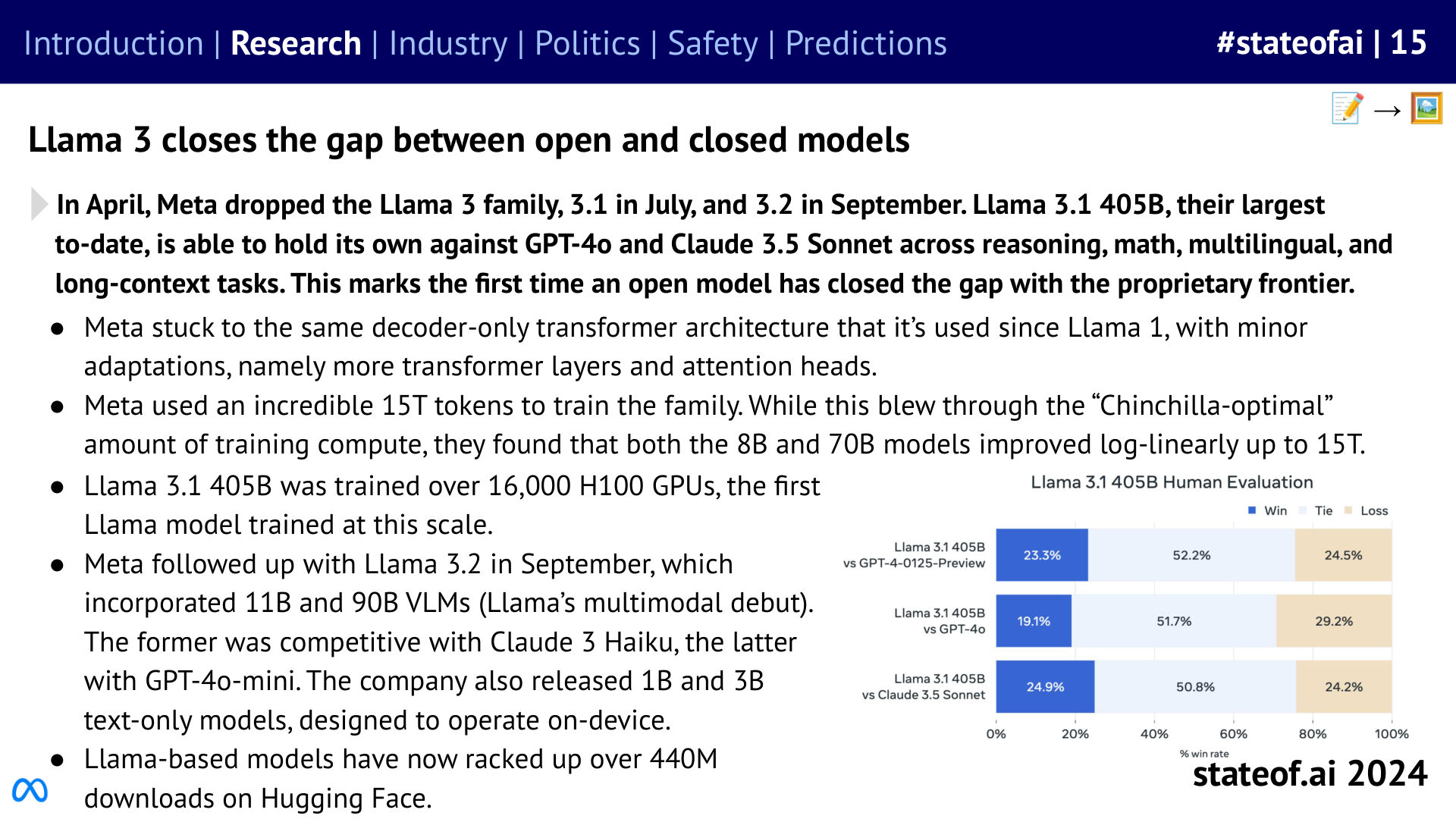
Llama 3.1 405B competed with GPT-4o and Claude 3.5 Sonnet across several reasoning, mathematics, multilingual, and long-context benchmarks. Meta trained the family on 15 trillion tokens and followed it with multimodal and on-device models. Availability of weights expanded what others could build and inspect, while the model’s license still mattered.
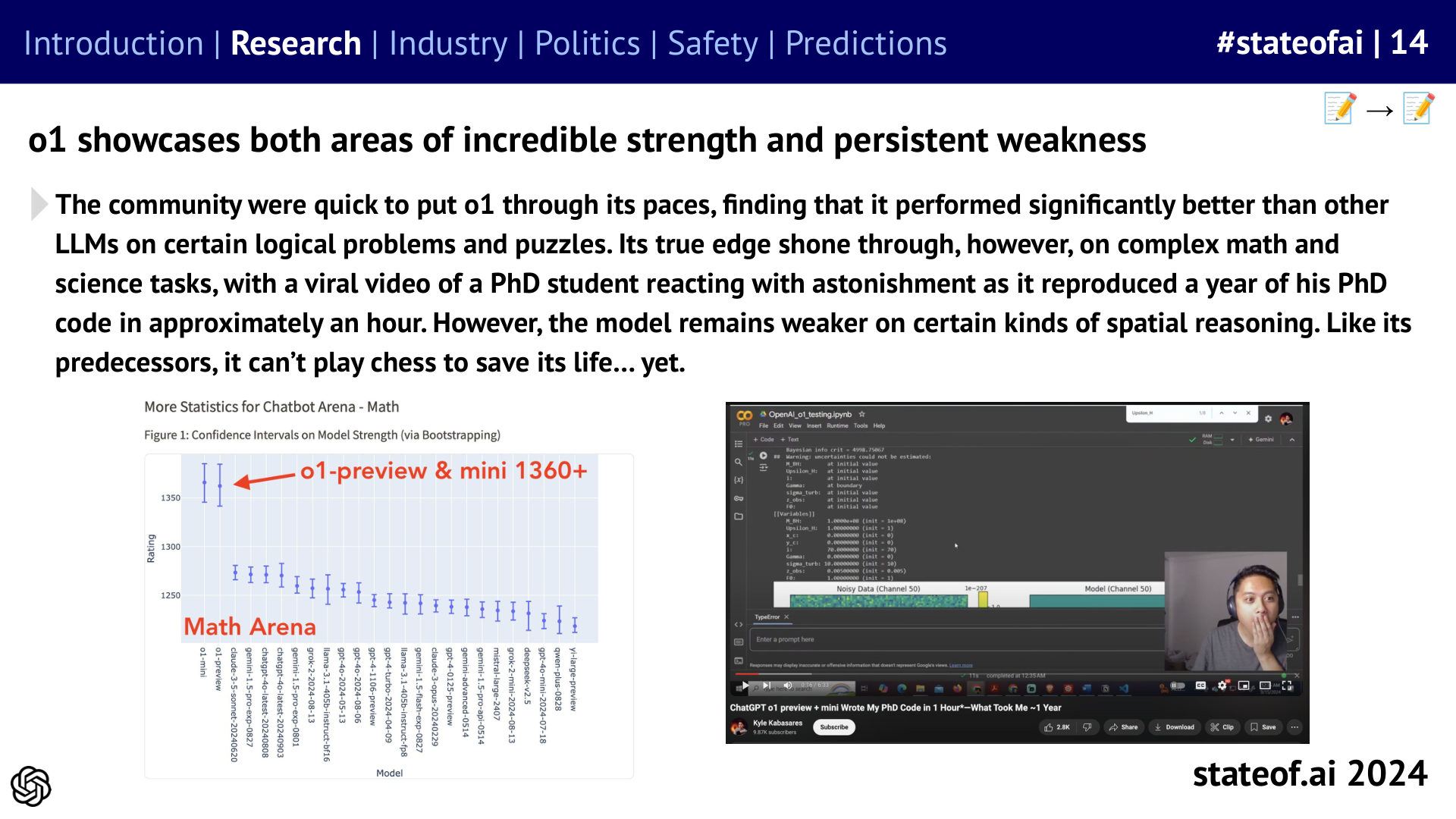
The first tests of o1 showed striking results on some complex mathematics and science problems, alongside weaknesses in spatial reasoning and games such as chess. The report treated these as evidence of uneven capabilities. A high benchmark score did not establish reliable reasoning across unfamiliar situations.
The report’s o1 discussion paired stronger results on some hard problems with higher cost and latency. That changed model selection from a simple ranking exercise into a task-specific choice. A system useful for a difficult mathematical question was not automatically the best option for every everyday interaction.
Evidence you can use
AI progress in the 2024 report
Historical snapshot: October 2024. Dates and populations are specified per row.
These are reported model specifications and launch-era prices. Benchmark comparisons depend on task, inference budget, and evaluation setup; they are not a universal ranking of intelligence.
o1 used additional computation while answering and reinforcement learning to improve its reasoning process. The report emphasized gains on complex math and science, with higher cost and slower responses than the general-purpose alternative.
Llama 3.1 405B was competitive with leading proprietary models on several evaluated tasks. That finding was about the reported benchmark comparisons, not a claim that every open model matched every closed model.
No. The report showed both impressive results and persistent weaknesses, including spatial reasoning and chess. Performance remained dependent on the kind of problem.
No. The report described slower responses, higher cost, and missing features alongside reasoning gains. Which model was useful depended on the task and the user’s constraints.
It was o1-preview’s output-token API price in the October 2024 report. It was a historical list price, not a current quote or the total price of every request.
It described the Llama 3 family’s training corpus in the report. It did not describe a model’s context window or the number of tokens needed for one inference.
It had 405 billion parameters. The report compared it with leading closed models across several benchmarks, while retaining the distinction between available weights and unrestricted licensing.
The report highlighted complex mathematics and science tasks, alongside improvements on some logical problems and puzzles. It also described persistent weaknesses in spatial reasoning and chess, showing why performance needed to be assessed by task.
Historical snapshot published October 10, 2024. This web edition was prepared on October 10, 2026 from the online deck and original launch posts. Findings and forecasts retain their original time frame.
2024 report, slide 13 (PDF page 14)Original 2024 report. Printed slide numbers are one lower than PDF page numbers because the cover is unnumbered.
2024 report, slide 14 (PDF page 15)Original 2024 report. Printed slide numbers are one lower than PDF page numbers because the cover is unnumbered.
2024 report, slide 15 (PDF page 16)Original 2024 report. Printed slide numbers are one lower than PDF page numbers because the cover is unnumbered.