All topicsSTATE OF AI REPORT.

NVIDIA’s lead grows into an infrastructure question

NVIDIA remained central to the AI buildout in 2024. Its chips dominated the research footprint tracked by the report, while the infrastructure required to use them began to collide with power availability and technology companies’ climate commitments.

Questions in this section

How dominant was NVIDIA in AI research in 2024?Why did electricity become an AI constraint?When did NVIDIA reach $3 trillion?

AI demand takes NVIDIA to $3 trillion

NVIDIA reached a $3 trillion market capitalization in June 2024 as major AI labs depended on its hardware. The report connected that financial milestone to the demand for large training and inference systems, while also examining whether the wider industry could earn returns on its infrastructure spending.
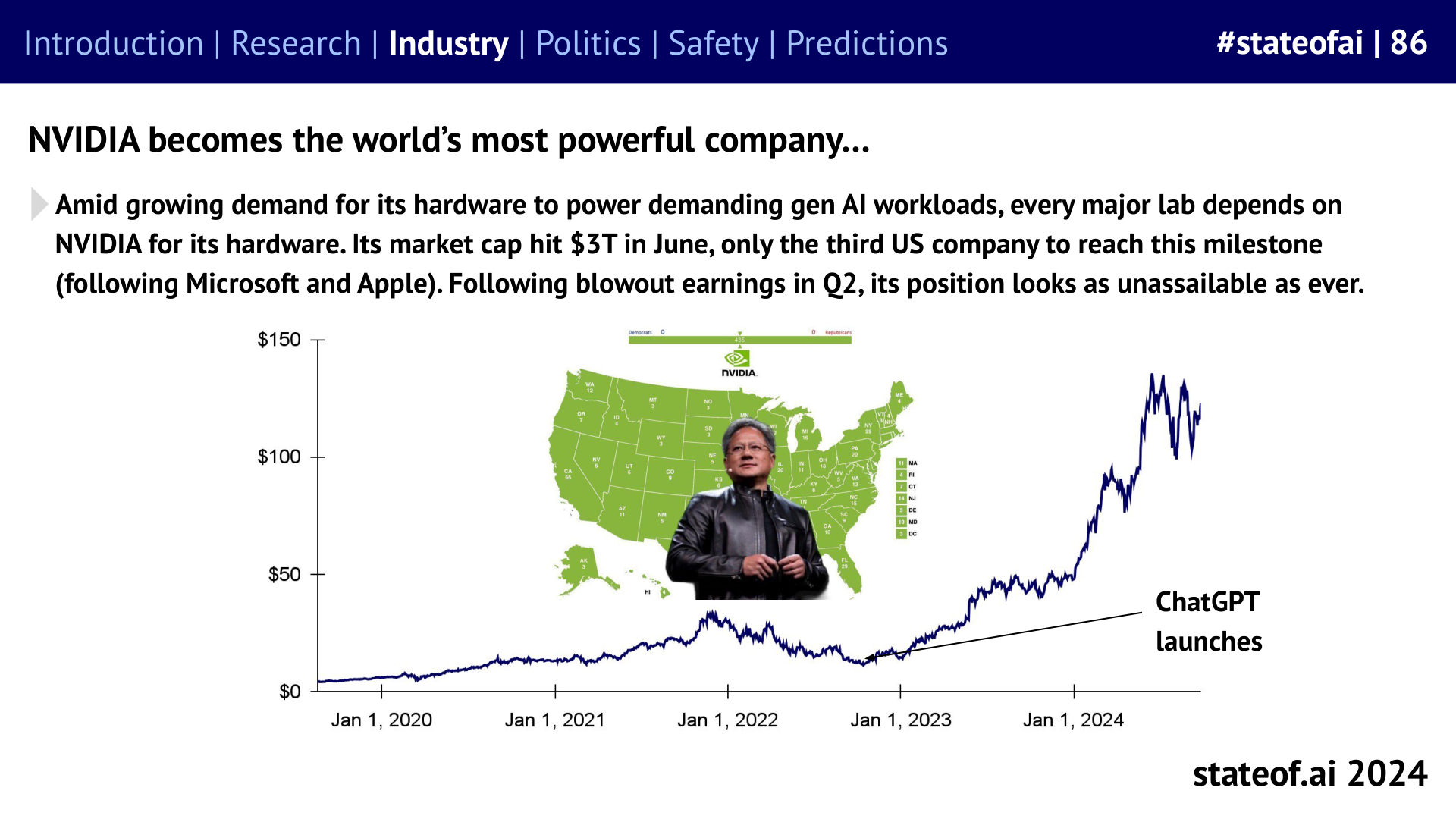
AI demand takes NVIDIA to $3 trillion - 2024 report, slide 86
AI demand takes NVIDIA to $3 trillion. 2024 report, slide 86 (PDF page 87)

Research usage shows a durable lead

The Compute Index found NVIDIA mentioned in AI research papers 11 times as often as all its peers combined. That ratio had narrowed from 19 times in the previous report as alternatives grew, including TPUs and Huawei Ascend. Paper mentions showed which hardware researchers used and reported; they were not a measure of chip revenue or installed capacity.
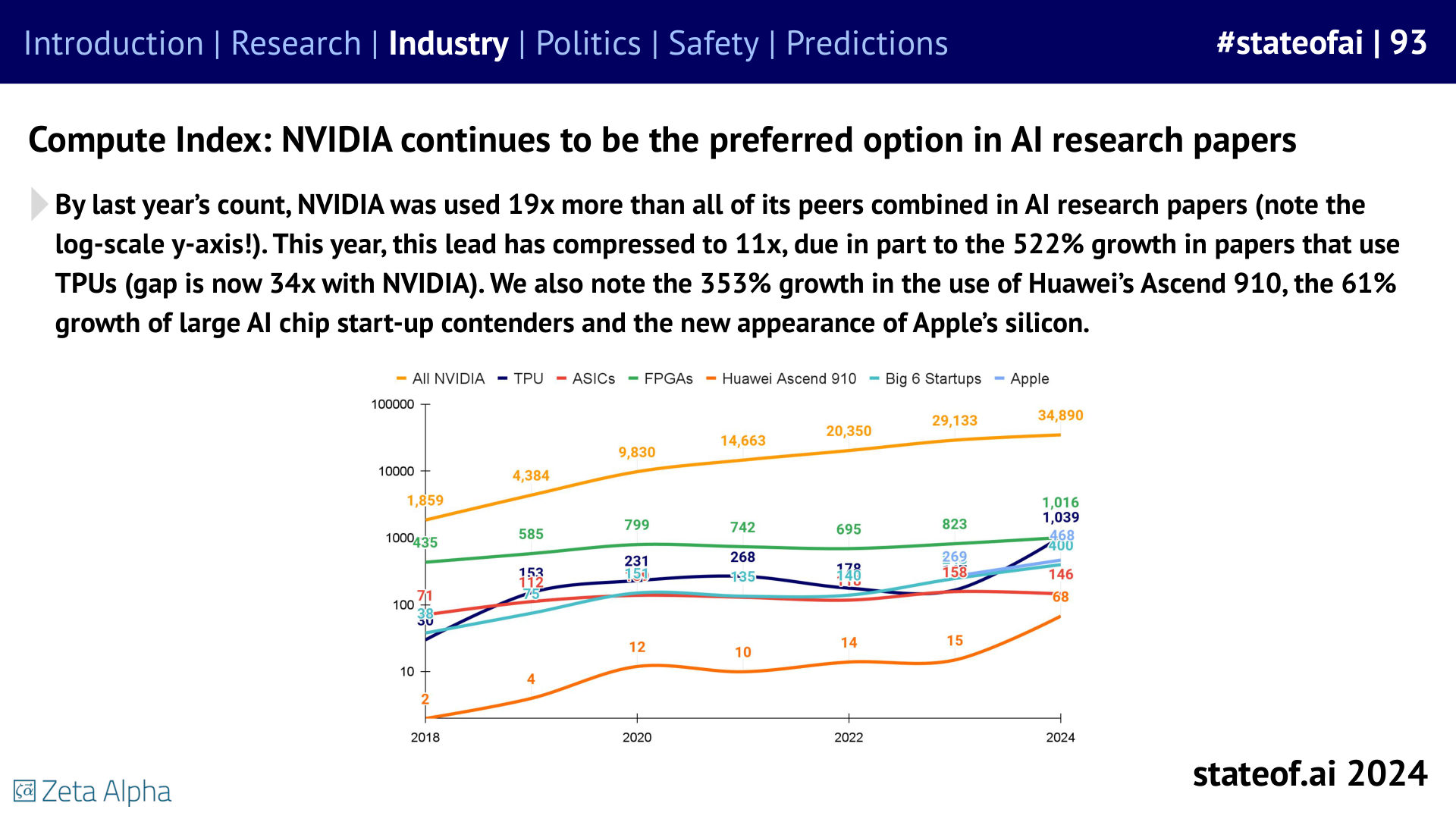
Research usage shows a durable lead - 2024 report, slide 93
Research usage shows a durable lead. 2024 report, slide 93 (PDF page 94)

Power demand challenges climate commitments

The report cited rising emissions at Google and Microsoft and growing demand for data-center electricity. It also distinguished forecasts from observed results: the projected increase in power demand by 2030 was an estimate, while company emissions figures described past changes. The buildout’s constraints extended beyond access to GPUs.
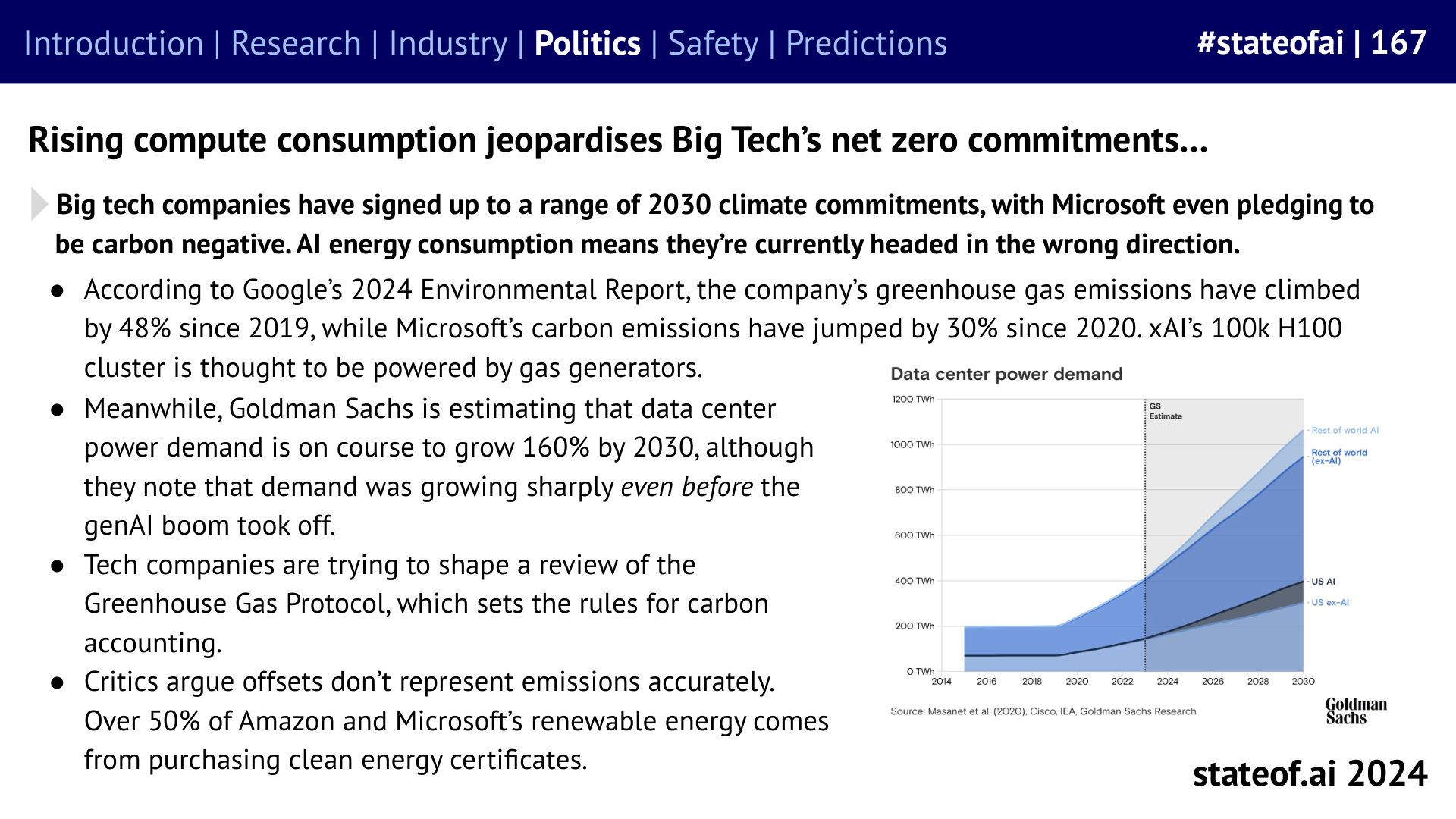
Power demand challenges climate commitments - 2024 report, slide 167
Power demand challenges climate commitments. 2024 report, slide 167 (PDF page 168)

Evidence you can use

Compute in the 2024 report

Historical snapshot: October 2024. Dates and populations are specified per row.

Compute in the 2024 report
MeasureReported valueDefinition and source
NVIDIA research-paper usage11x peers combinedCompute Index ratio in the 2024 report; based on hardware use identified in research papers.2024 report, slide 93 (PDF page 94)
Google greenhouse gas emissions48% above 2019Change cited from Google’s 2024 Environmental Report, across the company.2024 report, slide 167 (PDF page 168)
Microsoft carbon emissions30% above 2020Company-wide change cited by the report; not an estimate of AI-only emissions.2024 report, slide 167 (PDF page 168)

Research-paper usage is not market share. Company emissions cover activities beyond AI, so the reported changes cannot be attributed wholly to AI workloads. Forward projections elsewhere in the deck remain forecasts.

Frequently asked questions

Sources and dates

Historical snapshot published October 10, 2024. This web edition was prepared on October 10, 2026 from the online deck and original launch posts. Findings and forecasts retain their original time frame.

  1. 2024 report, slide 86 (PDF page 87)Original 2024 report. Printed slide numbers are one lower than PDF page numbers because the cover is unnumbered.
  2. 2024 report, slide 93 (PDF page 94)Original 2024 report. Printed slide numbers are one lower than PDF page numbers because the cover is unnumbered.
  3. 2024 report, slide 167 (PDF page 168)Original 2024 report. Printed slide numbers are one lower than PDF page numbers because the cover is unnumbered.
  4. State of AI Report 2024: online slides
  5. Nathan Benaich: The State of AI Report 2024Air Street Press, October 10, 2024.
  6. Welcome to State of AI Report 2024Original website launch post, October 10, 2024.

Cite this page

Benaich, Nathan. “NVIDIA’s lead grows into an infrastructure question.” State of AI Report 2024. Historical report snapshot; web edition prepared 2026-10-10.