All topicsSTATE OF AI REPORT.

AI designs proteins and interprets genetic variation

Beyond chatbots, the 2023 report documented AI methods working on scientific problems with distinct data and validation requirements. Diffusion models generated protein structures, AlphaMissense predicted the effects of genetic variation, and learned weather models improved on established forecasting tasks.

Questions in this section

What did RFdiffusion enable?What did AlphaMissense predict?How was NowcastNet evaluated?

Diffusion becomes a tool for protein design

RFdiffusion adapted a structure-prediction network into a generative system for protein backbones. Researchers could specify desired structural features, then use ProteinMPNN to design sequences for those structures. This created a way to propose new proteins with particular shapes and functions, with experimental testing still essential to determine what worked.
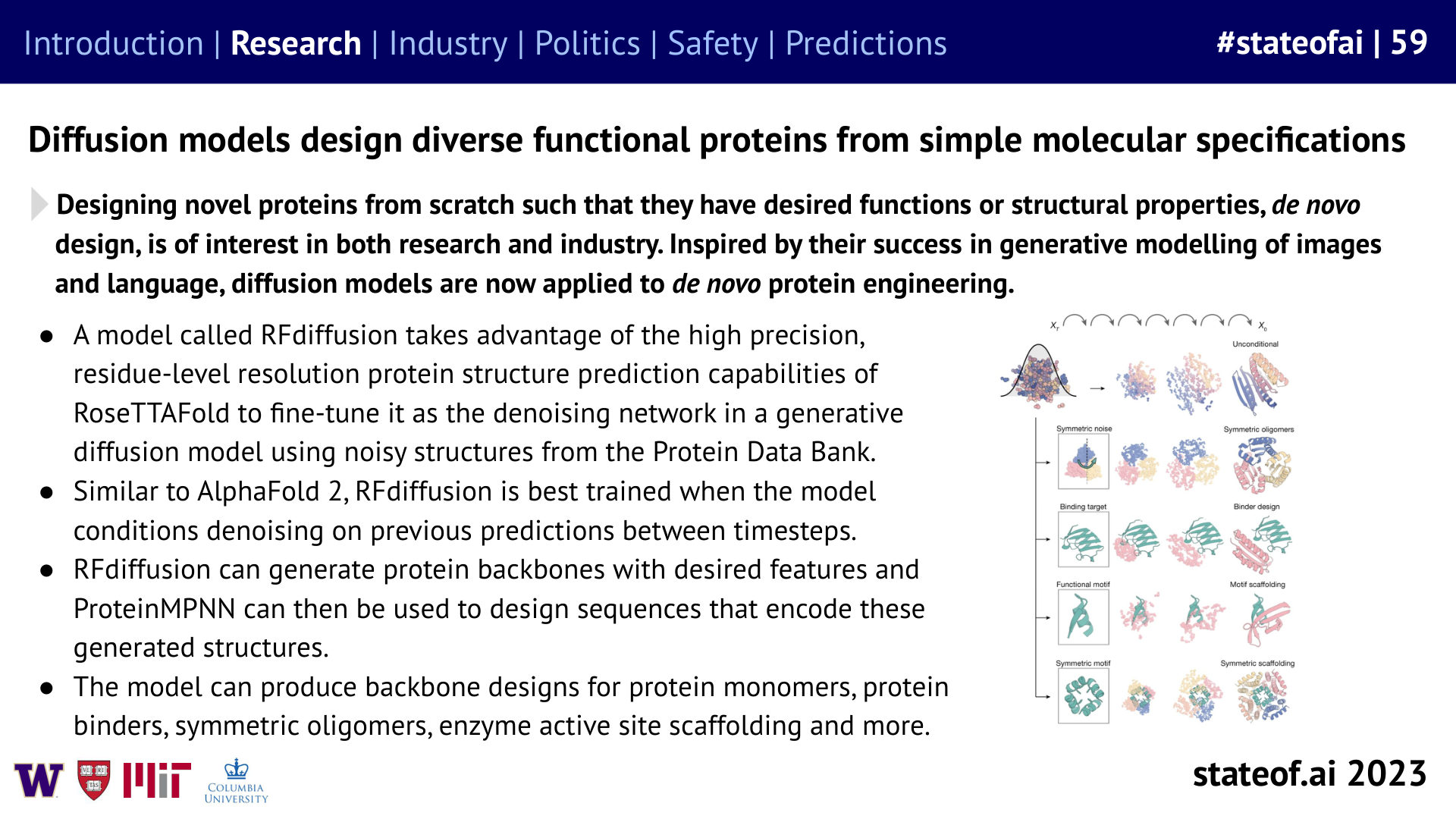
Diffusion becomes a tool for protein design - 2023 report, slide 59
Diffusion becomes a tool for protein design. 2023 report, slide 59 (PDF page 59)

AlphaMissense maps possible effects of genetic changes

AlphaMissense combined structural context and protein language modeling to predict the effects of 71 million missense variants. The report noted that most observed variants lacked confirmed clinical classifications. Its predicted labels expanded the information available to researchers, while remaining predictions rather than confirmed diagnoses.
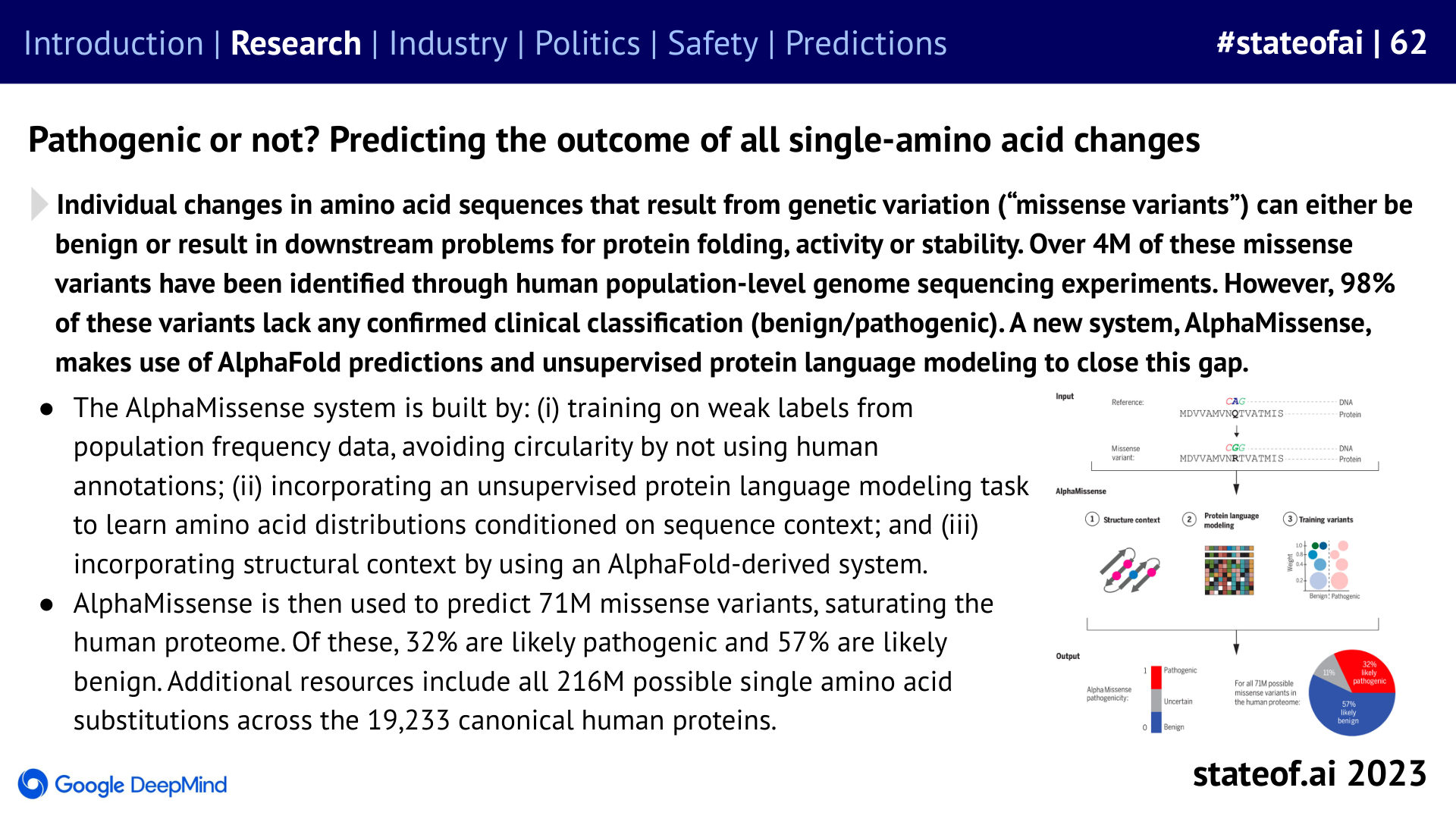
AlphaMissense maps possible effects of genetic changes - 2023 report, slide 62
AlphaMissense maps possible effects of genetic changes. 2023 report, slide 62 (PDF page 62)

Weather models combine learning with physical structure

NowcastNet combined physical principles and statistical learning for precipitation forecasting. In an evaluation by 62 professional meteorologists in China, it ranked first in 71% of cases against the compared methods. Pangu-Weather addressed medium-range forecasts using a different model and dataset. Results needed to be read within their own forecasting tasks.
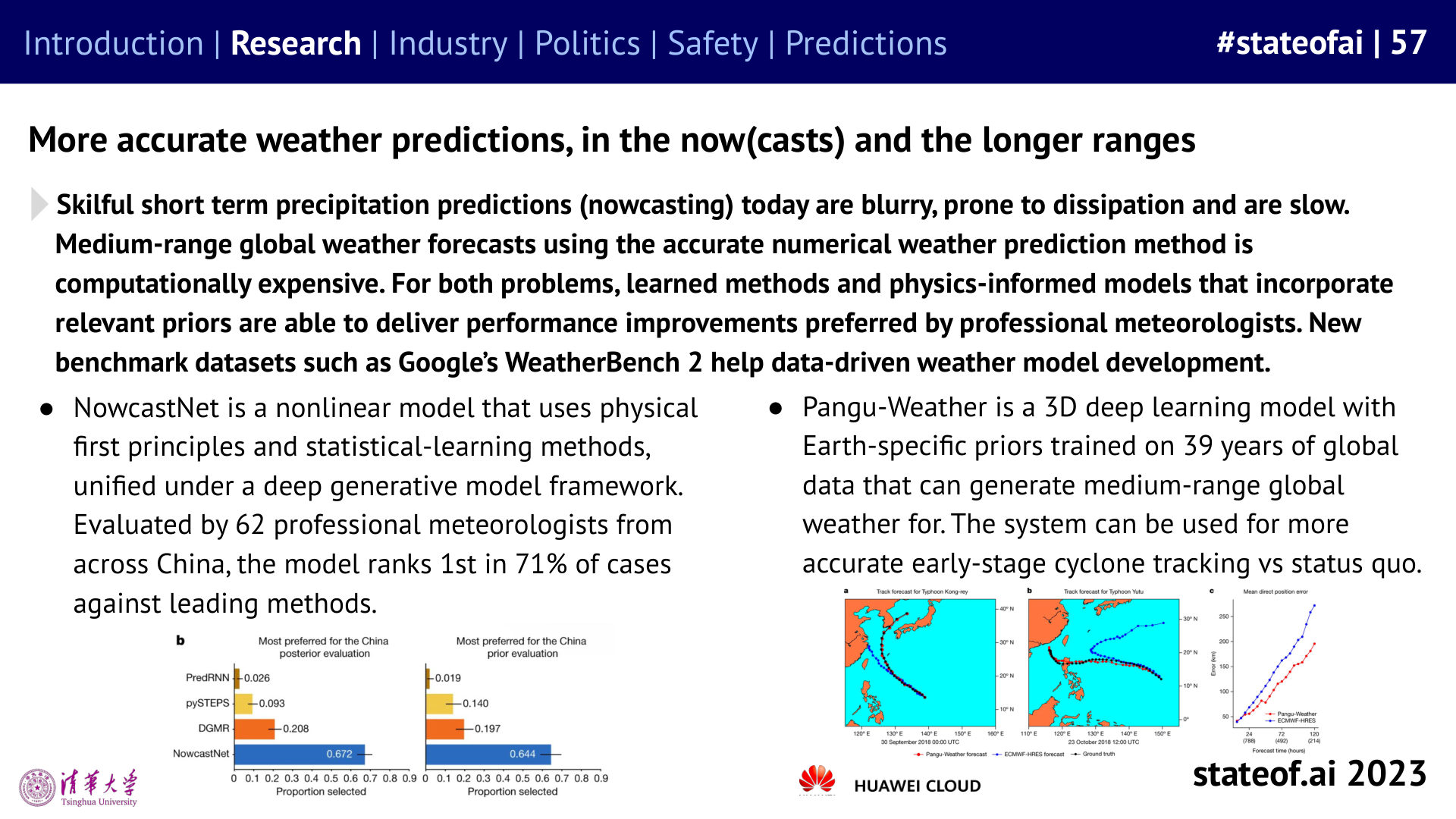
Weather models combine learning with physical structure - 2023 report, slide 57
Weather models combine learning with physical structure. 2023 report, slide 57 (PDF page 57)

Evidence you can use

AI for science in the 2023 report

Historical snapshot: October 2023. Dates and populations are specified per row.

AI for science in the 2023 report
MeasureReported valueDefinition and source
AlphaMissense predictions71M missense variantsPredicted effects across the human proteome, not 71 million clinically confirmed classifications.2023 report, slide 62 (PDF page 62)
NowcastNet expert evaluators62 meteorologistsProfessional meteorologists in China who evaluated the reported forecasts.2023 report, slide 57 (PDF page 57)
NowcastNet first-place ranking71% of casesShare of evaluated cases ranked first among compared methods; not forecast accuracy across all weather.2023 report, slide 57 (PDF page 57)

Variant labels are model predictions, not clinical diagnoses. Meteorologist rankings compare forecasts in a particular evaluation. Protein generation supplies candidates whose function must be established through appropriate experiments.

Frequently asked questions

Sources and dates

Historical snapshot published October 12, 2023. This web edition was prepared on October 10, 2026 from the online deck and original launch posts. Findings and forecasts retain their original time frame.

  1. 2023 report, slide 57 (PDF page 57)Original 2023 report. Printed slide numbers match PDF page numbers in this edition.
  2. 2023 report, slide 59 (PDF page 59)Original 2023 report. Printed slide numbers match PDF page numbers in this edition.
  3. 2023 report, slide 62 (PDF page 62)Original 2023 report. Printed slide numbers match PDF page numbers in this edition.
  4. State of AI Report 2023: online slides
  5. Nathan Benaich: The State of AI Report 2023Air Street Press, October 12, 2023.
  6. Welcome to State of AI Report 2023Original website launch post, October 12, 2023.

Cite this page

Benaich, Nathan. “AI designs proteins and interprets genetic variation.” State of AI Report 2023. Historical report snapshot; web edition prepared 2026-10-10.