By Nathan Benaich (Air Street Capital) · 2023 report
In October 2023, governments were still choosing how to regulate the new generation of AI systems. Some leaned on existing laws, others developed AI-specific frameworks, and international governance remained at an early stage. Control over advanced semiconductors was already a concrete instrument of state policy.
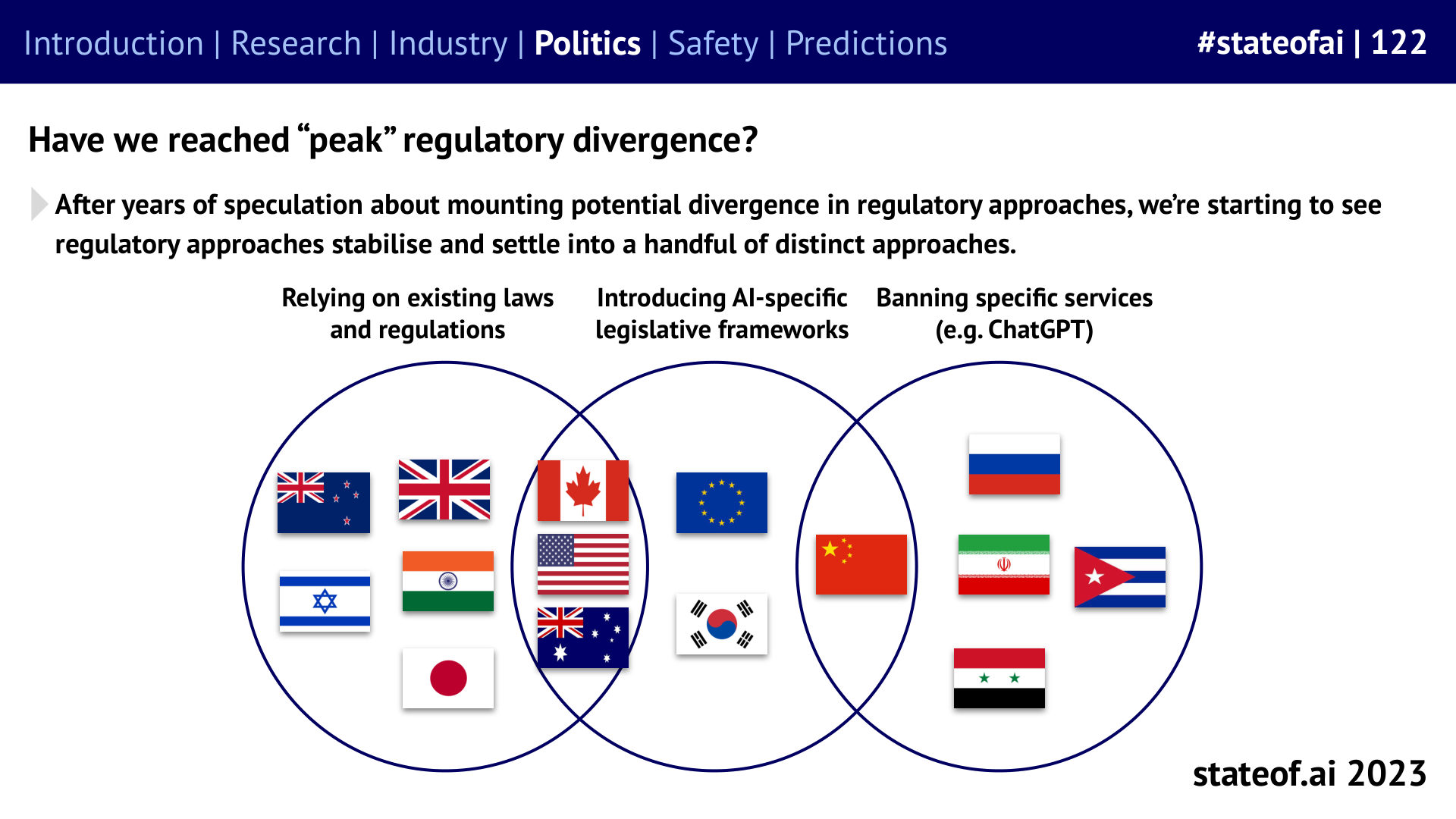
The report grouped emerging approaches around existing laws, new AI-specific frameworks, and restrictions on particular services. The UK and India emphasized existing regulation, while the EU’s AI Act was still moving through the legislative process and China had introduced generative AI rules. These were the positions recorded at publication, not a current legal map.
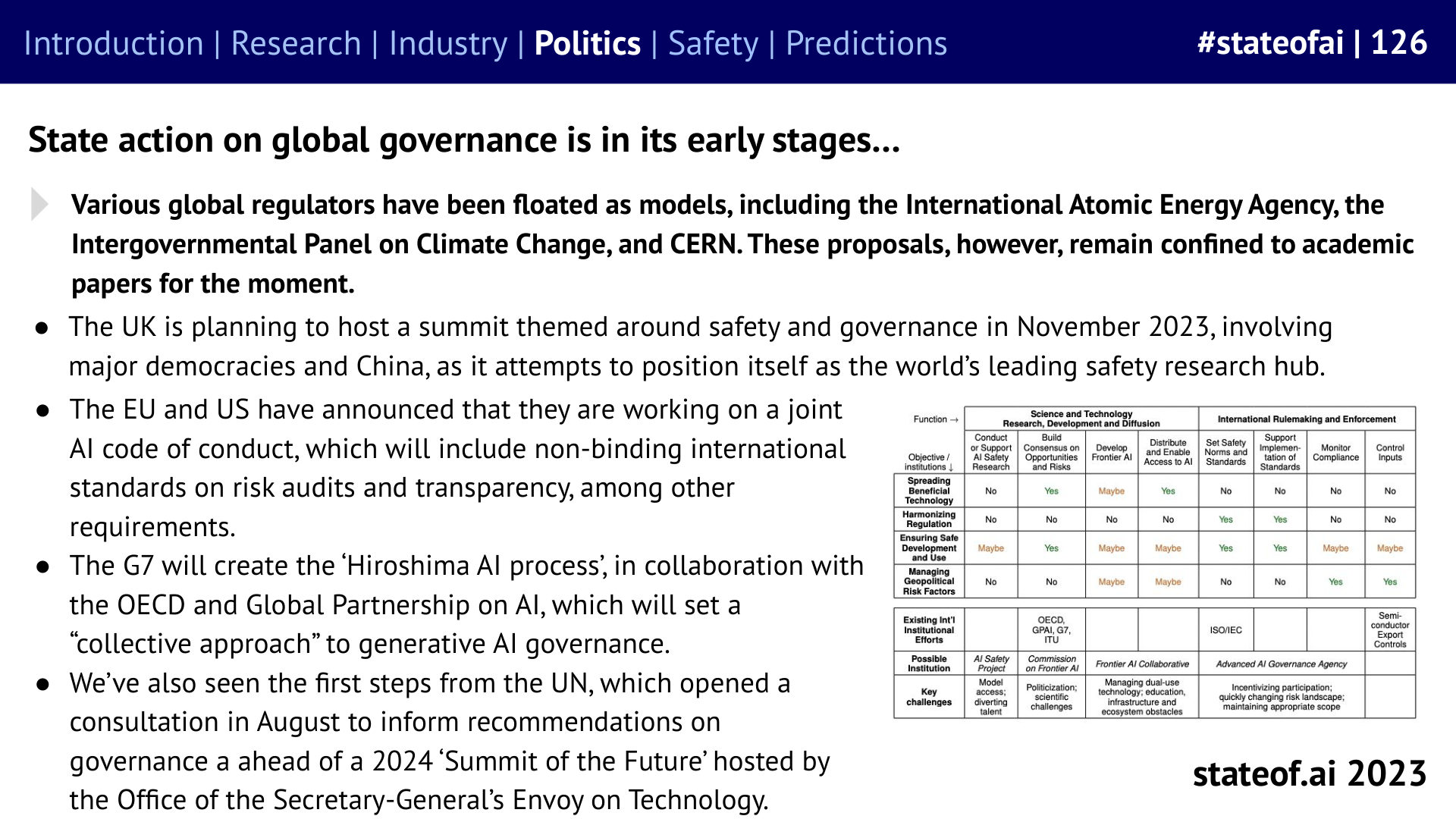
The UK was preparing a November 2023 safety summit, the EU and US were discussing a code of conduct, and the G7’s Hiroshima process was developing. Proposals for global institutions drew comparisons with existing scientific and regulatory bodies, but had not created a binding worldwide AI regime.
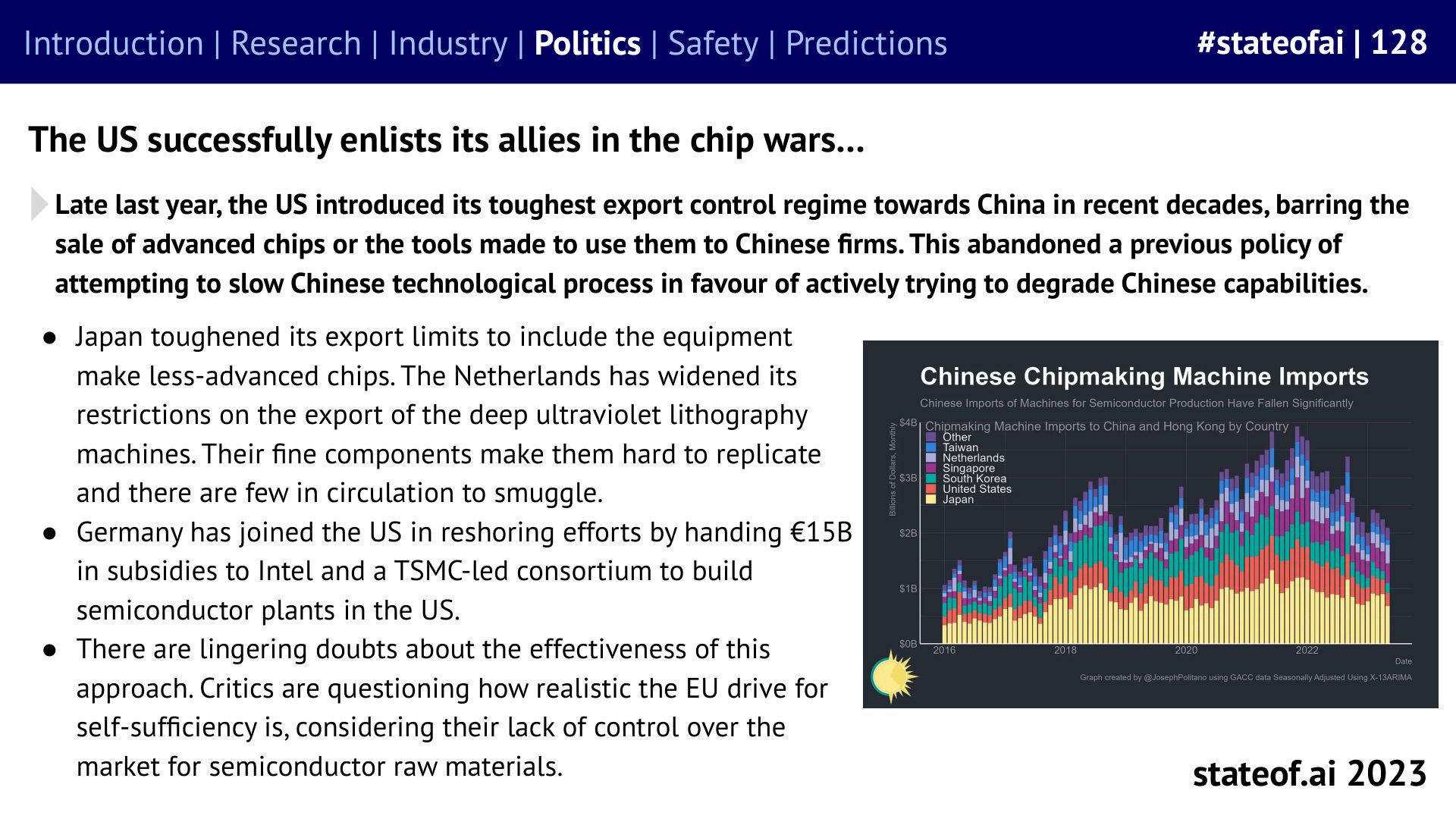
The US secured allied cooperation in restricting advanced semiconductor technology to China. The report discussed Japanese and Dutch export restrictions alongside doubts about the effectiveness and feasibility of the broader strategy. Hardware supply chains made AI policy an industrial and geopolitical issue as well as a question of model behavior.
Coordination proposals were different from binding governance
A summit, a code-of-conduct discussion, and a proposal for a new institution could all signal political attention. They did not create the same obligations or enforcement powers. The 2023 report captured an international process taking shape, with many institutional outcomes still unsettled.
Evidence you can use
AI policy in the 2023 report
Historical snapshot: October 2023. Dates and populations are specified per row.
The table preserves the policy picture as of October 2023. Proposals, scheduled events, and enacted restrictions are identified separately. It is not current legal or compliance guidance.
The report distinguished reliance on existing law, new AI-specific legislative frameworks, and restrictions on particular services. It emphasized that major jurisdictions were taking different approaches.
The report described proposals and early coordination efforts, including a planned UK summit and the G7 Hiroshima process. It did not identify a binding global AI regulator.
It grouped approaches into relying on existing laws, introducing AI-specific legislative frameworks, and banning particular services such as ChatGPT. These categories described the regulatory landscape in the 2023 snapshot.
The legislation was still in process when the report appeared. Later negotiations, adoption, and implementation cannot be inferred from that snapshot’s account of the proposal.
No. It was a prospective event in the October report. Treating it as a completed outcome would move evidence from outside the report’s original time frame into the snapshot.
They demonstrated efforts to coordinate on AI through a code of conduct and the Hiroshima process. They did not, by themselves, establish a binding global regulator.
The report connected their semiconductor-equipment controls with US efforts to restrict advanced technology access in China. AI competition depended on manufacturing supply chains as well as model regulation.
Historical snapshot published October 12, 2023. This web edition was prepared on October 10, 2026 from the online deck and original launch posts. Findings and forecasts retain their original time frame.
Benaich, Nathan. “Governments choose different paths for AI rules.” State of AI Report 2023. Historical report snapshot; web edition prepared 2026-10-10.