Research talent moves toward well-funded institutions
By Nathan Benaich and Ian Hogarth · 2020 report
The 2020 report examined the relationship between universities and large technology companies. Academic expertise moved into industry, while international education and migration underpinned US research strength. Simple national labels could obscure how researchers moved between institutions and countries.
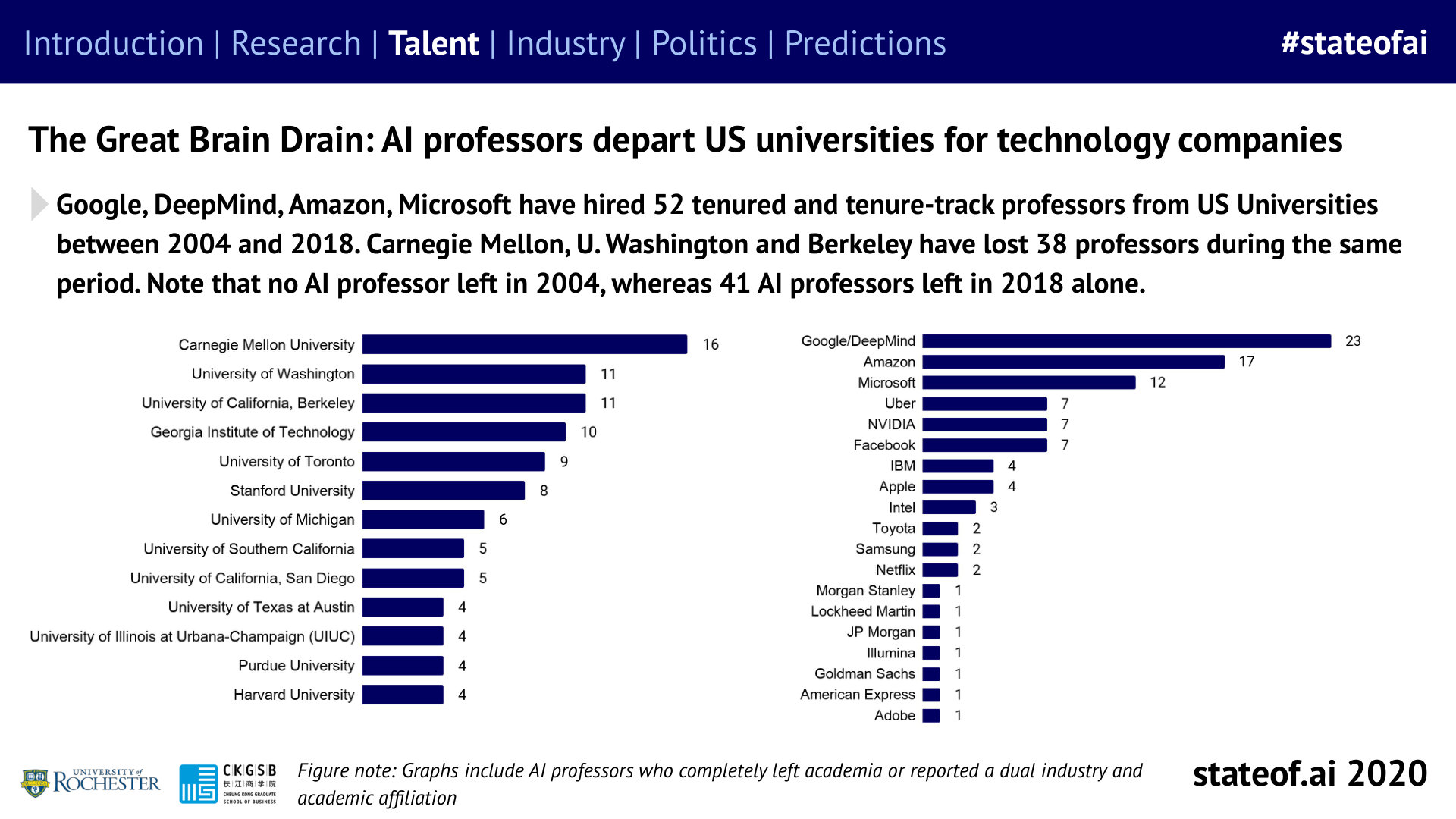
Google, DeepMind, Amazon, and Microsoft had hired 52 tenured or tenure-track professors from US universities between 2004 and 2018 in the cited analysis. The figure included people with dual academic and industry affiliations, so it should not be read as 52 complete departures from academia.
Chinese education contributes to international research
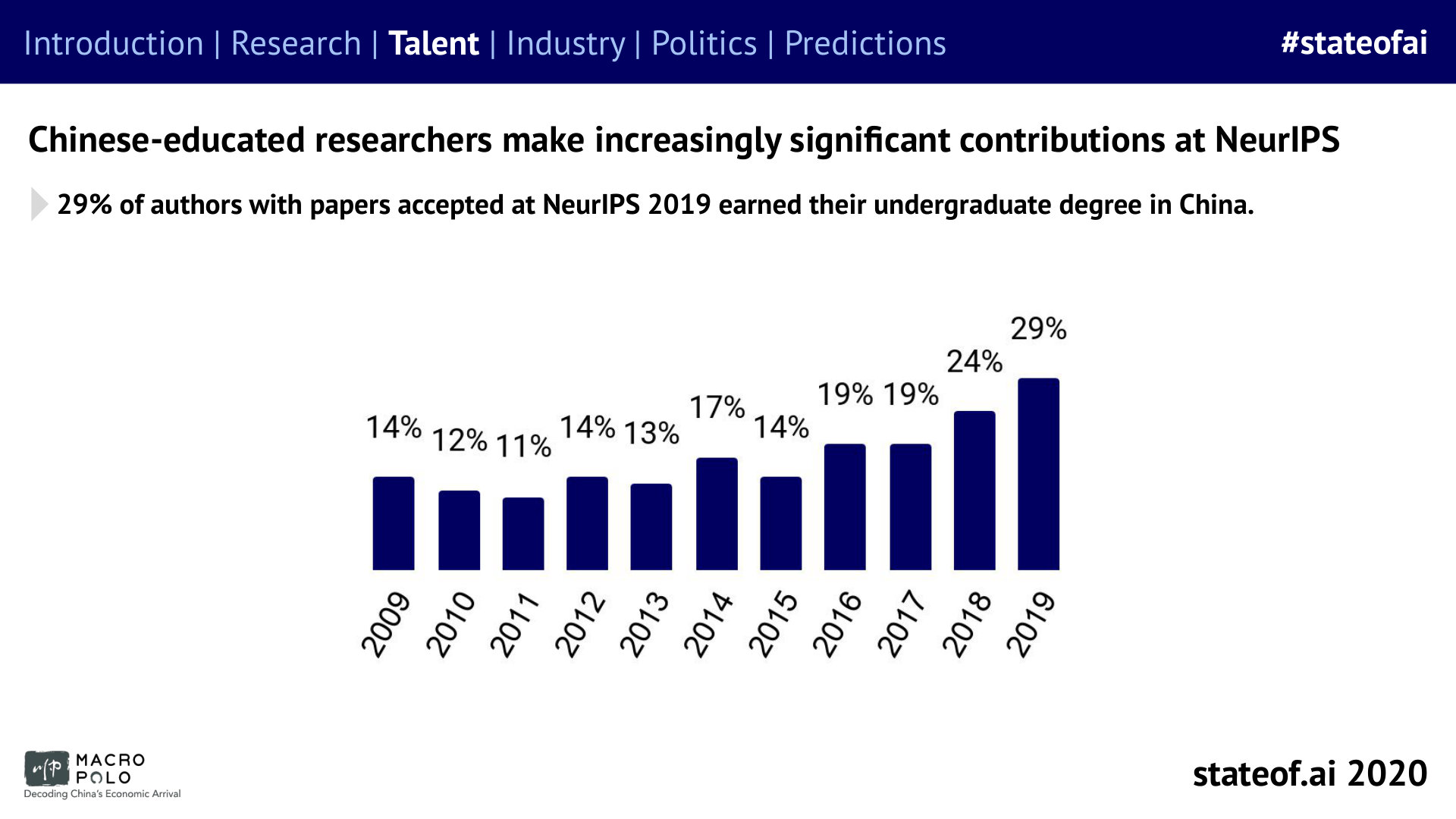
Among authors with papers accepted at NeurIPS 2019, 29% had earned their undergraduate degree in China. That measured educational origin rather than nationality or current employer. The report also described the US retaining a large share of international PhD graduates.
New training programs joined AI with domain expertise
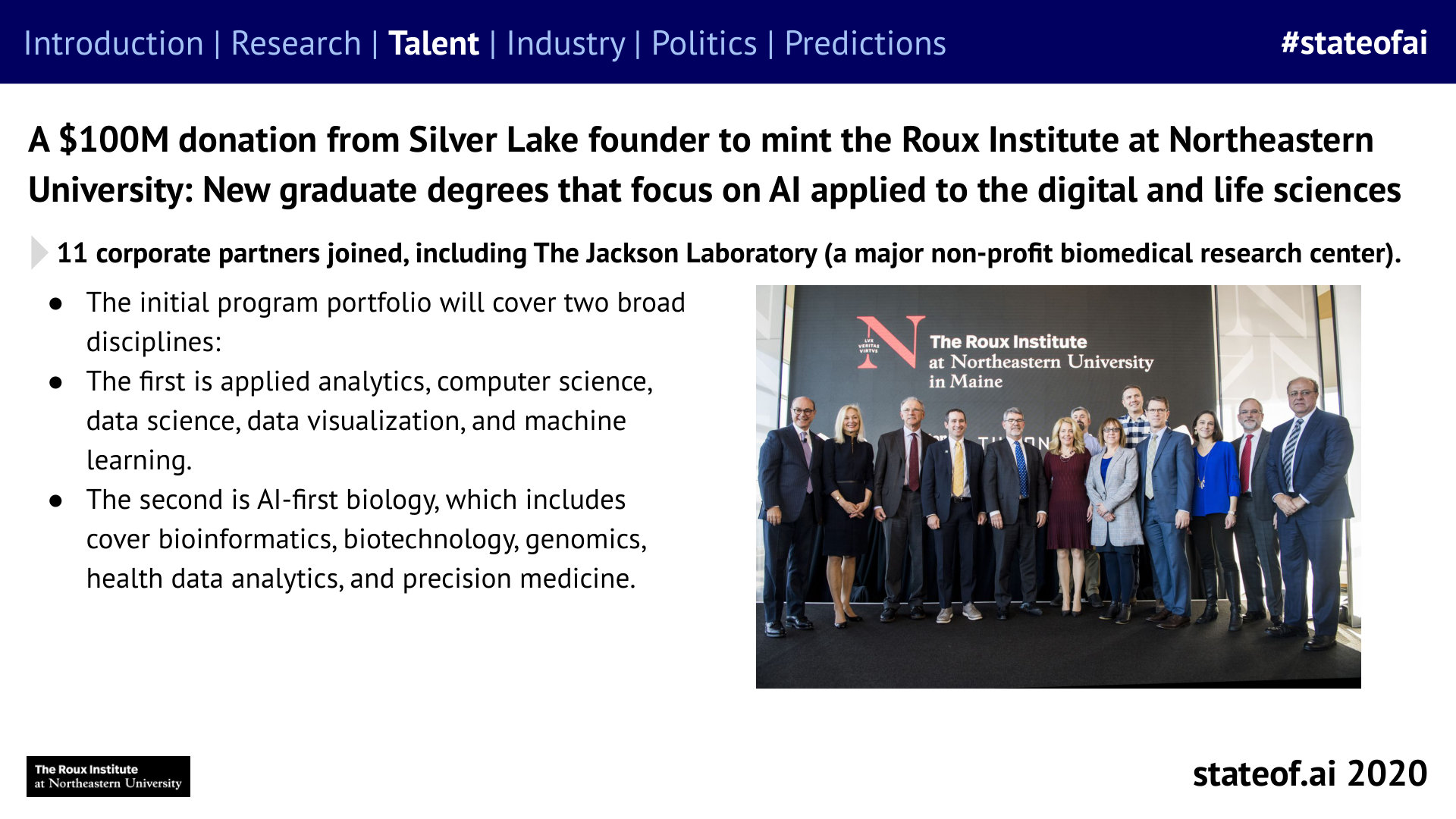
A $100 million donation supported the creation of the Roux Institute at Northeastern University. The report described graduate programs spanning computing and analytics alongside AI-first biology, including genomics, bioinformatics, and precision medicine. Eleven corporate partners had joined. The initiative showed one way institutions were trying to connect technical training with specific scientific and industrial problems.
Undergraduate degree location among NeurIPS 2019 accepted-paper authors.2020 report, PDF page 70
Affiliation changes are not all permanent exits from academia. Education location, citizenship, employer location, and migration are distinct attributes and should not be substituted for one another.
No. The report distinguished complete departures from dual affiliations. A company appointment could coexist with a university role, so the total was not simply a count of emptied academic positions.
The 52 appointments accumulated between 2004 and 2018. They did not describe hiring in 2020 alone or establish that the same number of moves occurred each year.
The figure concerned authors of accepted NeurIPS 2019 papers whose undergraduate education took place in China. The conference and education stage defined the population and measure.
No. Education location is a different attribute from nationality. It also does not establish current residence, employer, or where a researcher completed postgraduate training.
Supported by a $100 million donation, its planned graduate programs combined computing and analytics with AI-first biology. The report listed areas such as machine learning, bioinformatics, genomics, and precision medicine, and noted 11 corporate partners.
Historical snapshot published October 1, 2020. This web edition was prepared on 2026-10-11 from the online deck and original launch posts. Findings and forecasts retain their original time frame.
2020 report, PDF page 64Original 2020 report. This edition has no printed slide numbers. References use one-based PDF pages.
2020 report, PDF page 68Original 2020 report. This edition has no printed slide numbers. References use one-based PDF pages.
2020 report, PDF page 70Original 2020 report. This edition has no printed slide numbers. References use one-based PDF pages.
Benaich, Nathan, and Ian Hogarth. “Research talent moves toward well-funded institutions.” State of AI Report 2020. Historical report snapshot; web edition prepared 2026-10-11.