Training grows while representation remains uneven
By Nathan Benaich and Ian Hogarth · 2019 report
AI education was expanding quickly, but the 2019 report showed that participation remained concentrated. Universities were investing in computing across disciplines, while studies of conference authorship exposed substantial gender imbalance.
Universities make AI a broader educational priority
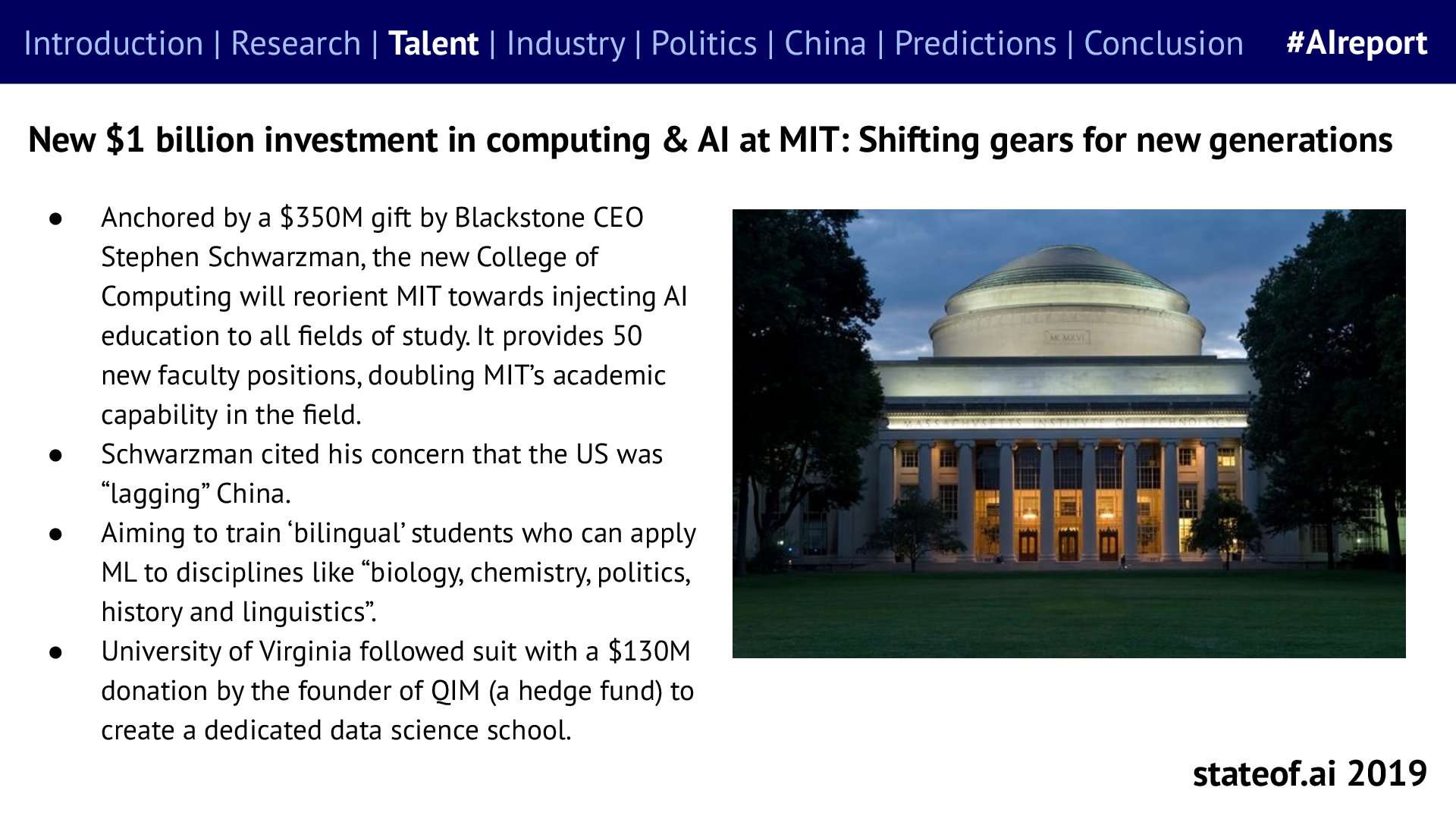
MIT’s new computing initiative aimed to bring AI into fields including biology, chemistry, and history. A $350 million gift anchored the $1 billion investment, with 50 new faculty positions planned. The ambition was to educate people who could connect computing with another discipline.
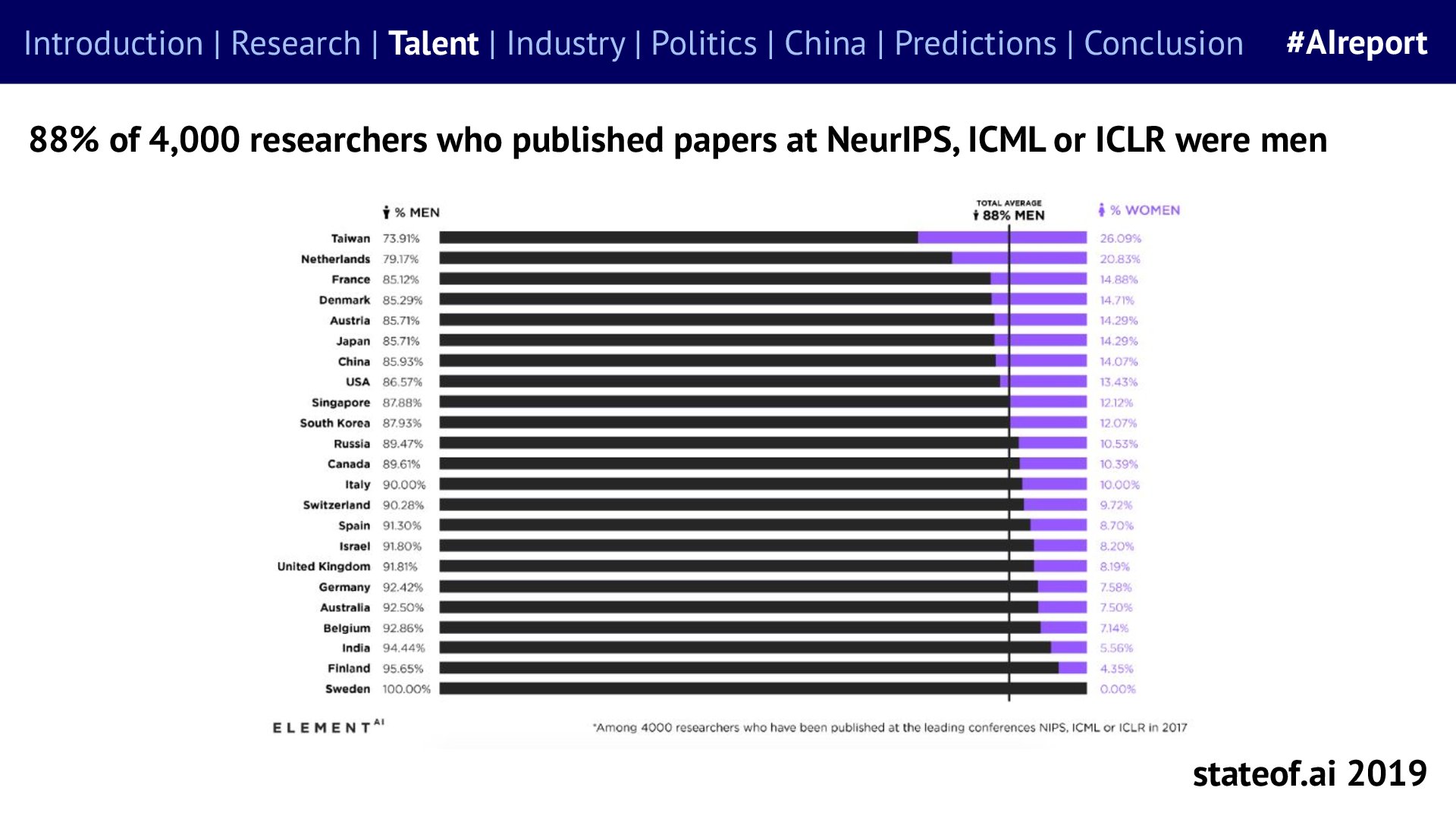
The report cited an analysis in which 88% of 4,000 researchers publishing at NeurIPS, ICML, or ICLR were men. This was a defined sample of research authors, not a census of all people working in AI.
MIT’s initiative joined computing capacity with work across other disciplines and proposed 50 faculty positions. The report presented a response to demand for people who could combine computational methods with subject knowledge, rather than treating every future AI practitioner as a specialist in the same narrow field.
Evidence you can use
Talent in the 2019 report
Historical snapshot: June 2019. Dates and populations are specified per row.
University commitments are plans; conference statistics describe a particular sample. Neither directly measures the size or composition of the entire AI workforce.
The initiative was anchored by a $350 million gift from Stephen Schwarzman. The gift and the total announced investment described different parts of the same plan.
The report listed 50 new positions as part of the computing initiative. That number described planned capacity, not a verified count of hires completed at publication.
No. The report emphasized combining AI and computing with other disciplines. The ambition included students and faculty using computational methods within their own fields.
No. It concerned the authors sampled at three machine-learning conferences. It did not measure every AI employee, student, or person working in technology.
Not as a clean trend. The earlier 17% figure concerned women among NIPS registrations; the 2019 analysis concerned authors across three conferences. Their populations and methods differed.
Historical snapshot published June 28, 2019. This web edition was prepared on 2026-10-11 from the online deck and original launch posts. Findings and forecasts retain their original time frame.
2019 report, PDF page 43Original 2019 report. This edition has no printed slide numbers. References use one-based PDF pages.
2019 report, PDF page 48Original 2019 report. This edition has no printed slide numbers. References use one-based PDF pages.
Benaich, Nathan, and Ian Hogarth. “Training grows while representation remains uneven.” State of AI Report 2019. Historical report snapshot; web edition prepared 2026-10-11.