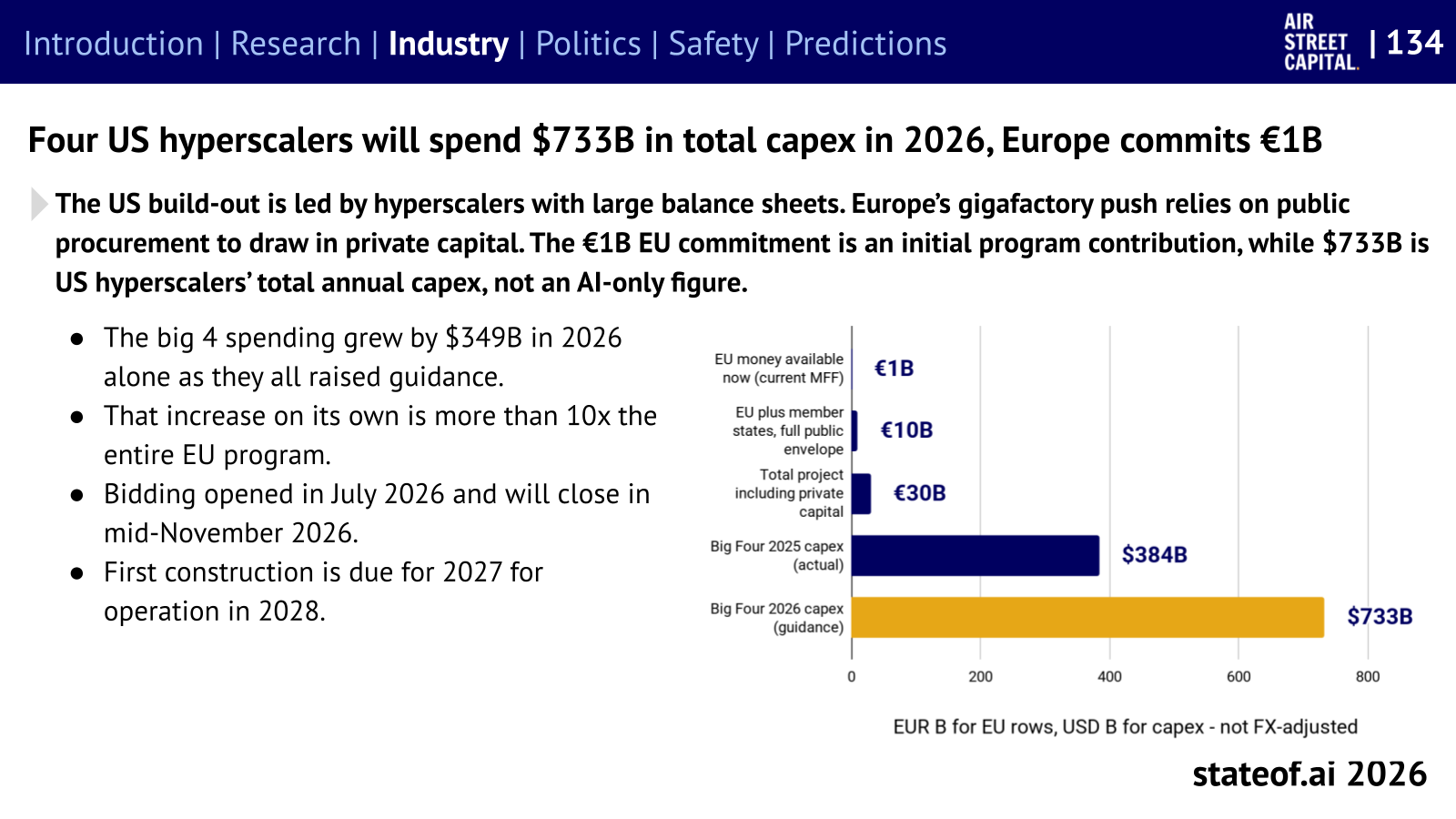
NVIDIA is cementing its role as the “central bank for AI” as it marches toward a $6T market cap. Its partnership with six financial institutions aims to mobilize over $500B for AI infrastructure to help developers focus on finding and financing sites, permits, power, cooling, networking, and chips.
Local opposition is delaying construction
But things are definitely not all rosy in data center land. Last year, we predicted a wave of US data-center NIMBYism and Gallup's March survey found that 71% of Americans opposed a local AI data center, versus 53% for a nuclear plant. Data Center Watch reported at least 45 projects, representing nearly $68B in planned investment, blocked or delayed by local opposition in Q2. Local consent is already determining which projects can proceed.
A power contract is the beginning of a construction process
Capacity moves through land acquisition, approvals, construction, energization, and hardware installation before a customer can run a job. The gap is especially visible among former crypto miners: the report tracks about 5.6GW of contracted AI power against roughly 900MW live at Q2 end. Existing sites and grid connections can help, but the AI facilities still require substantial new construction.
CoreWeave reported 4.2GW of contracted power as of August 11, 2026, alongside 1.5GW of active power at Q2 end. Contracted power secures future supply. It does not mean all that capacity is already operating. The figures refer to different reporting dates, and neither measures completed customer work or usable GPU performance.
Further reading: slide 123.
Agent training needs CPUs, memory, and working environments
Training an agent involves letting it act, observe results, and try again. These rollouts can use more compute than the subsequent learning update. MAI-Thinking-1 allocated 4,096 of 4,864 GB200s to inference, roughly five times the allocation to its learner. The training infrastructure must also synchronize fresh model weights with the machines generating new experience.
Realistic work requires stateful environments. Kimi K3 used millions of sandboxes with pause, resume, and snapshot capabilities. DeepSeek’s DSec describes a deployment unit with 30,000 CPU cores and 250TB of RAM, while reporting that most sandboxes used little of their requested CPU capacity. Scheduling and reclaiming idle resources therefore become part of the economics of better agents, alongside buying GPUs.
Further reading: slide 26.
Financing shifts some risk beyond the data-center owner
The infrastructure build-out increasingly uses leases, purchase commitments, and guarantees. A guarantee can support borrowing by promising to cover a specified shortfall if the customer defaults or the asset is worth less than expected. It also exposes the guarantor to a second channel of loss when customer demand or asset values disappoint.
Morgan Stanley’s compilation in the report puts off-balance-sheet commitments and credit support above $3T across seven hyperscalers and chipmakers. Most are purchase commitments and leases for facilities that have not opened. They are future contractual payments, not all current borrowings or immediate cash losses. The question is how much capacity customers will ultimately use, and who carries the obligations if the build-out gets ahead of demand.
Further reading: slide 125, slide 127.
Chips have different economic lives and different jobs
Older hardware remains in the rental market. The report records September 2026 median posted rates of $1.76 per hour for A100 and $0.95 for V100, six and nine years after their respective launches. Continued availability shows that new chips do not instantly erase every use for older ones. Posted rents cannot establish profitability or the correct accounting life without utilization and operating costs.
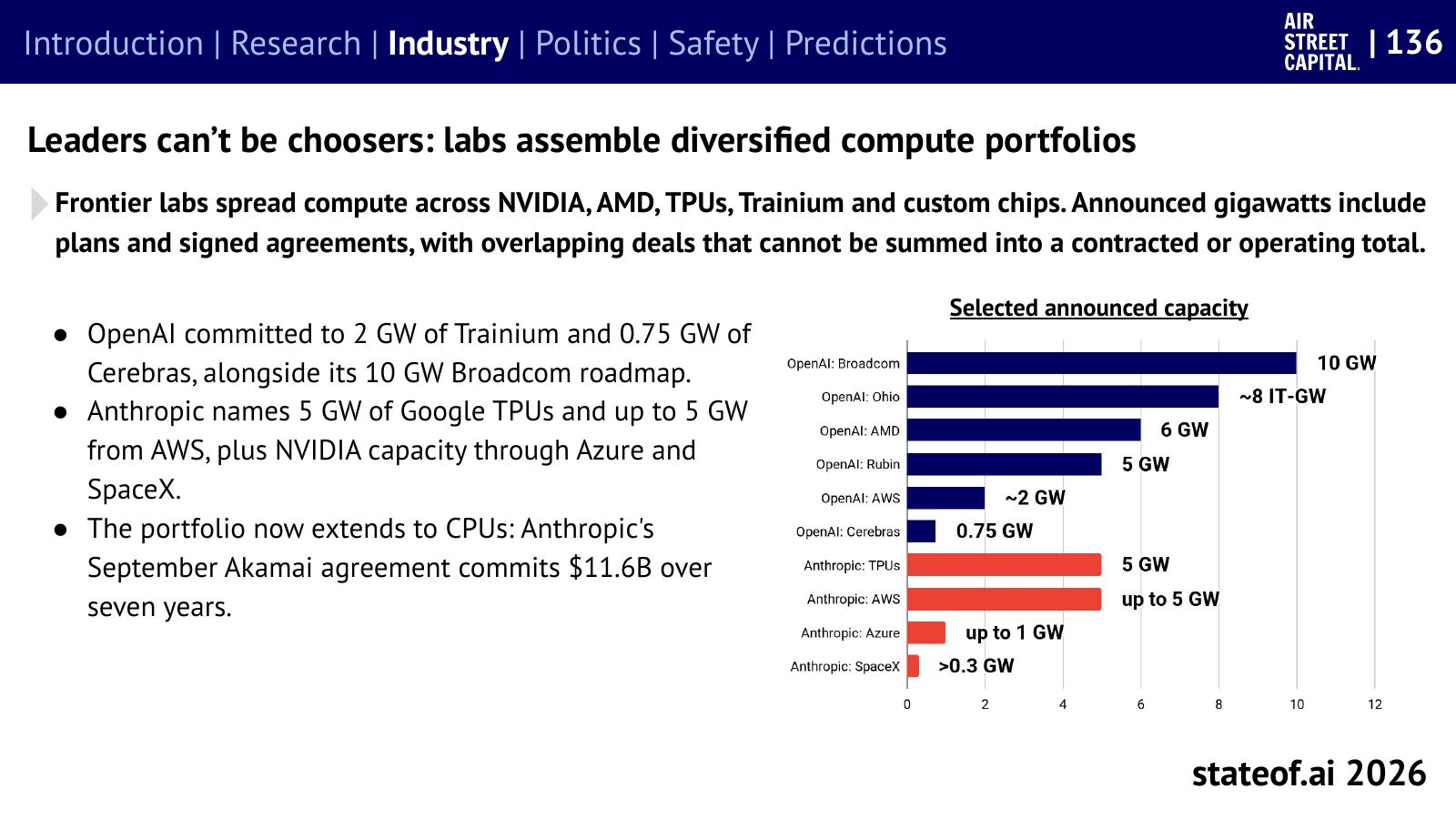
Frontier labs are also assembling mixed portfolios across NVIDIA, AMD, TPUs, Trainium, and custom chips. These announcements include roadmaps, conditional commitments, and overlapping arrangements. They should not be added into a single operating-capacity total. Comparing the portfolios requires tracking what has actually been delivered and which workload each system can serve.
Further reading: slide 129, slide 136.